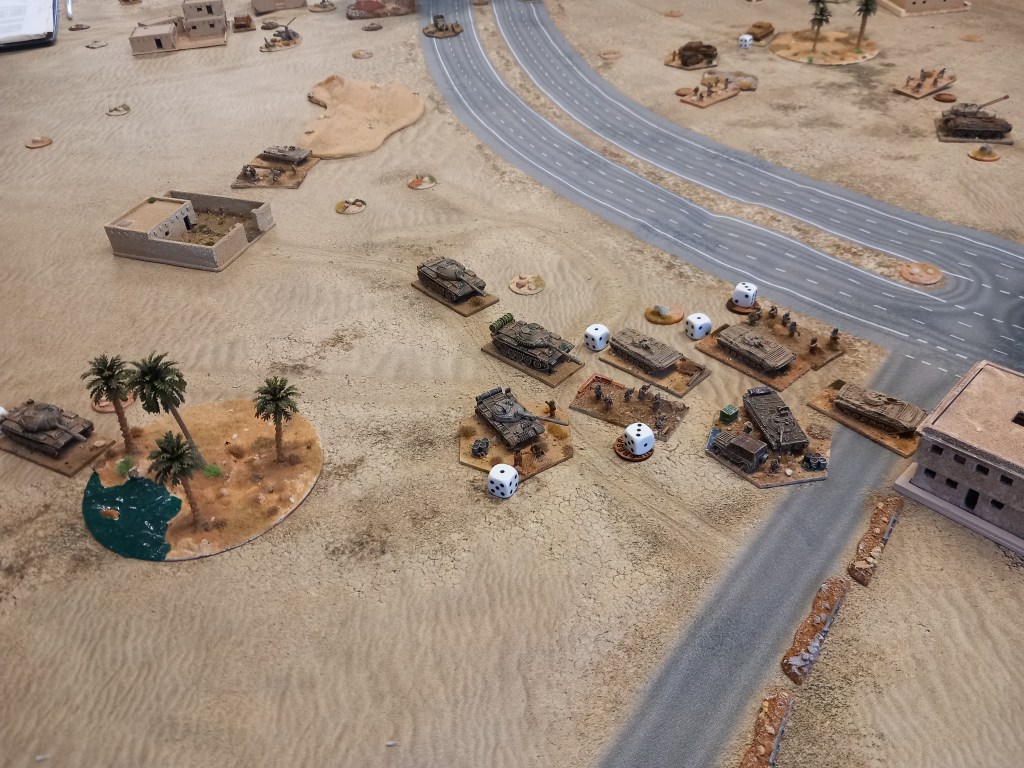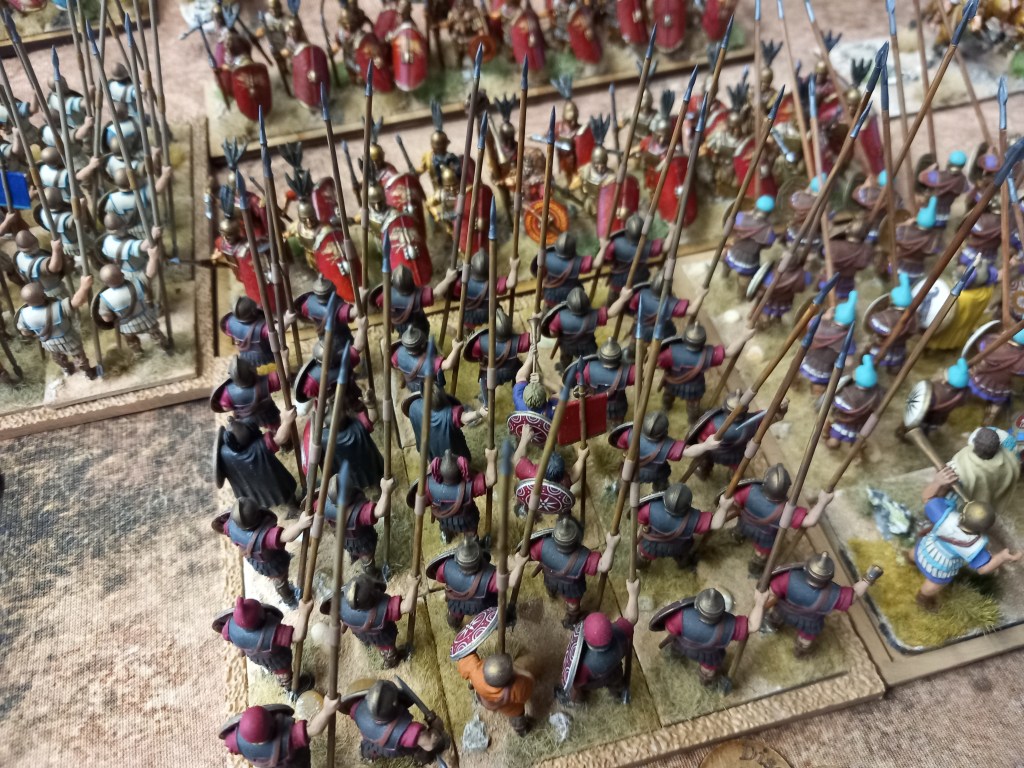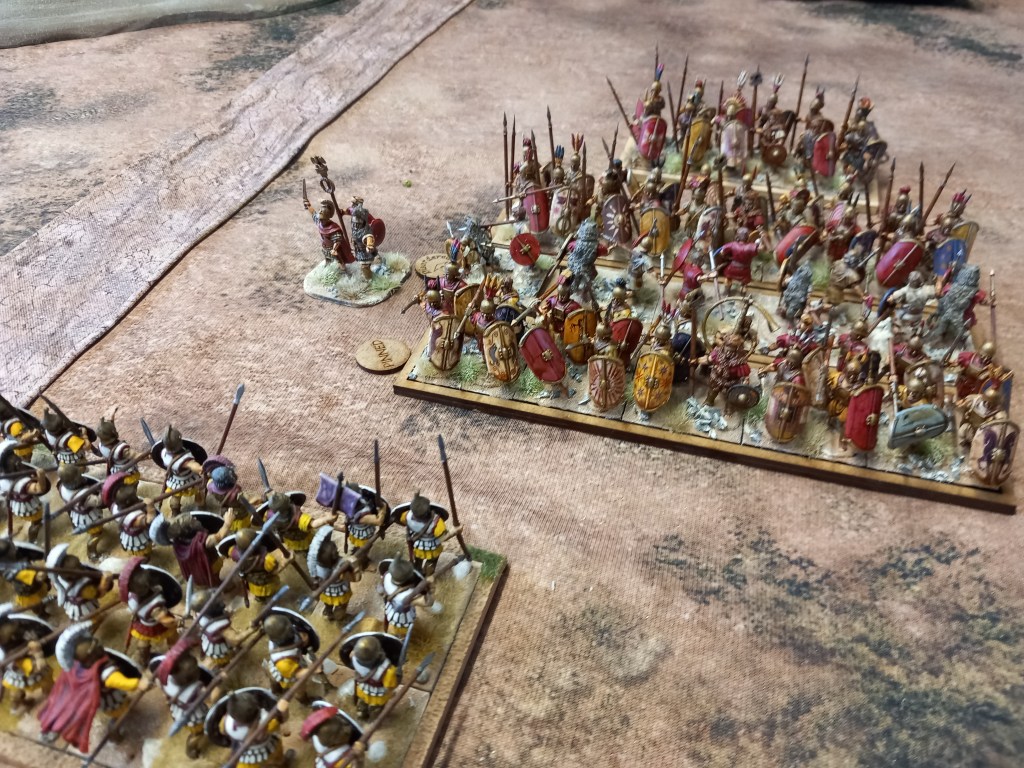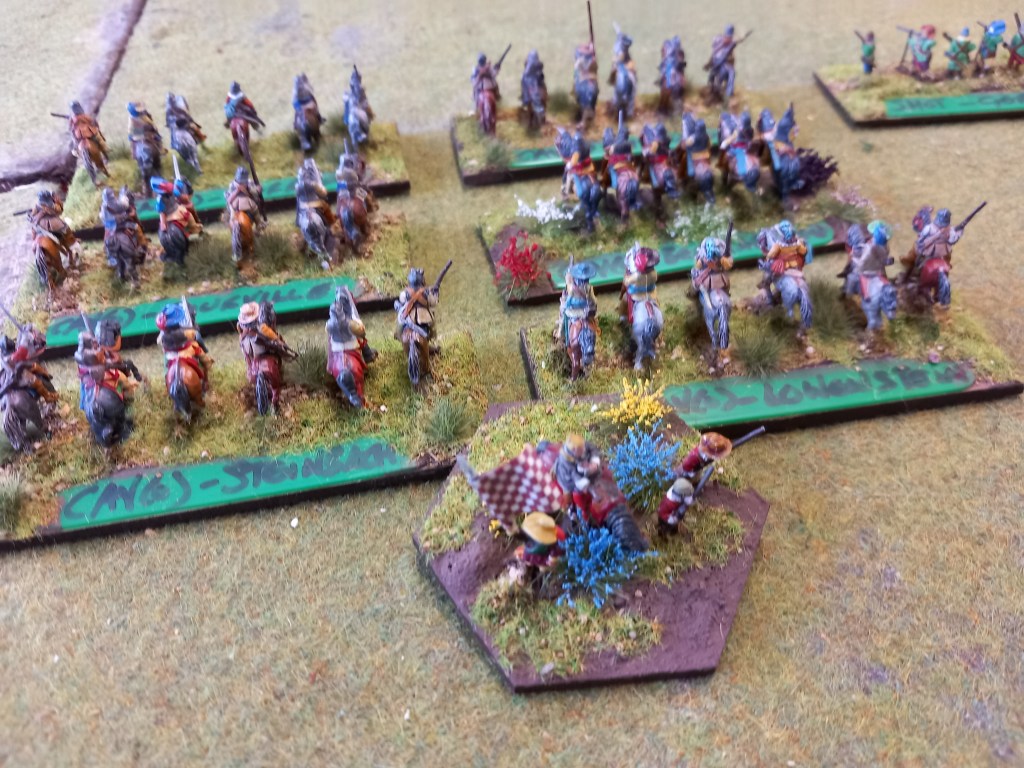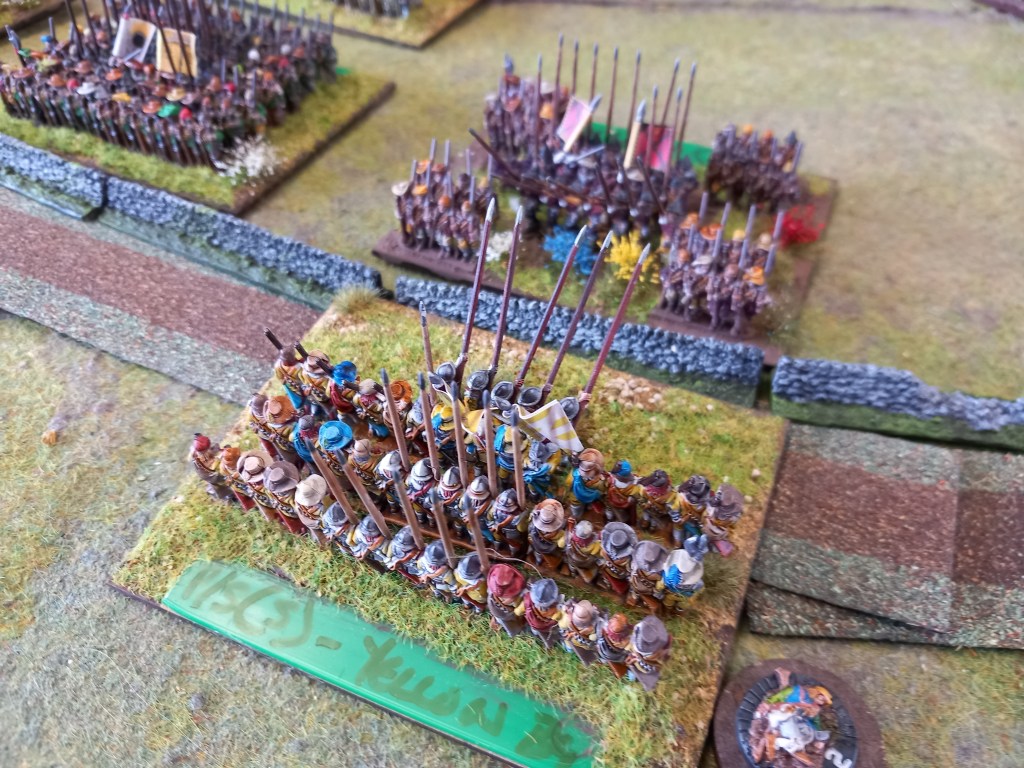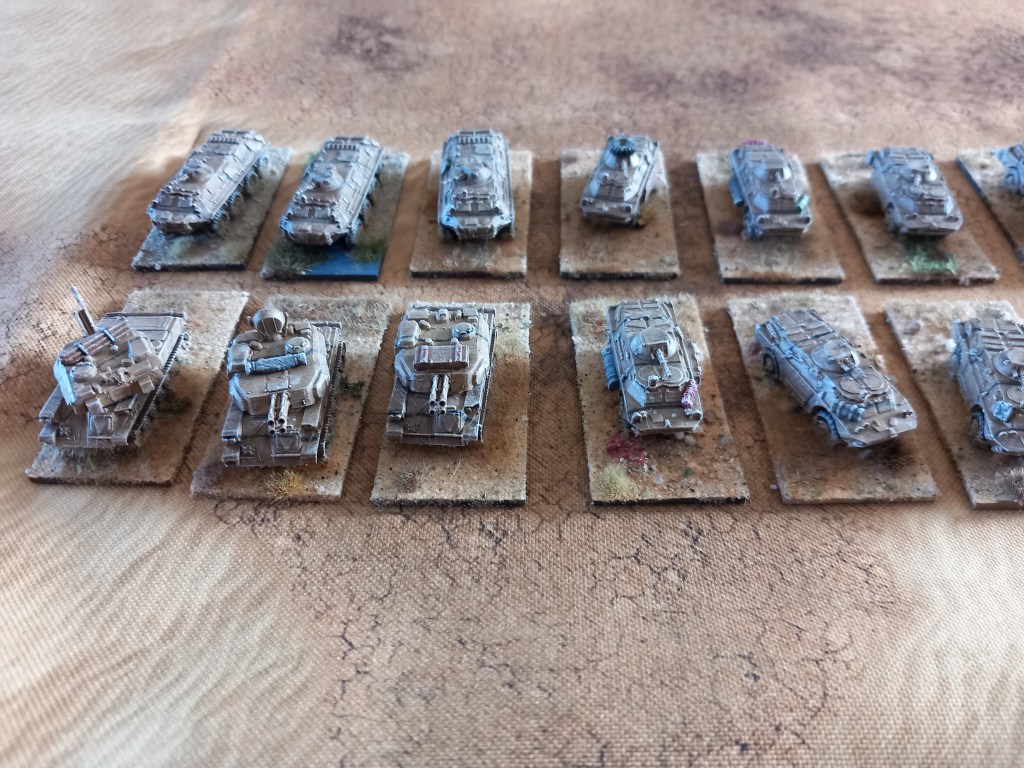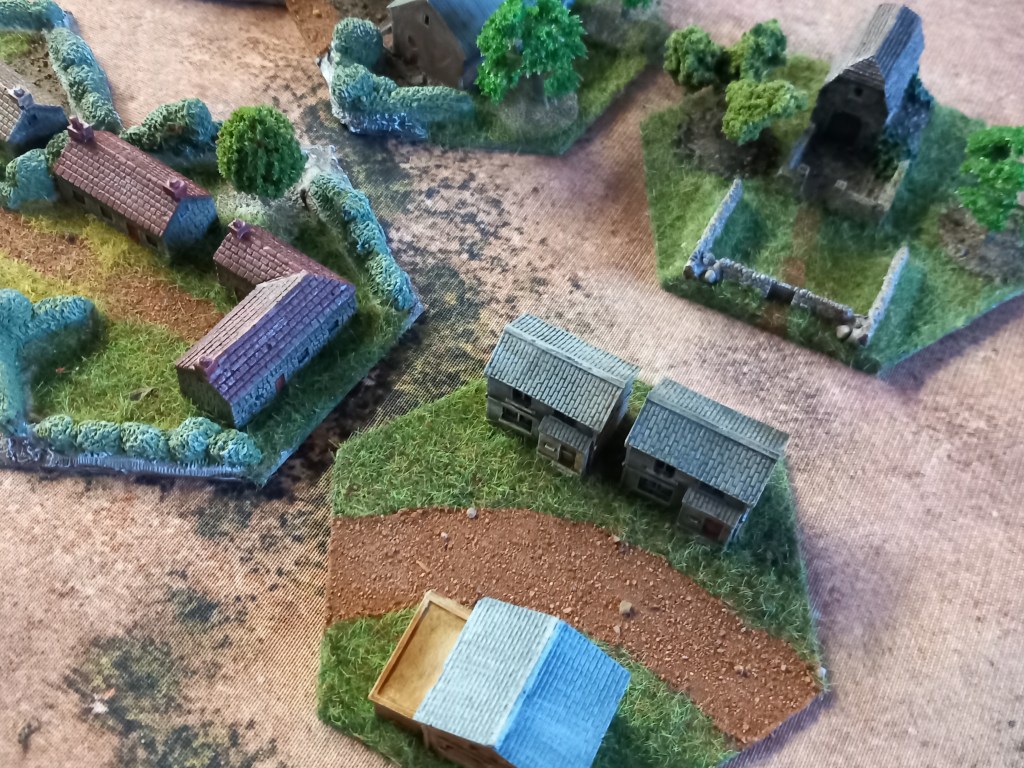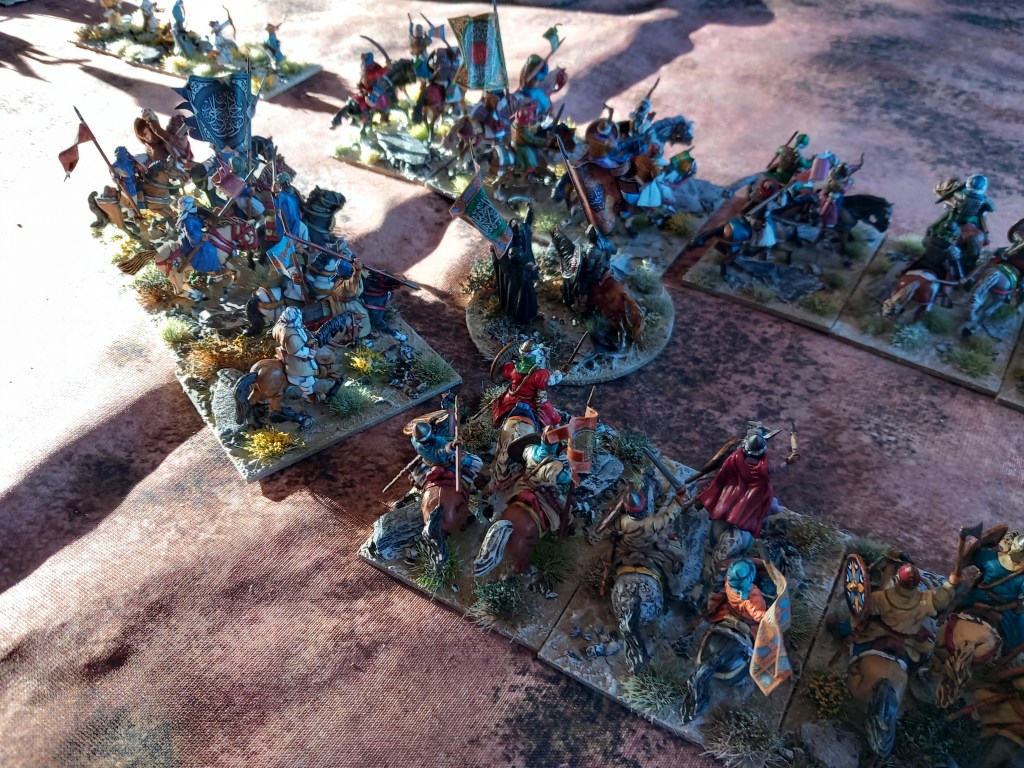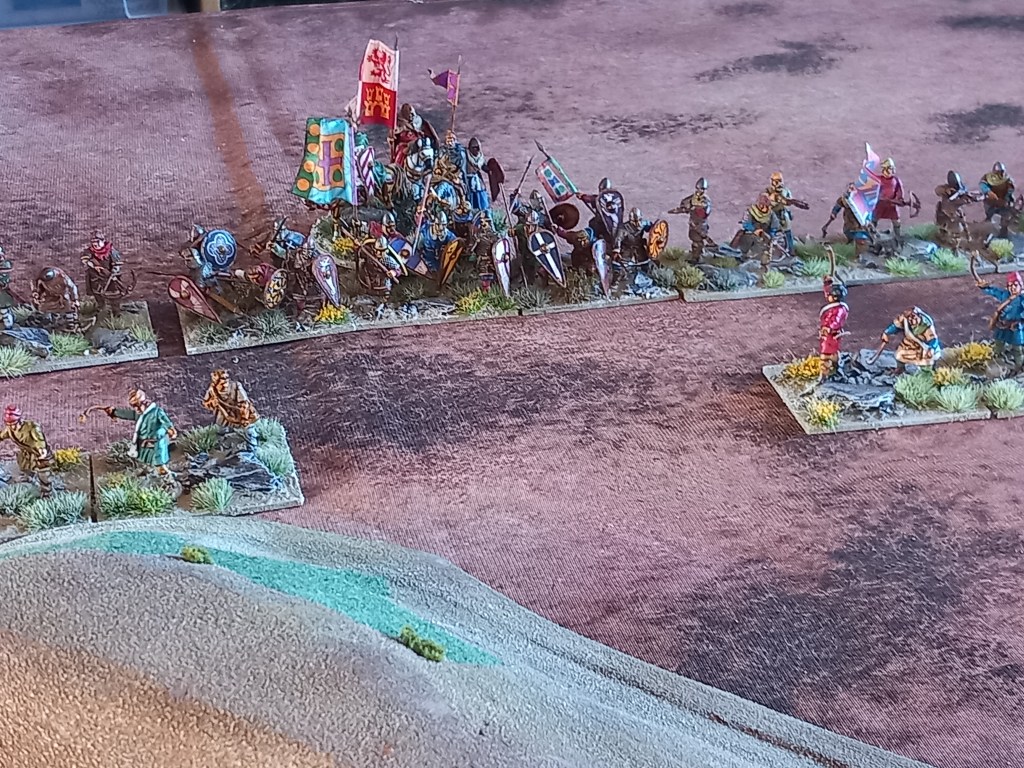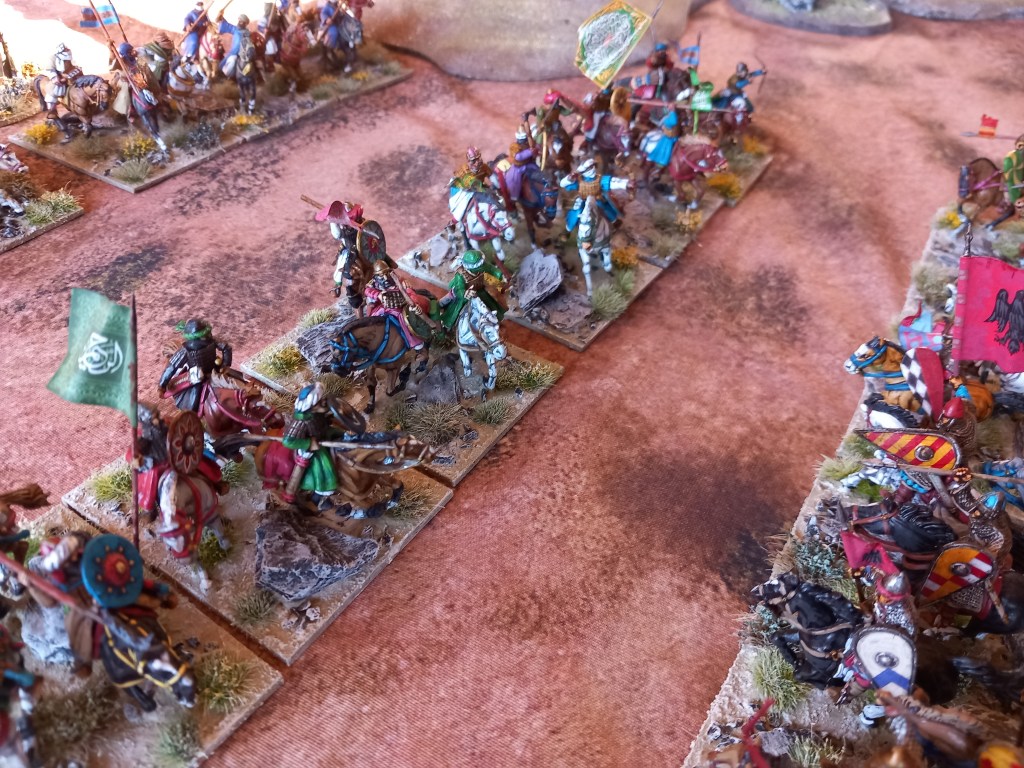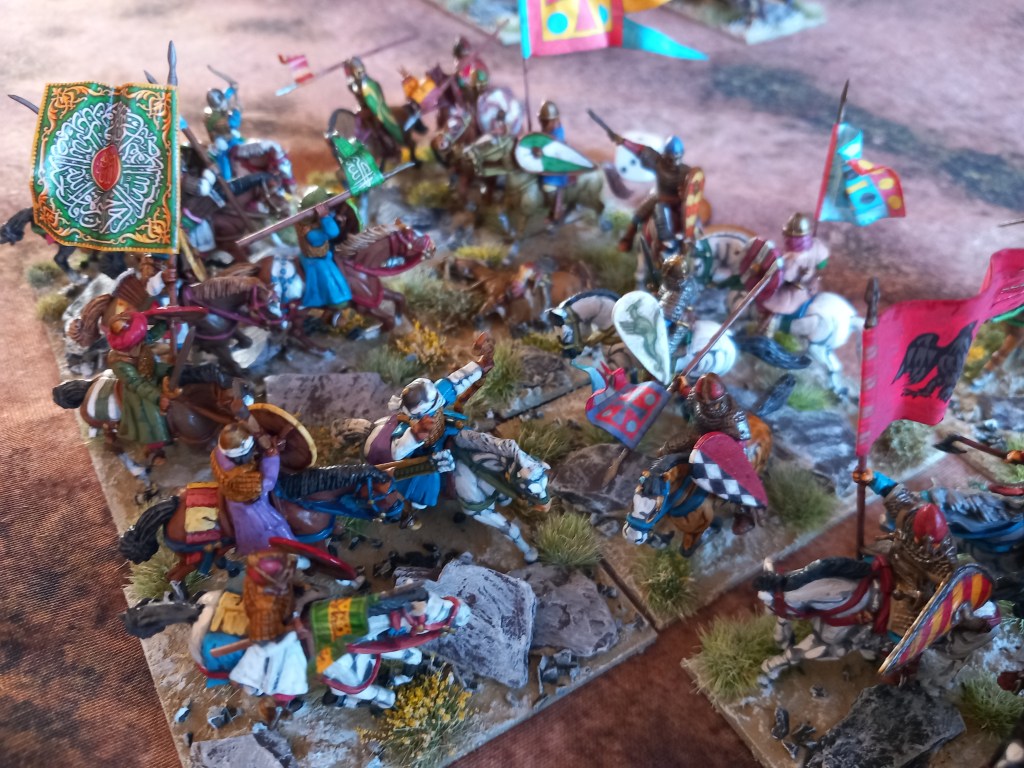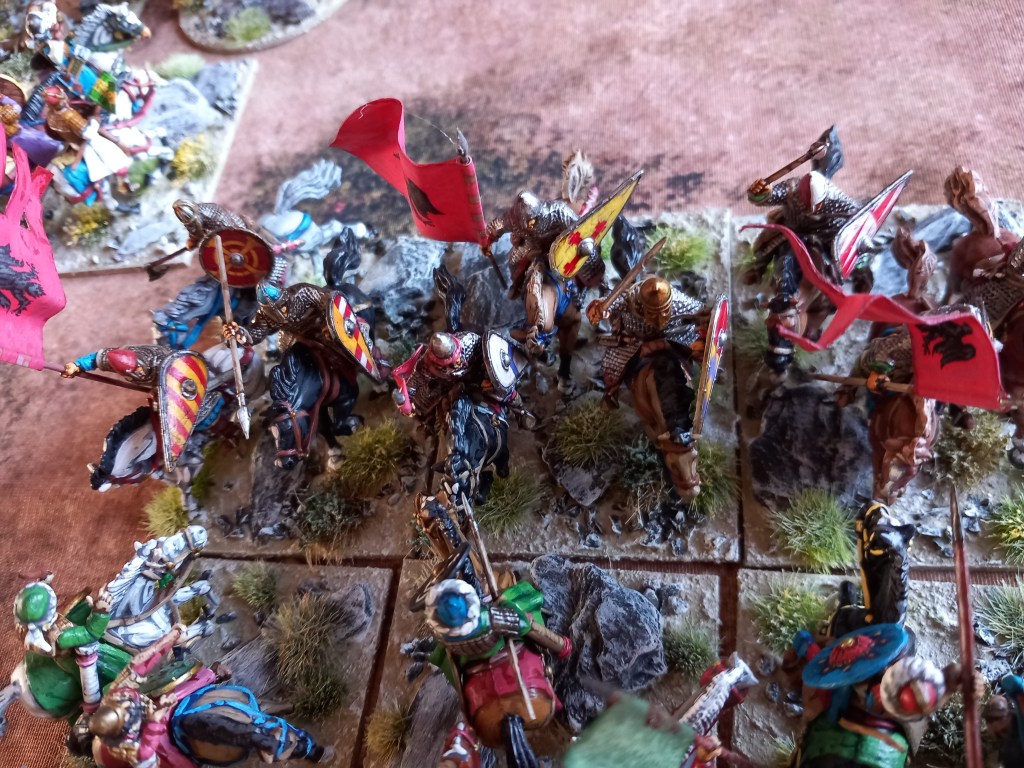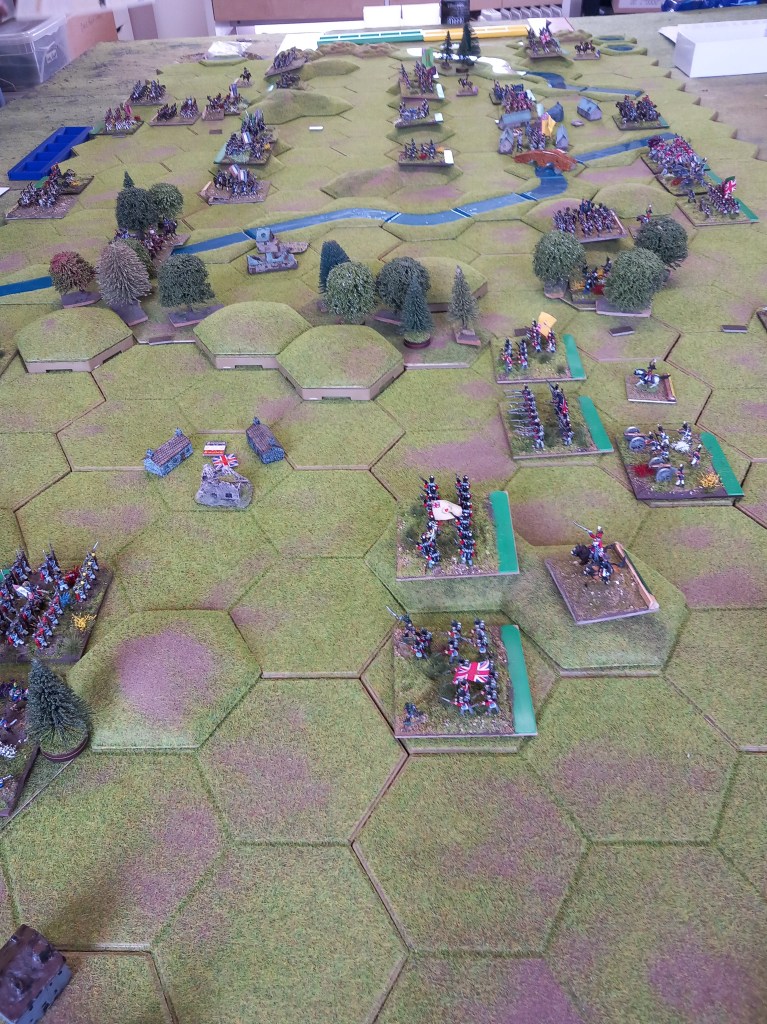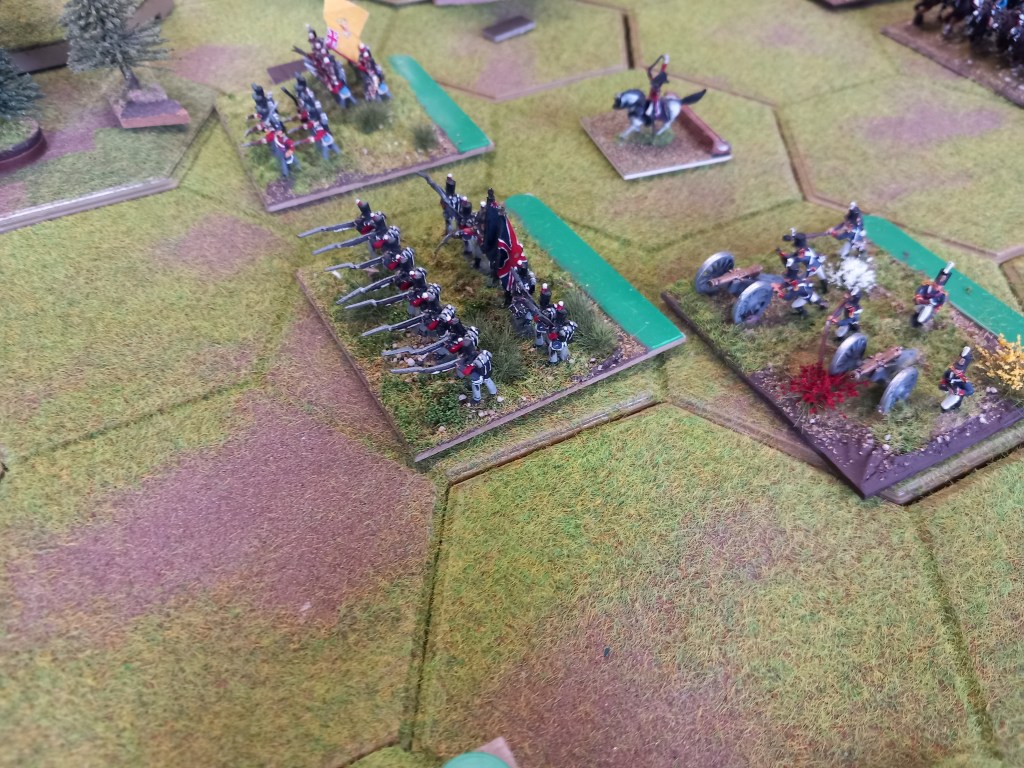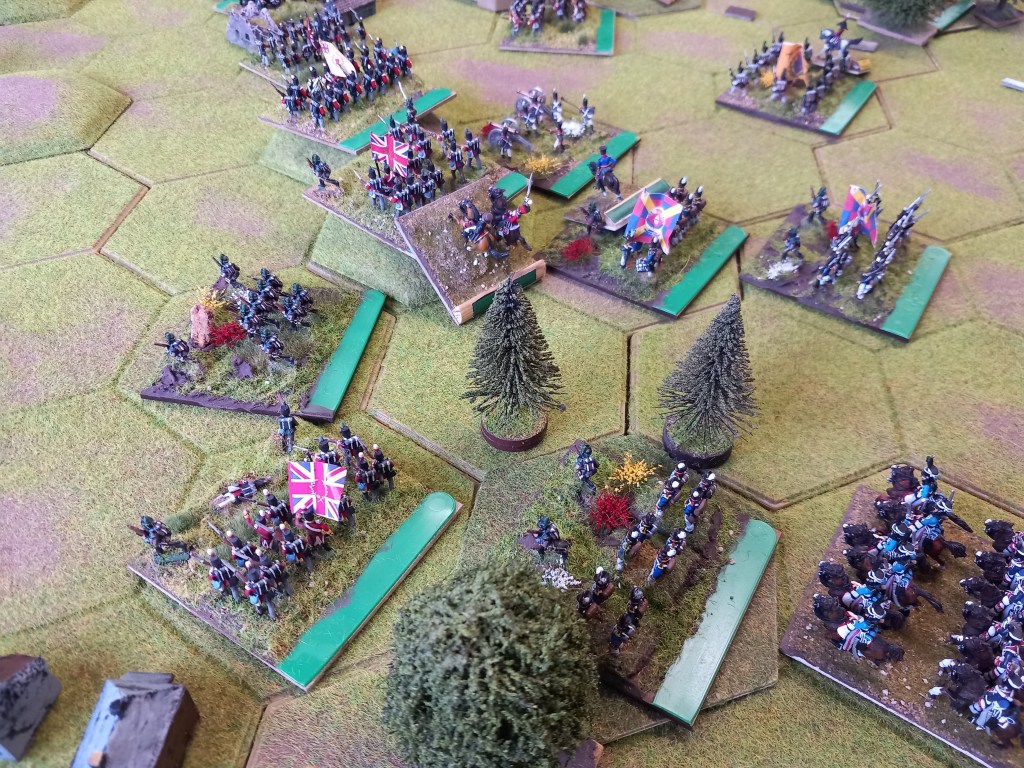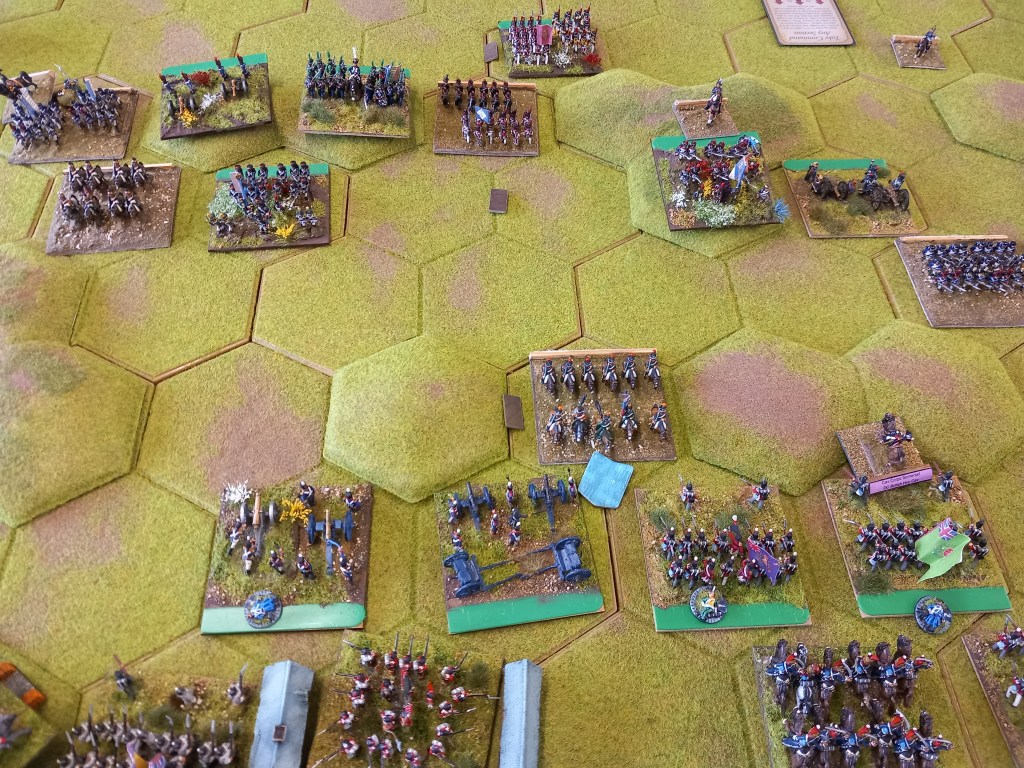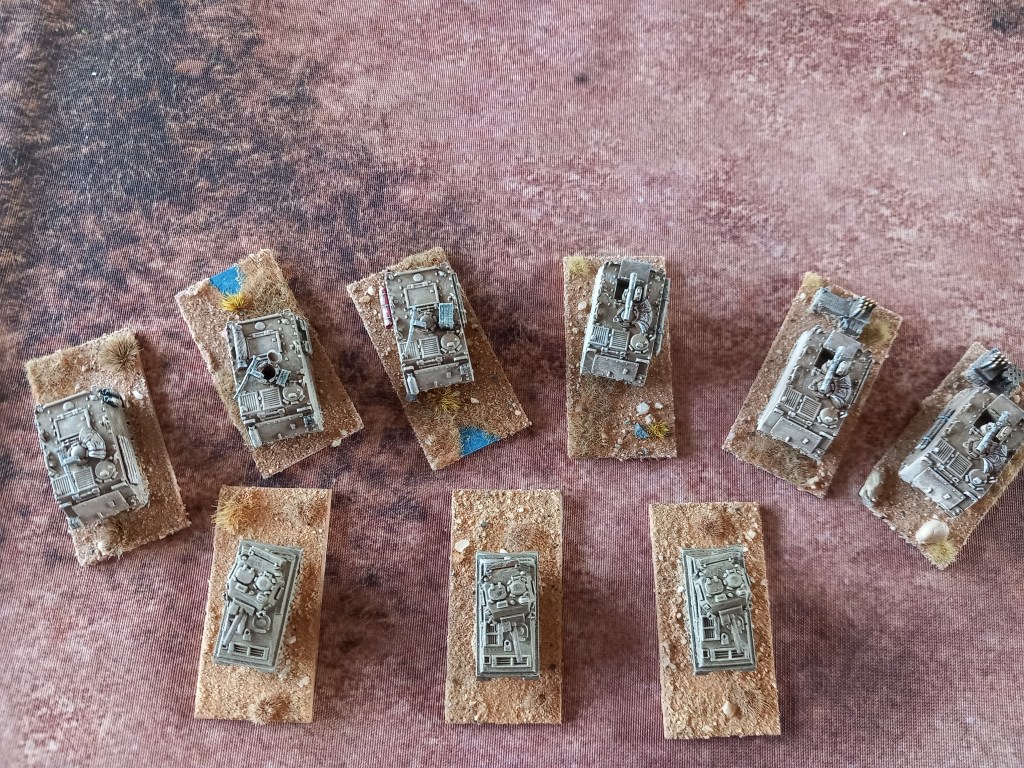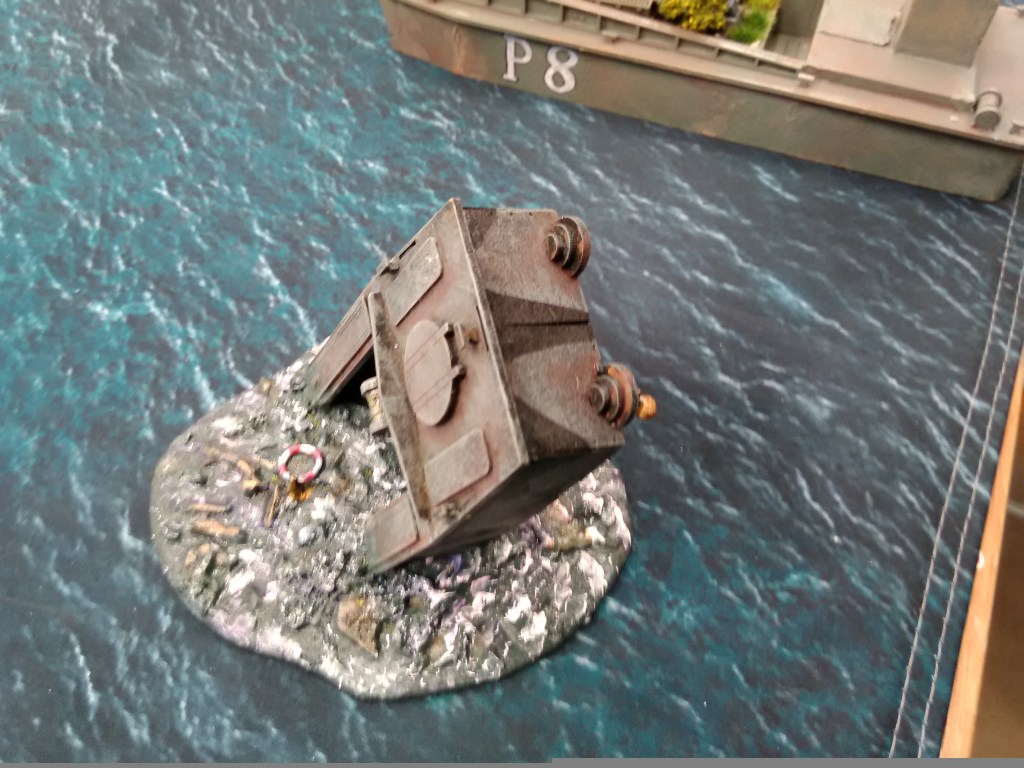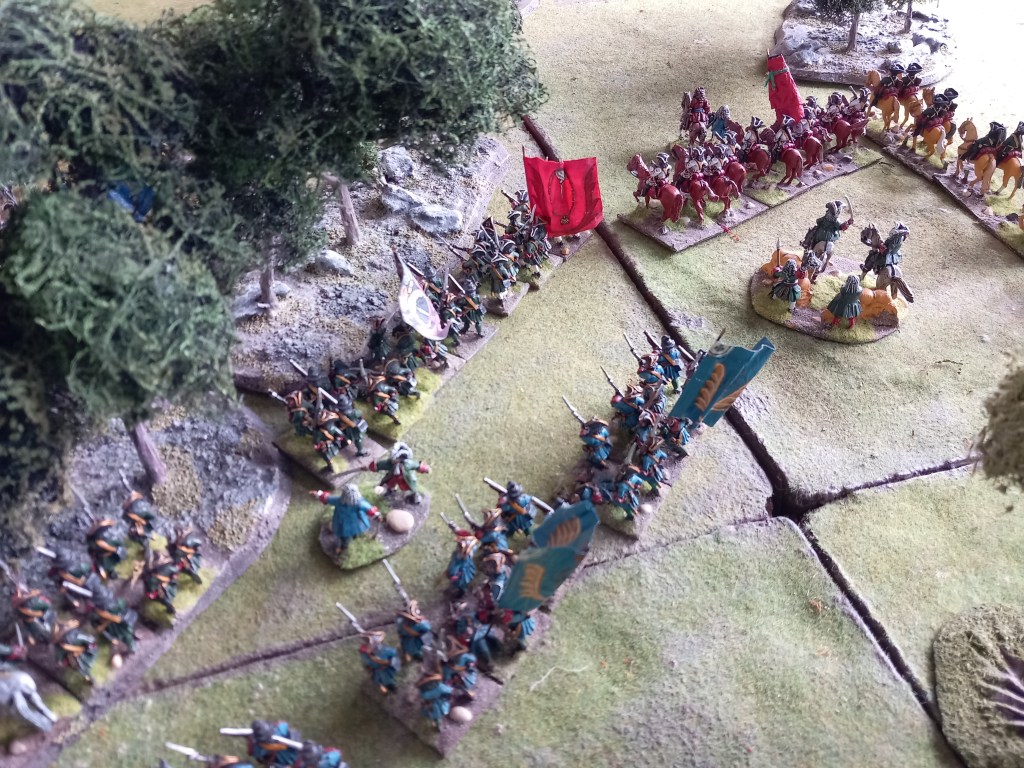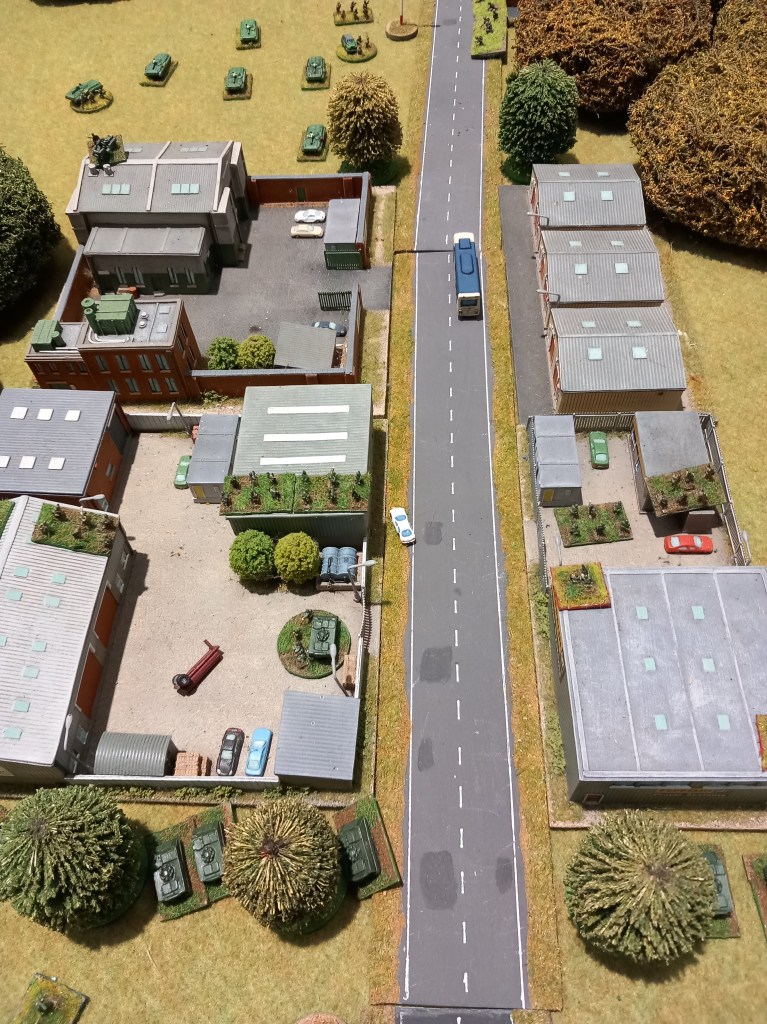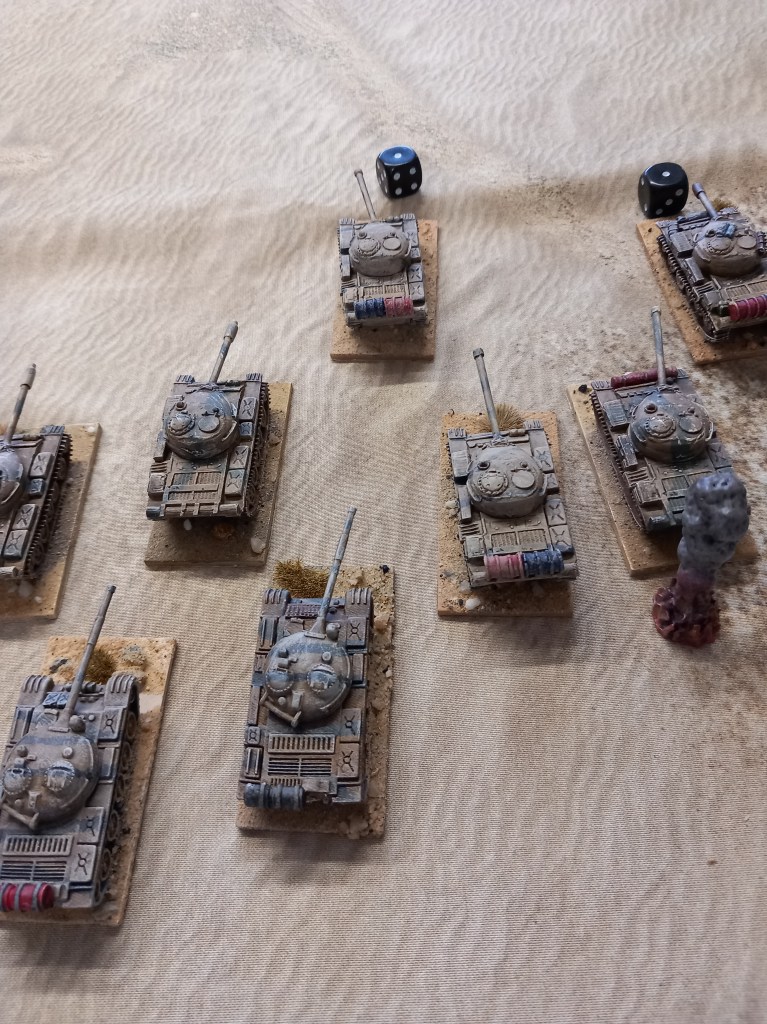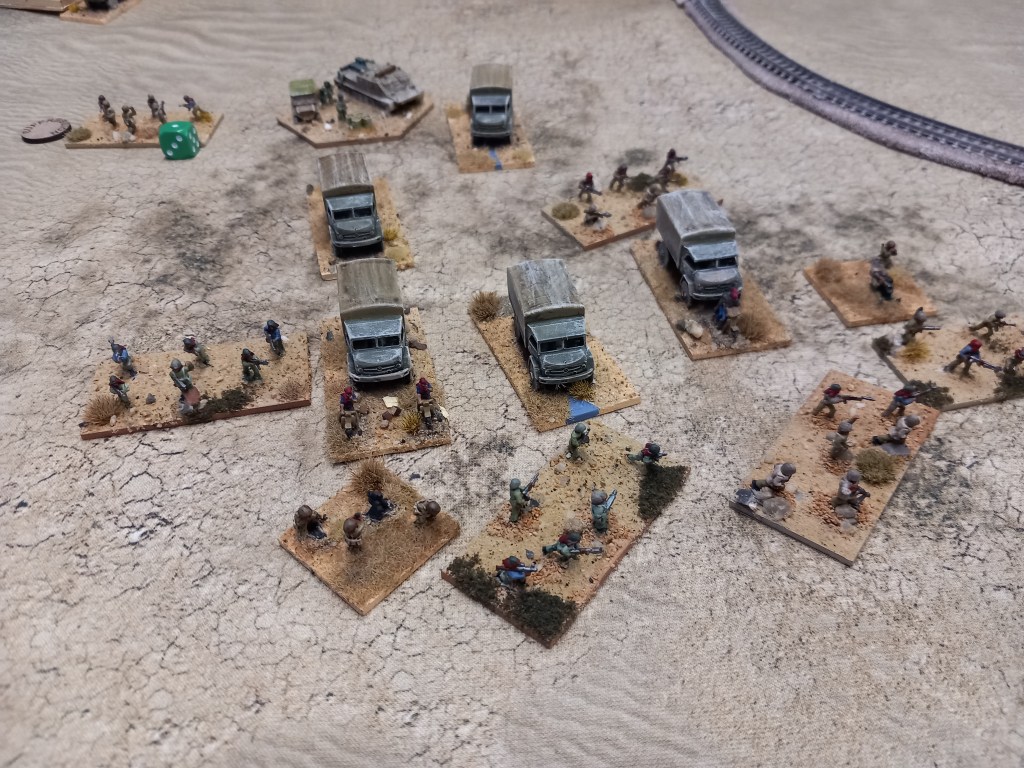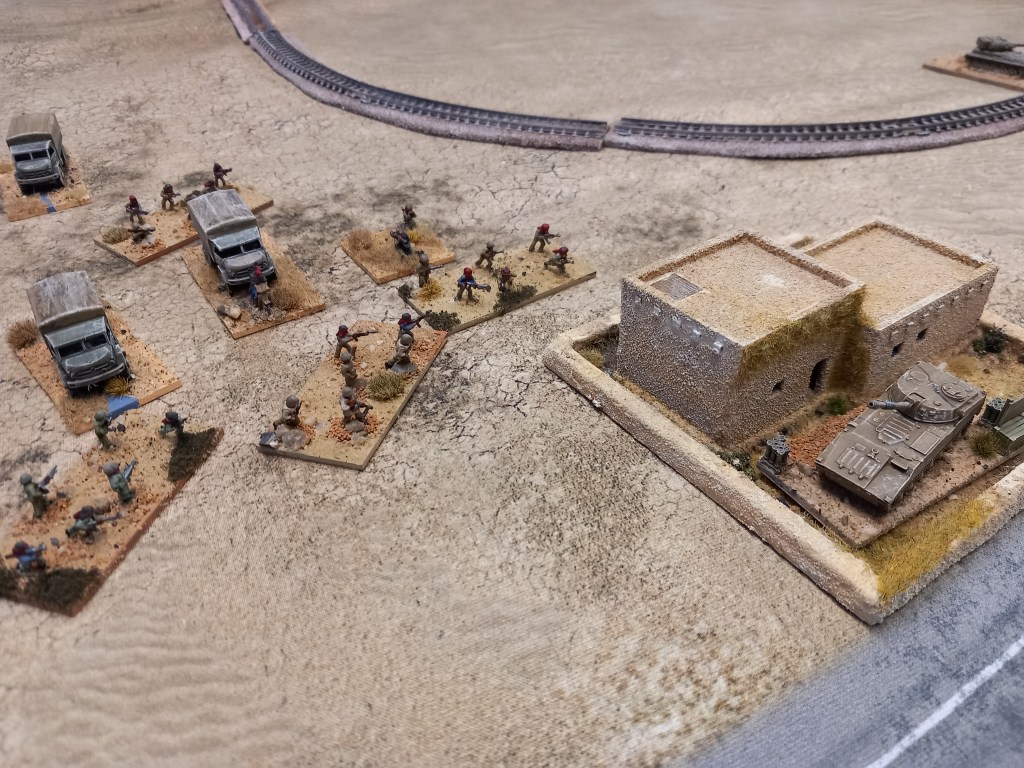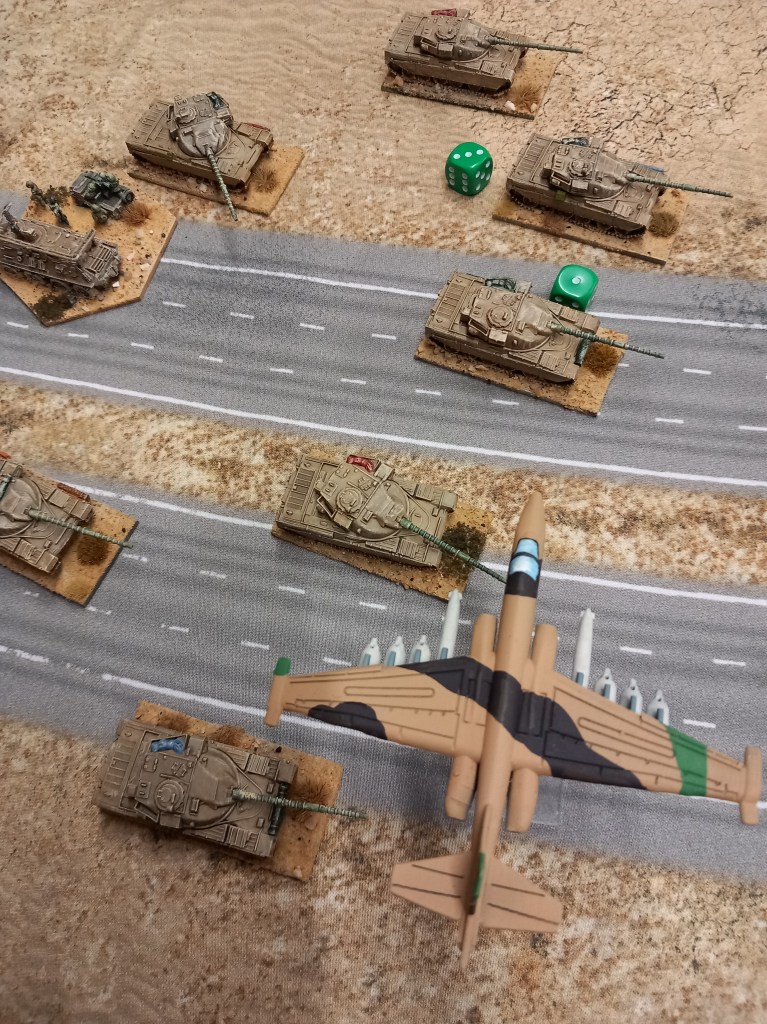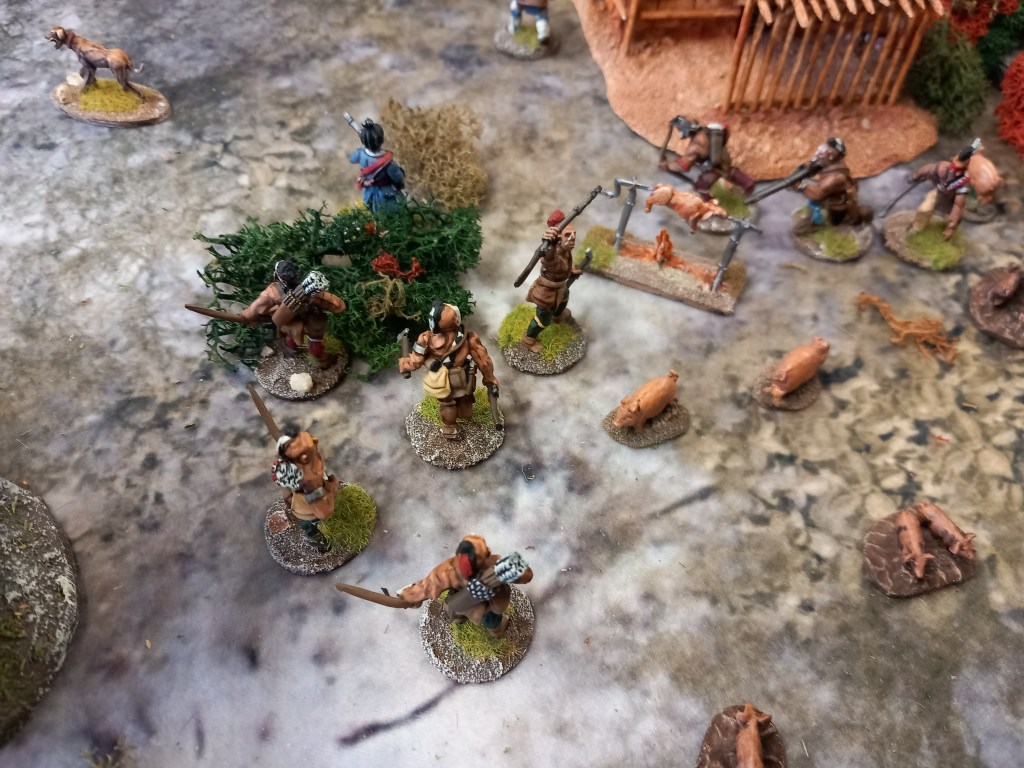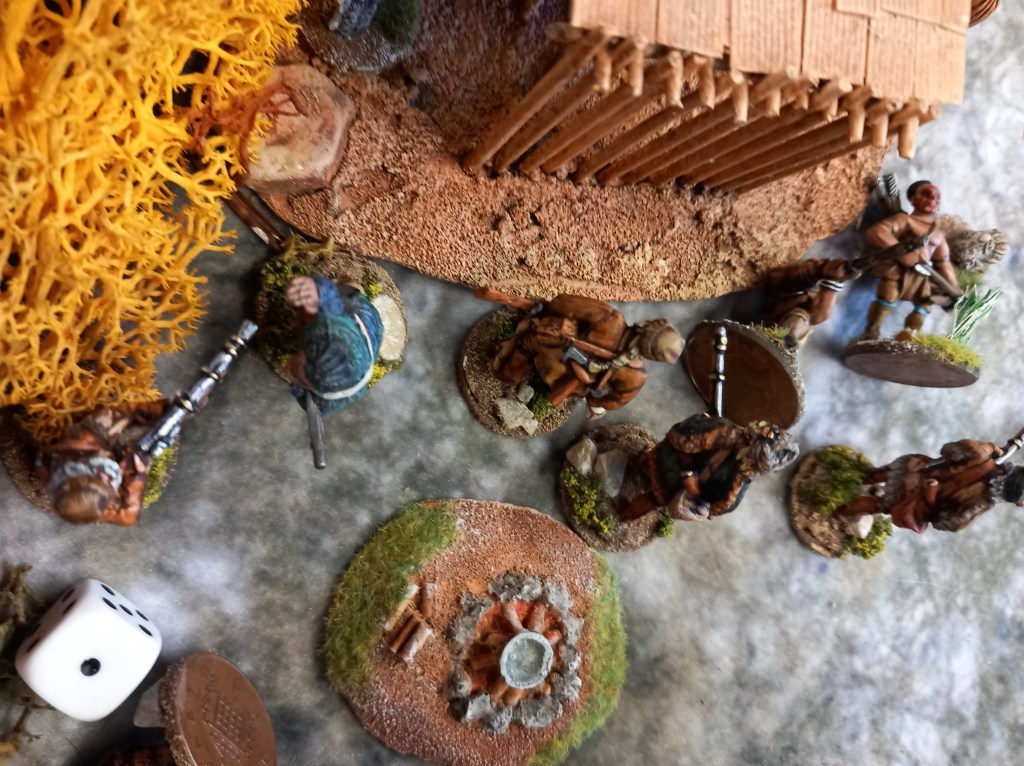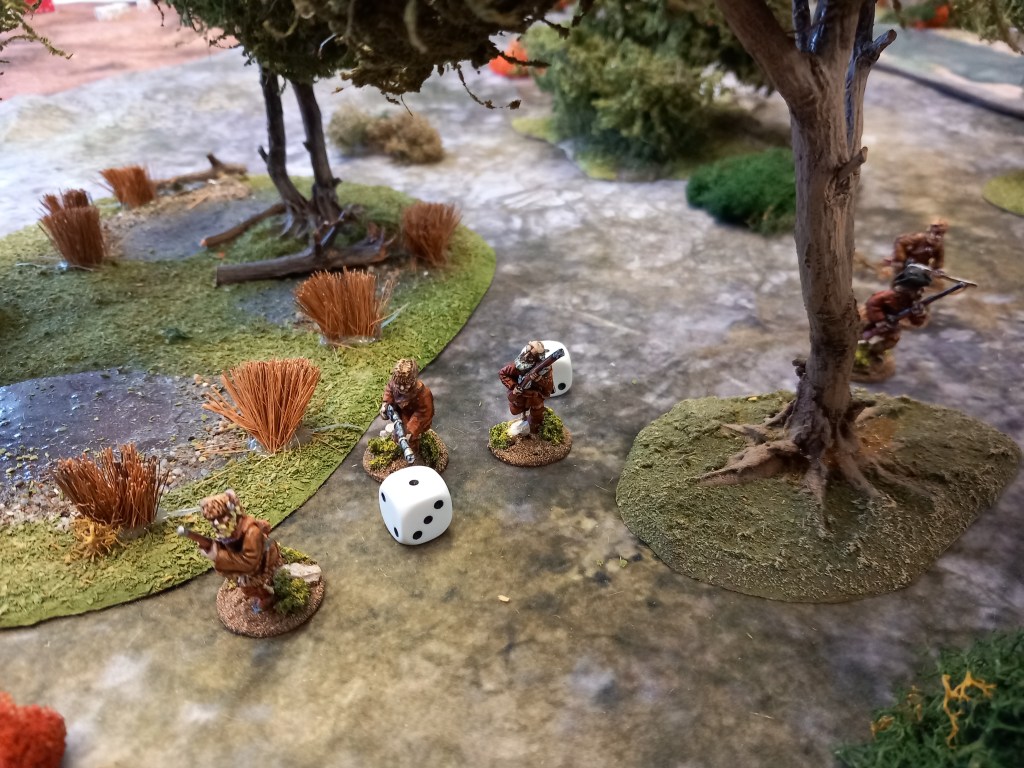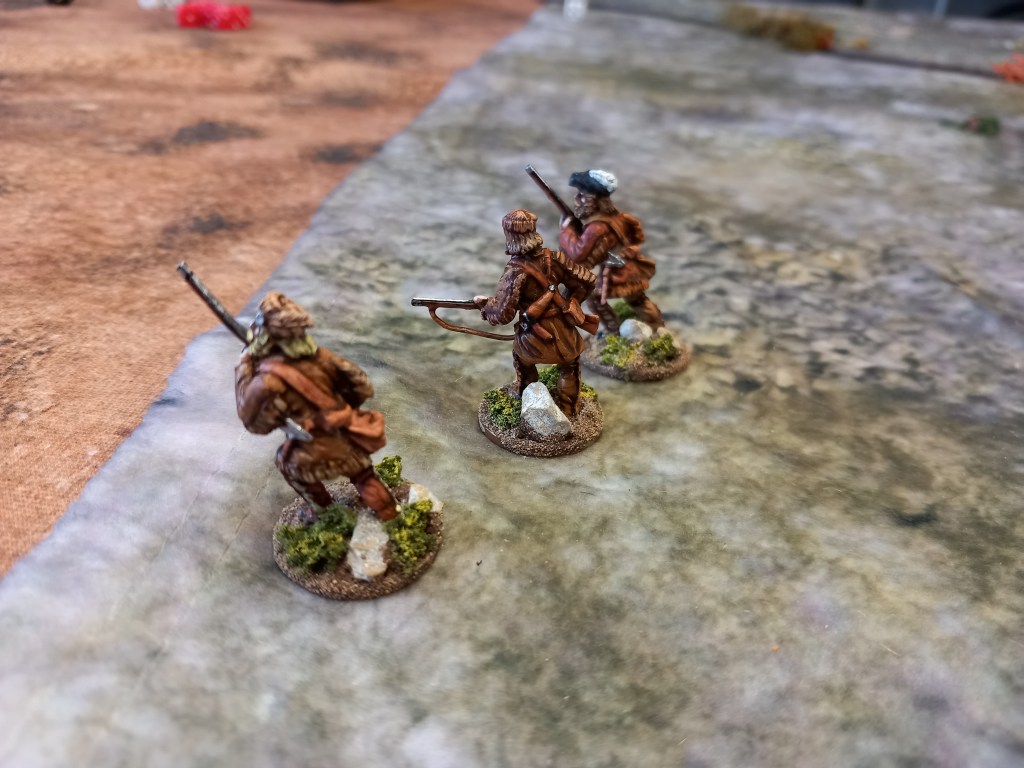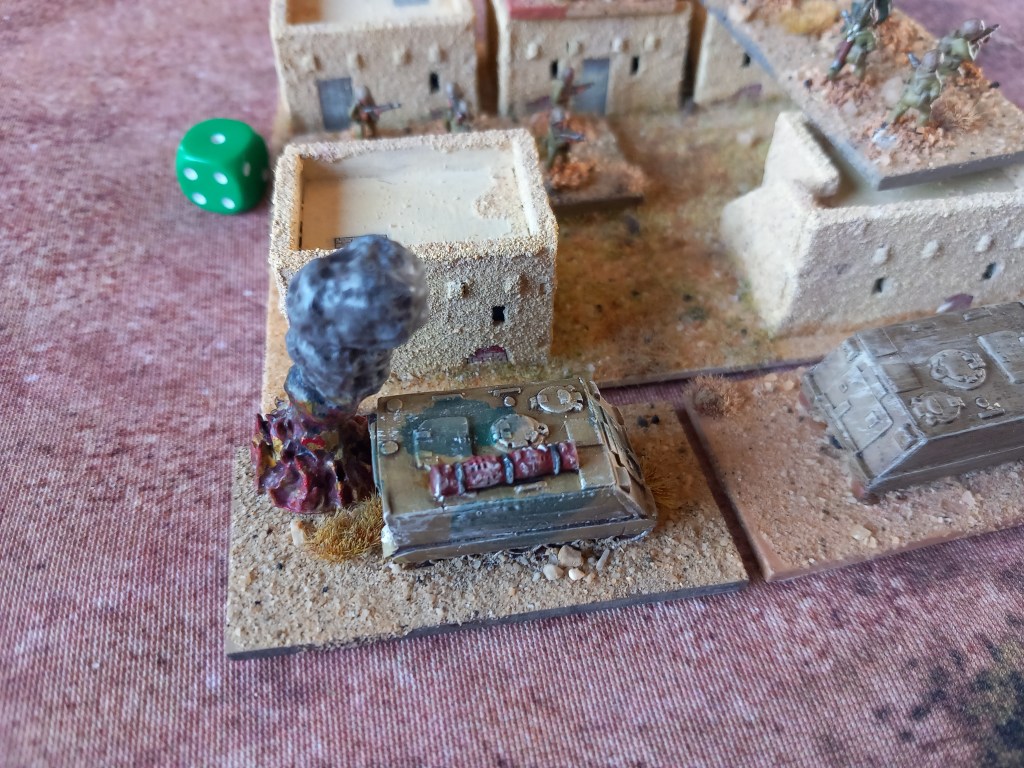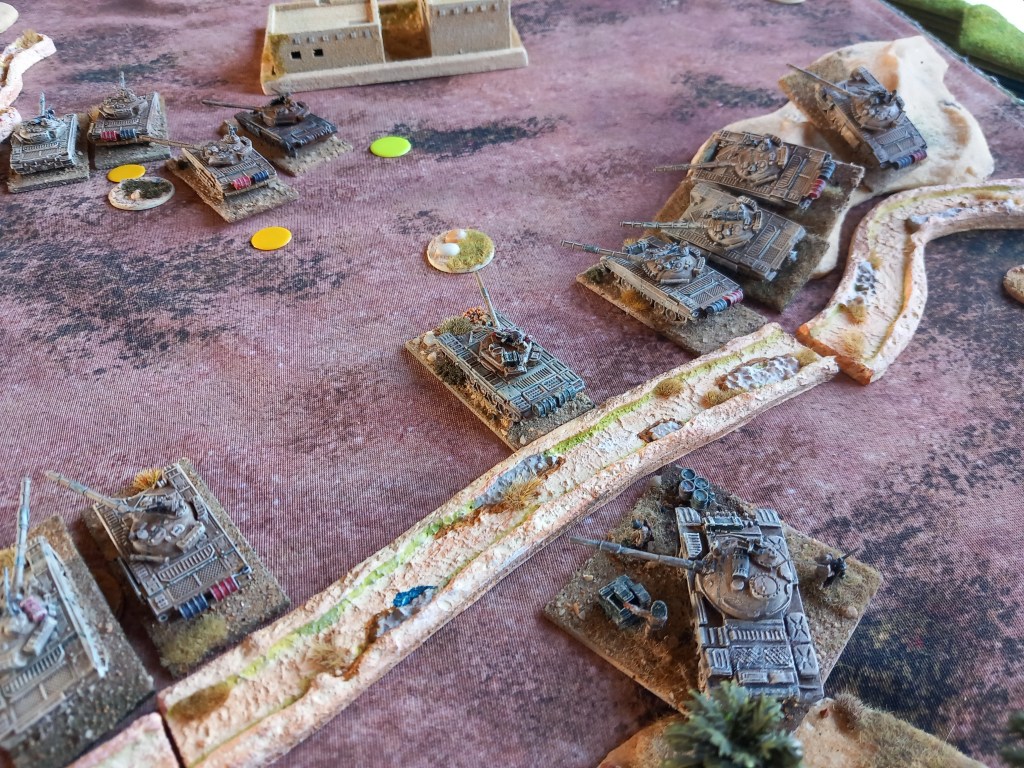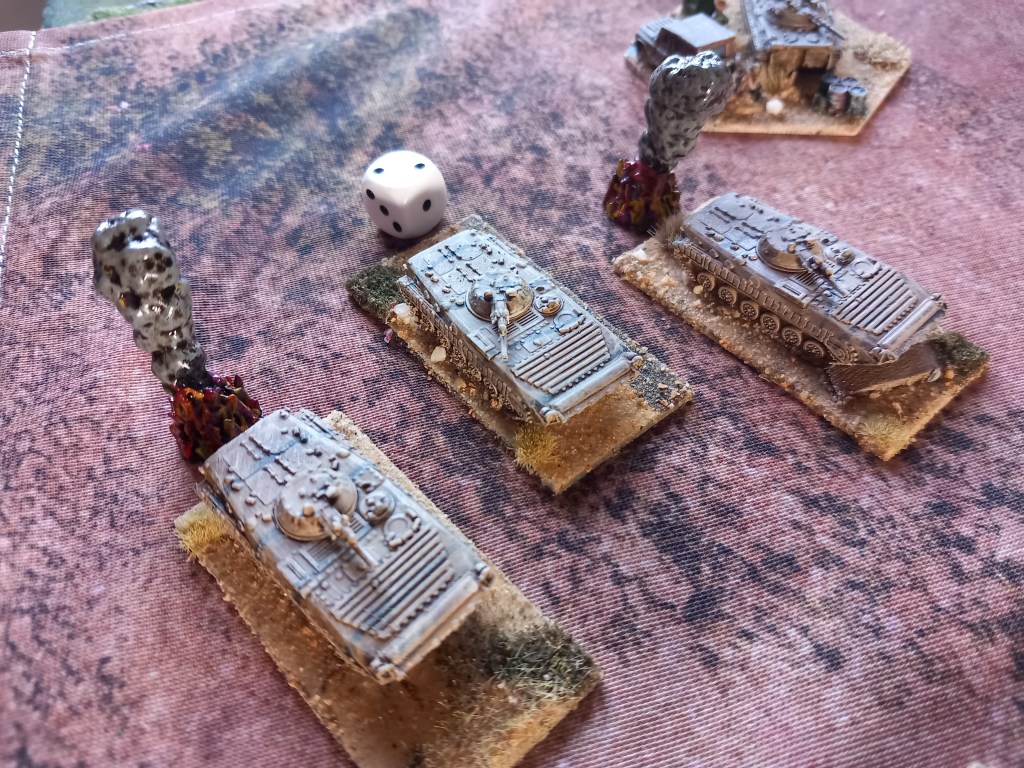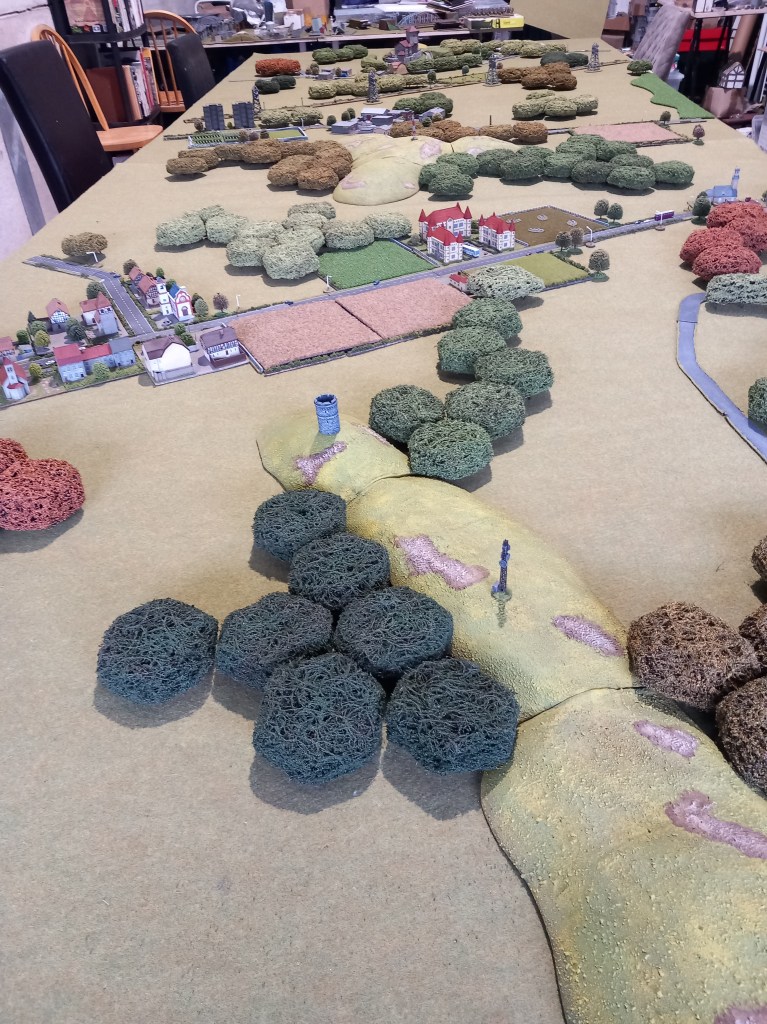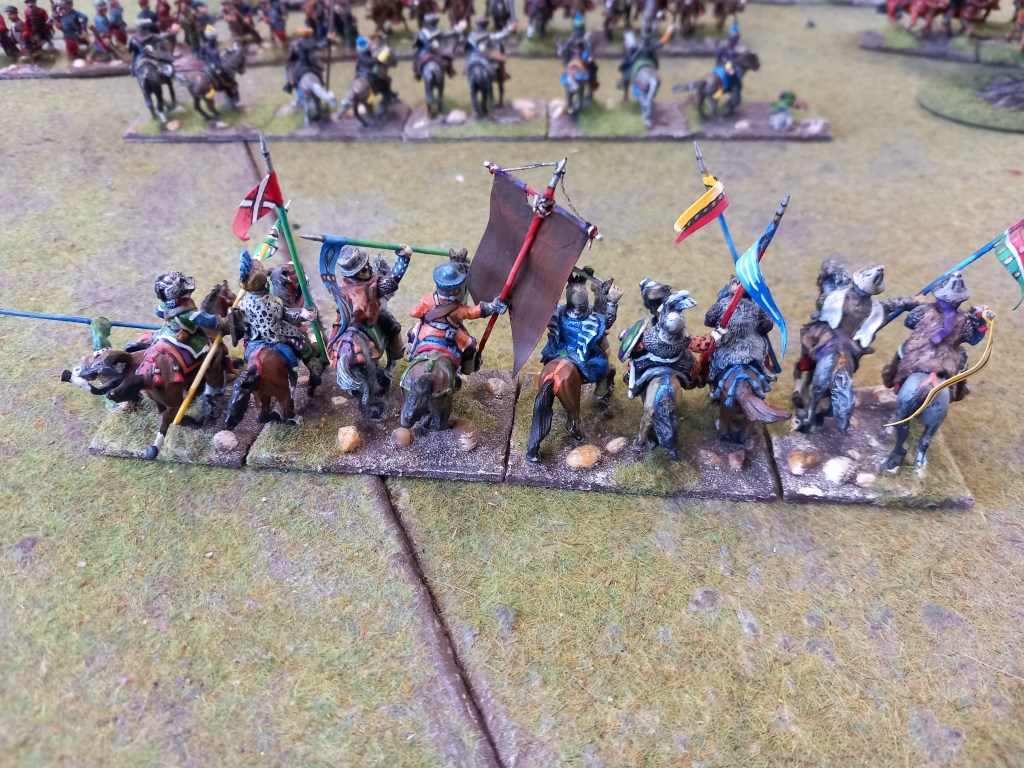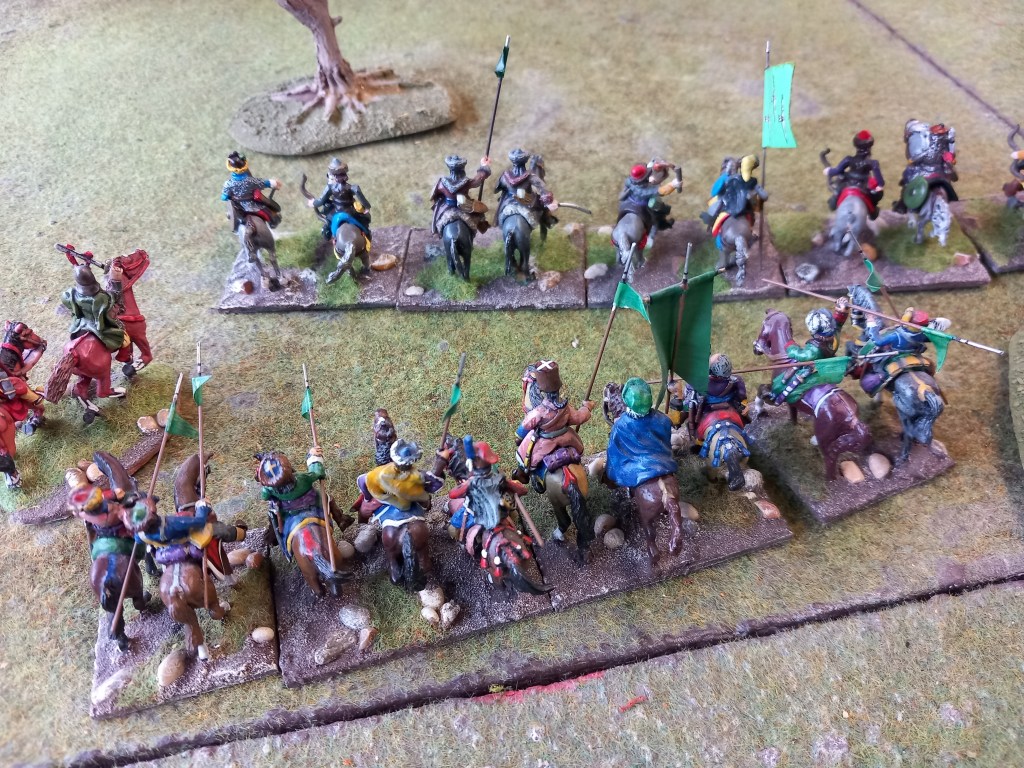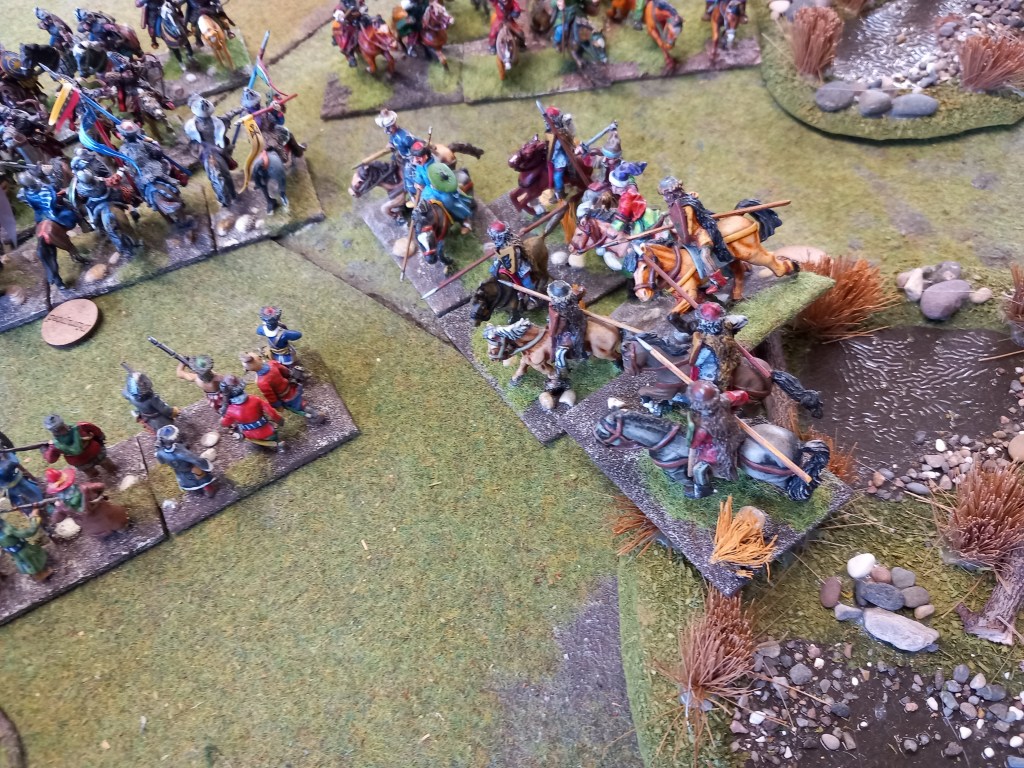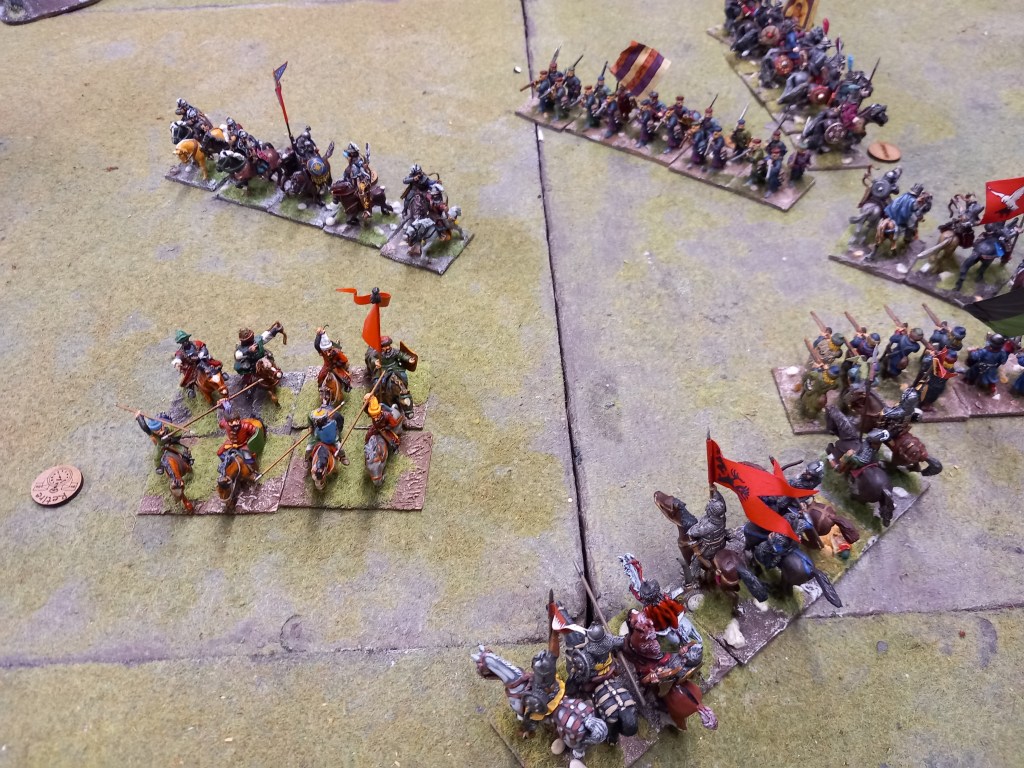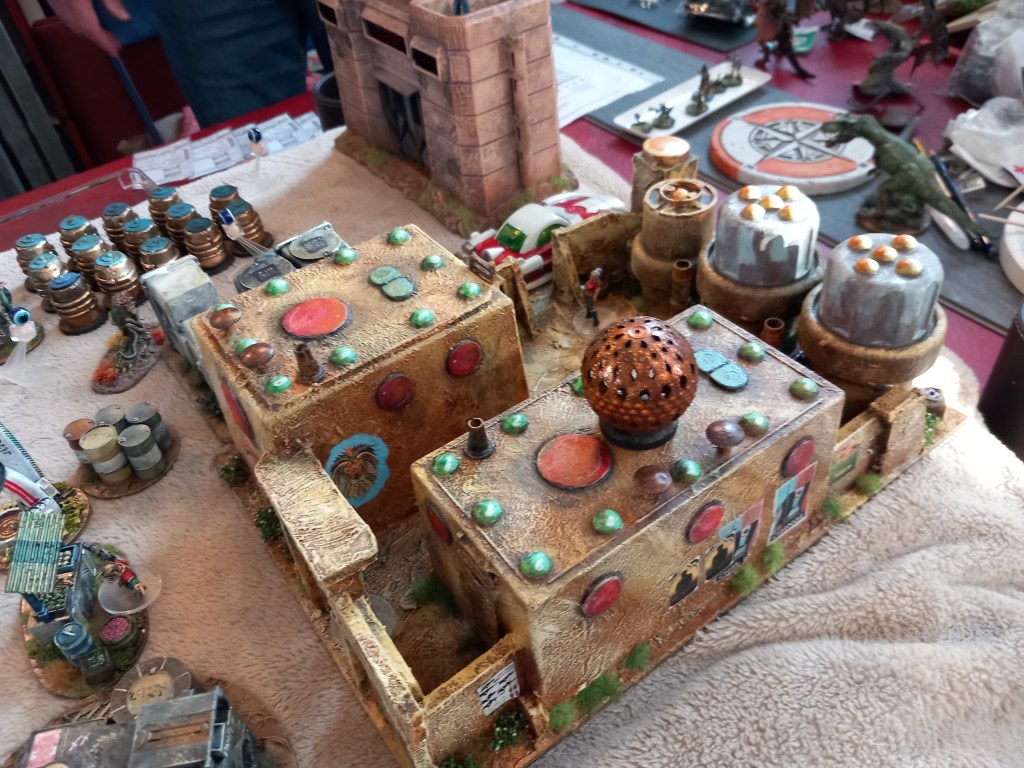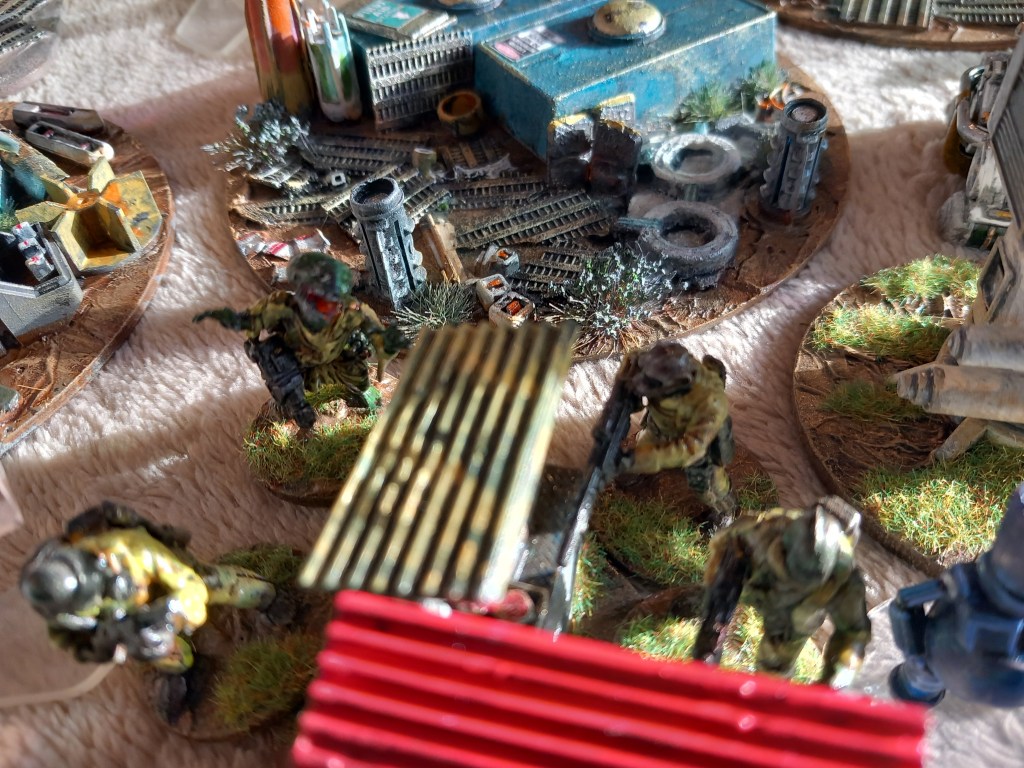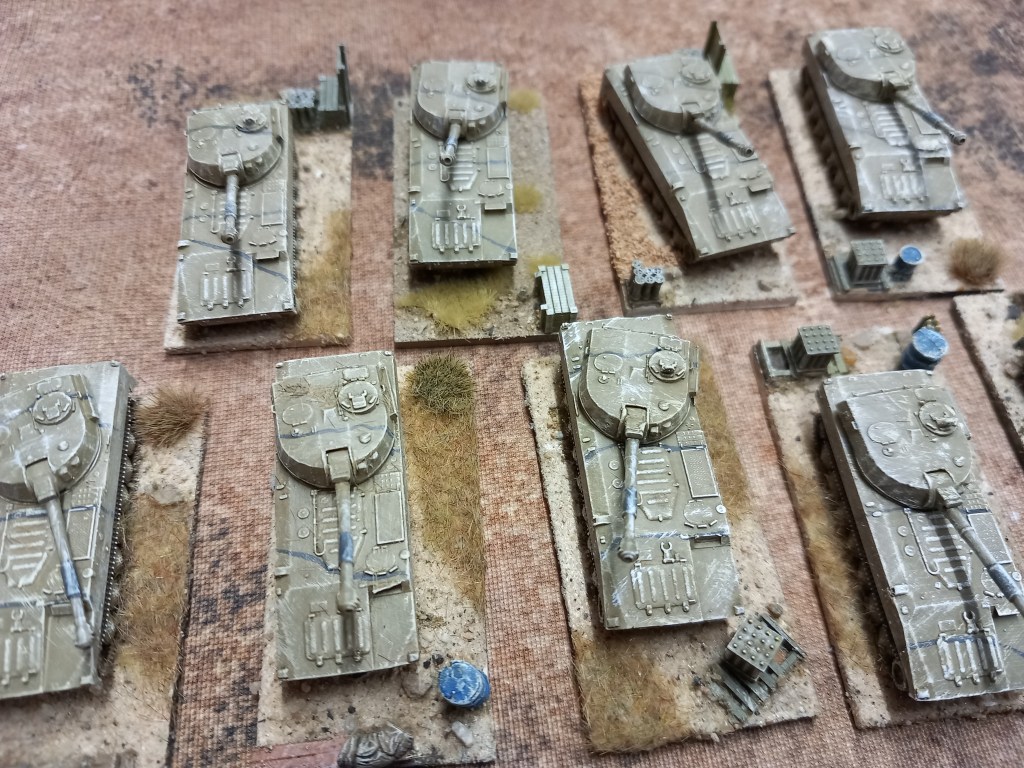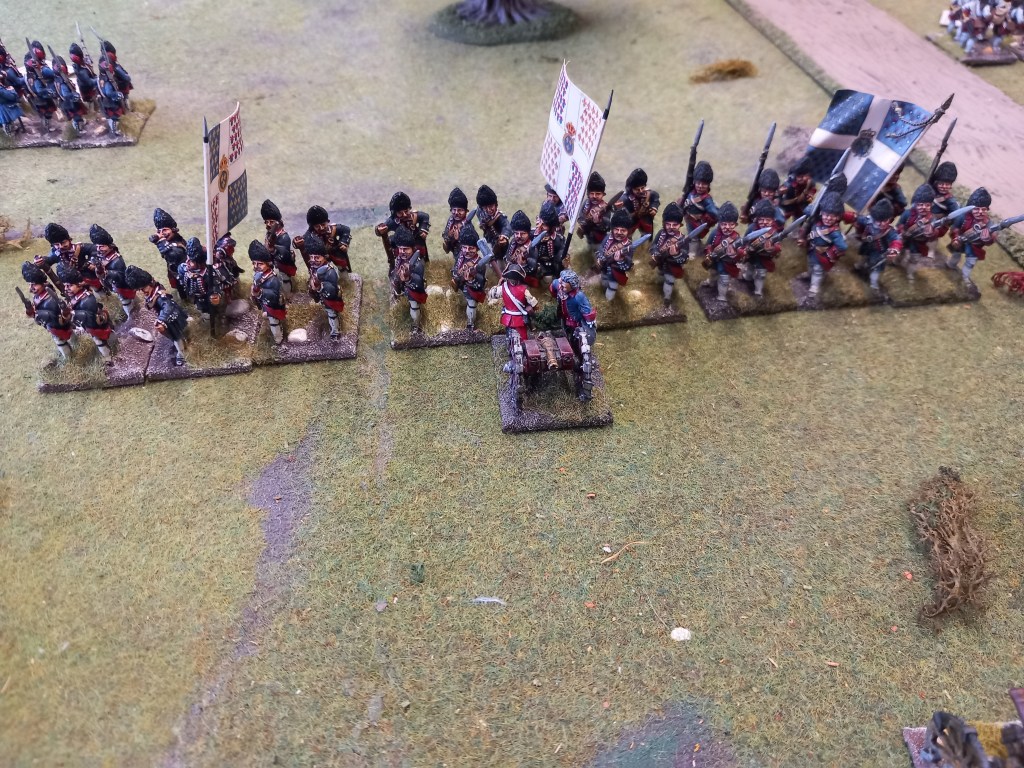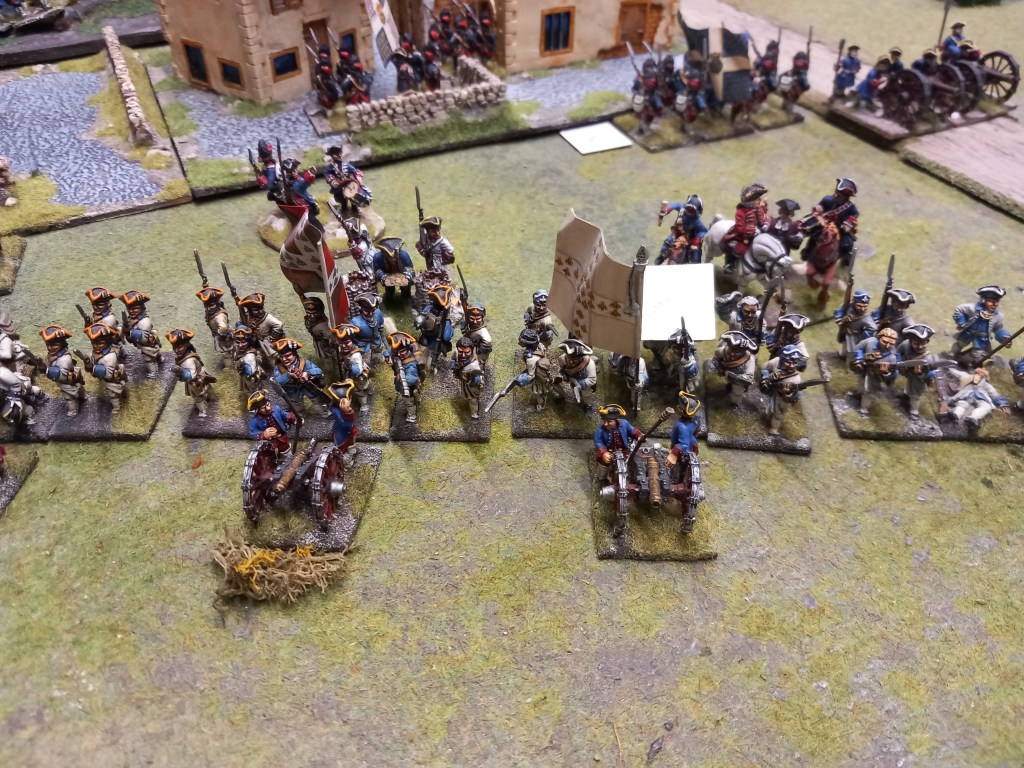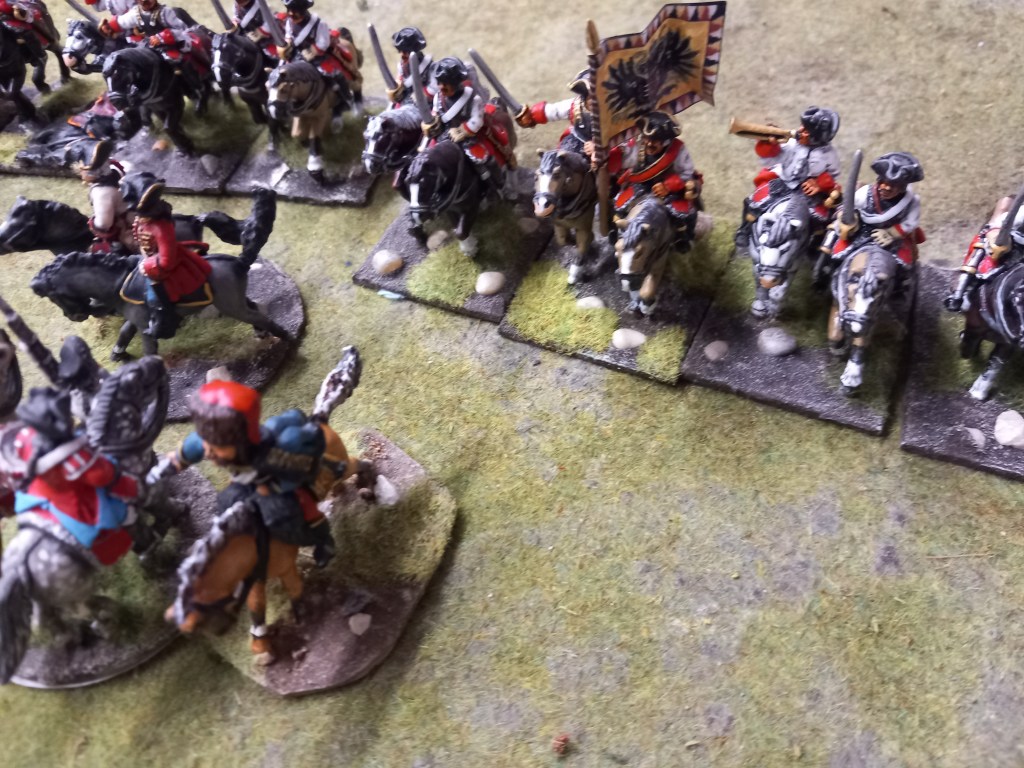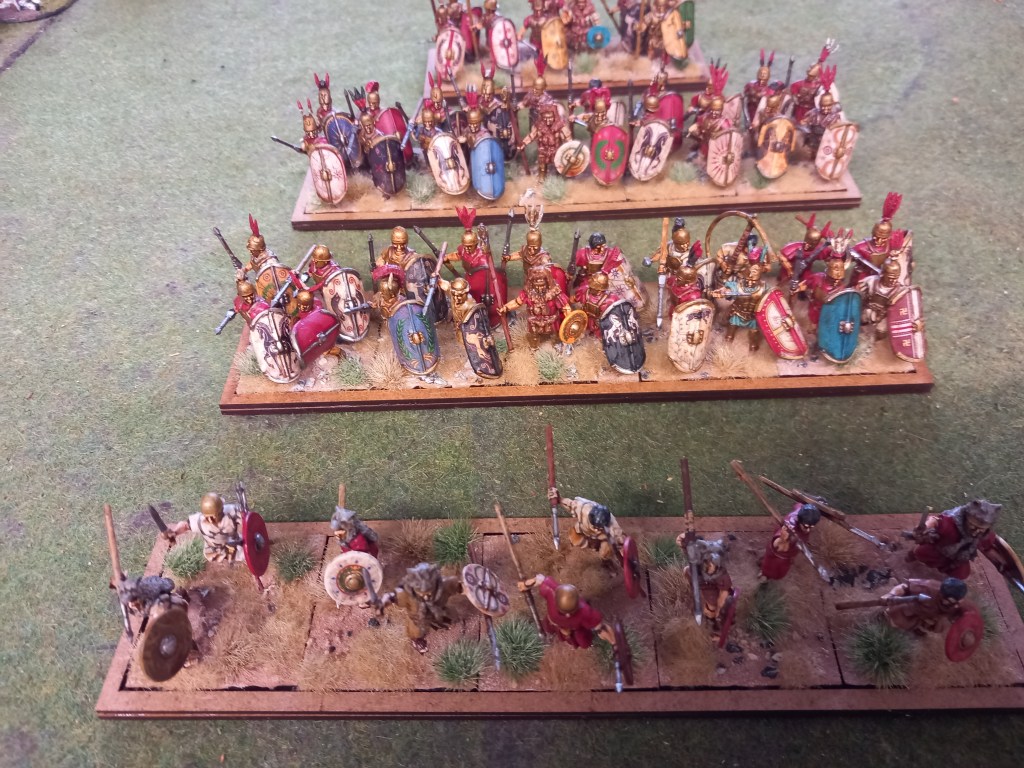
April 2025 Report

A third of the year gone but still we keep playing ๐Ÿ˜Š

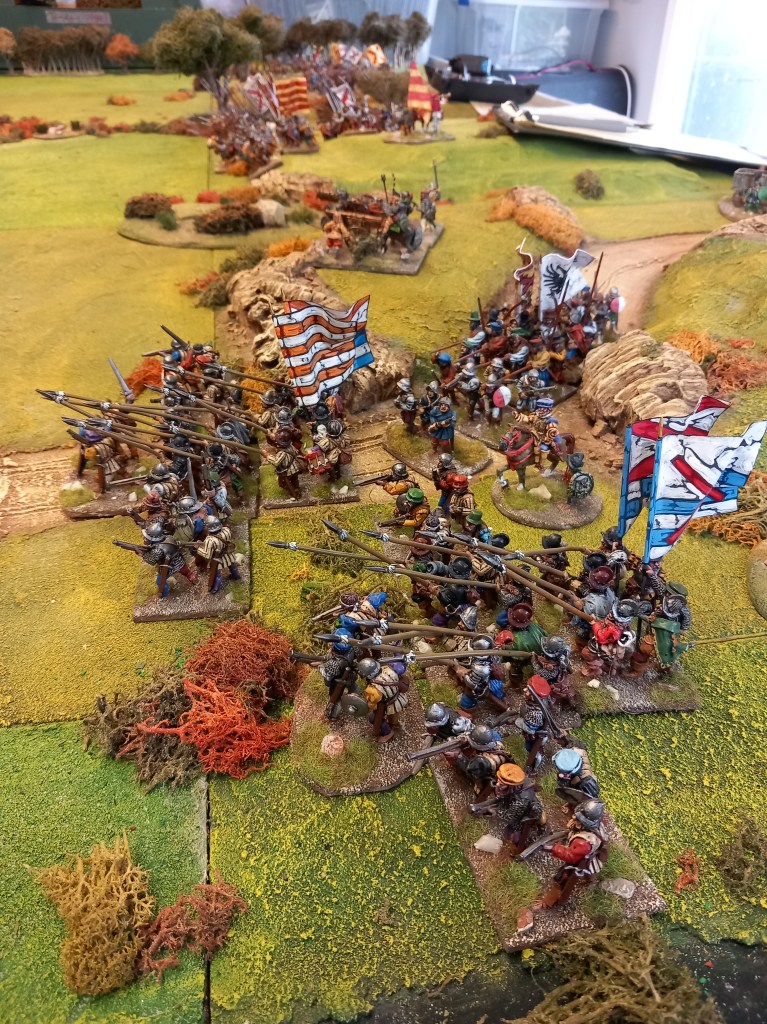
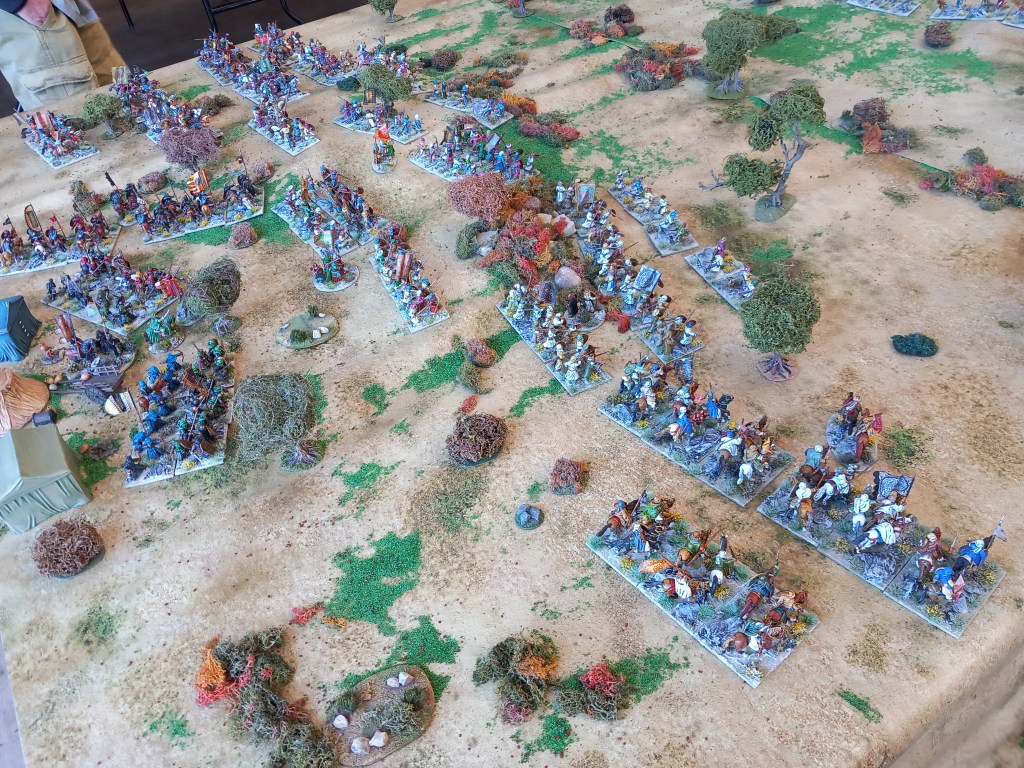
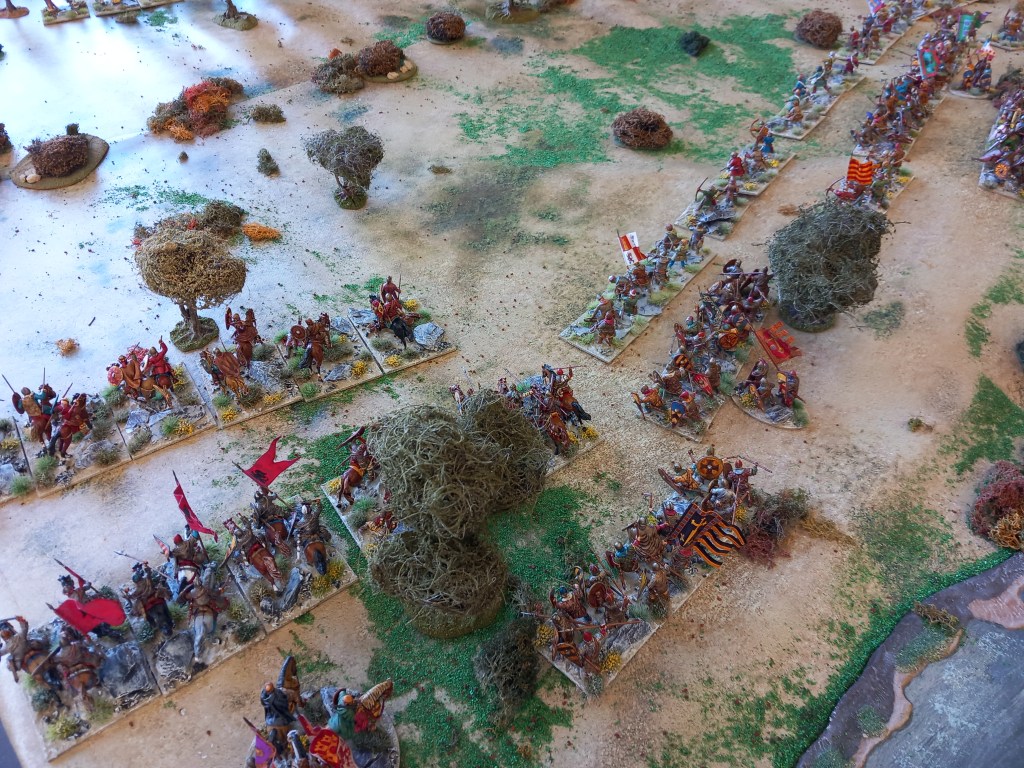
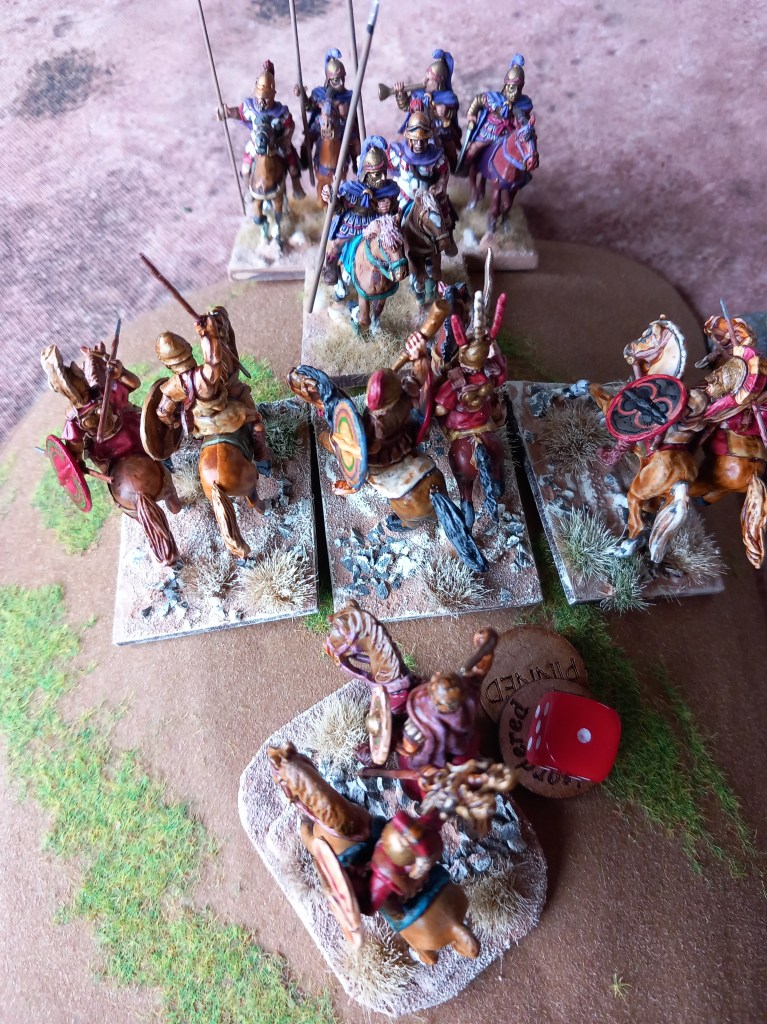
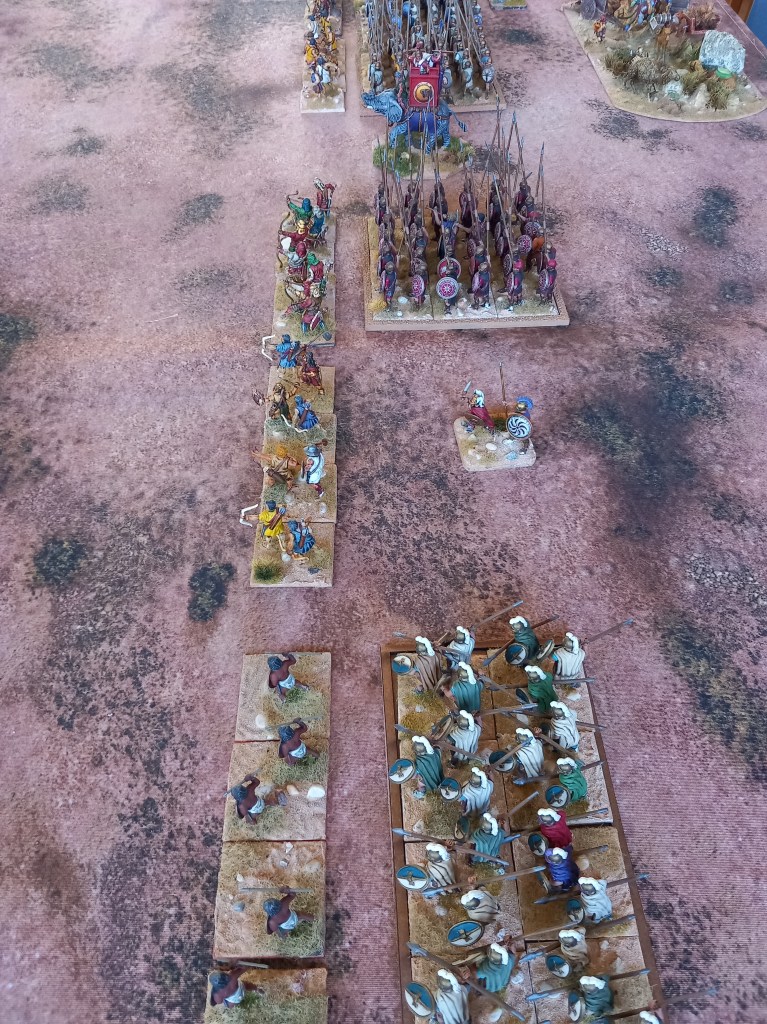
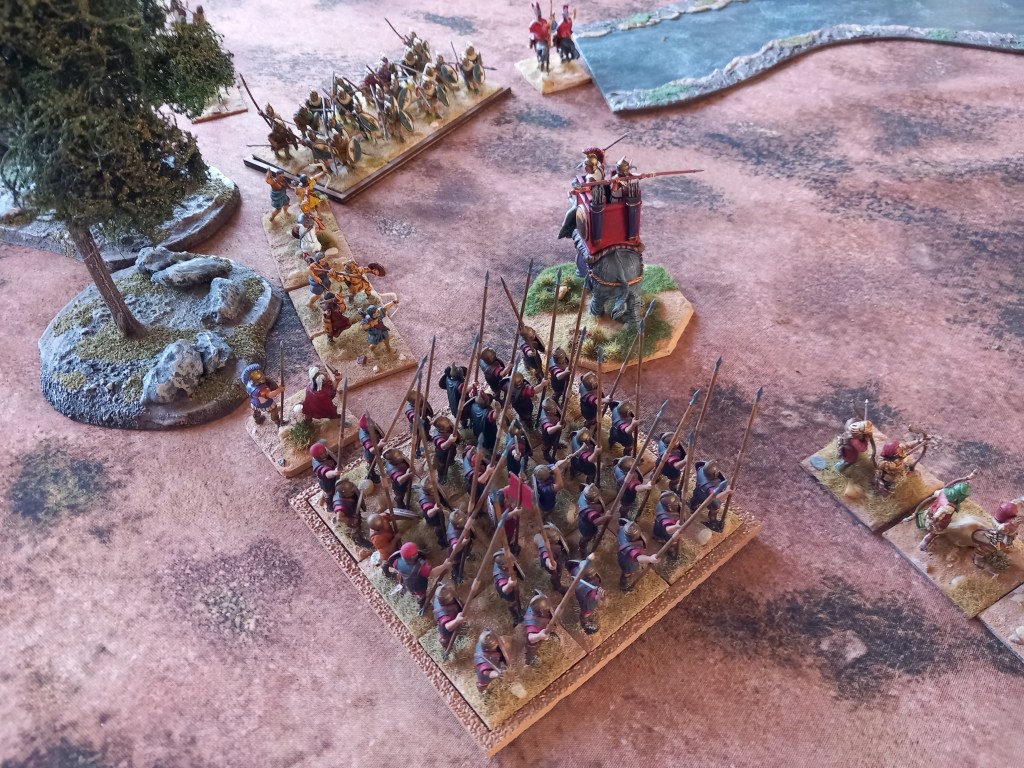
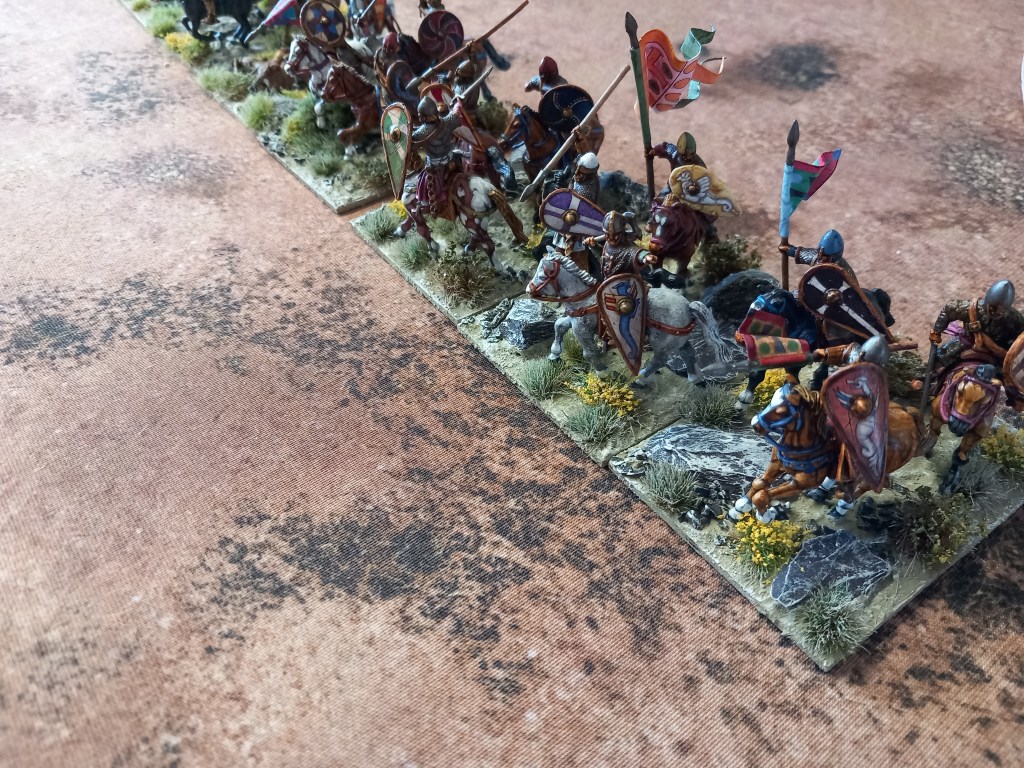
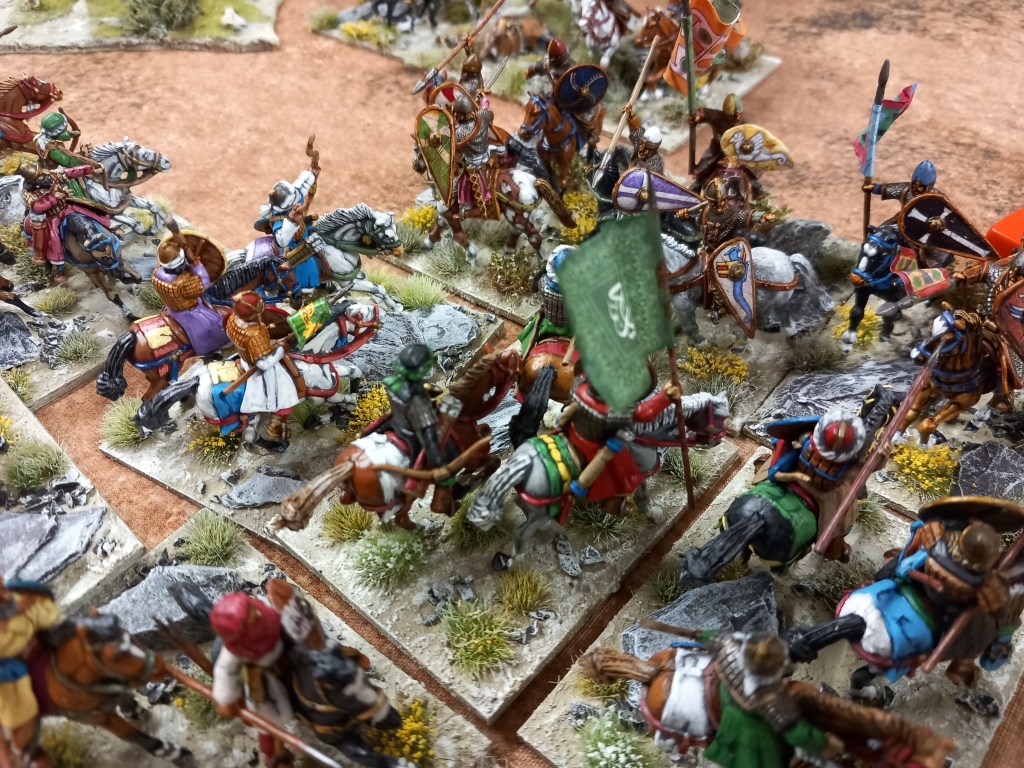
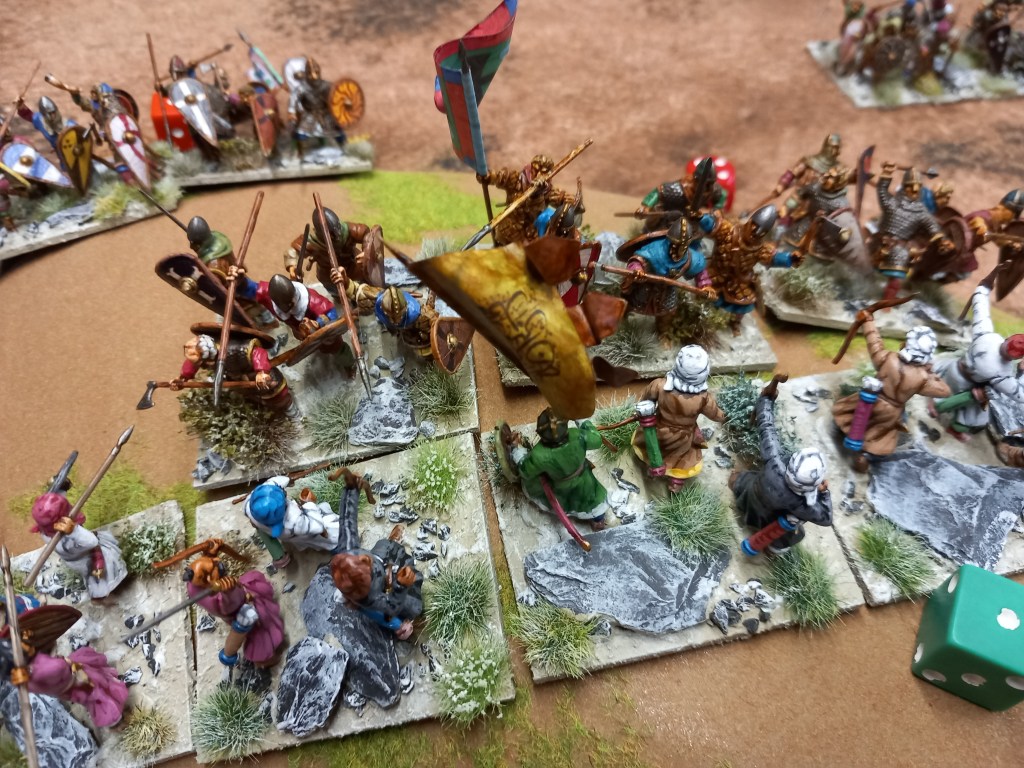
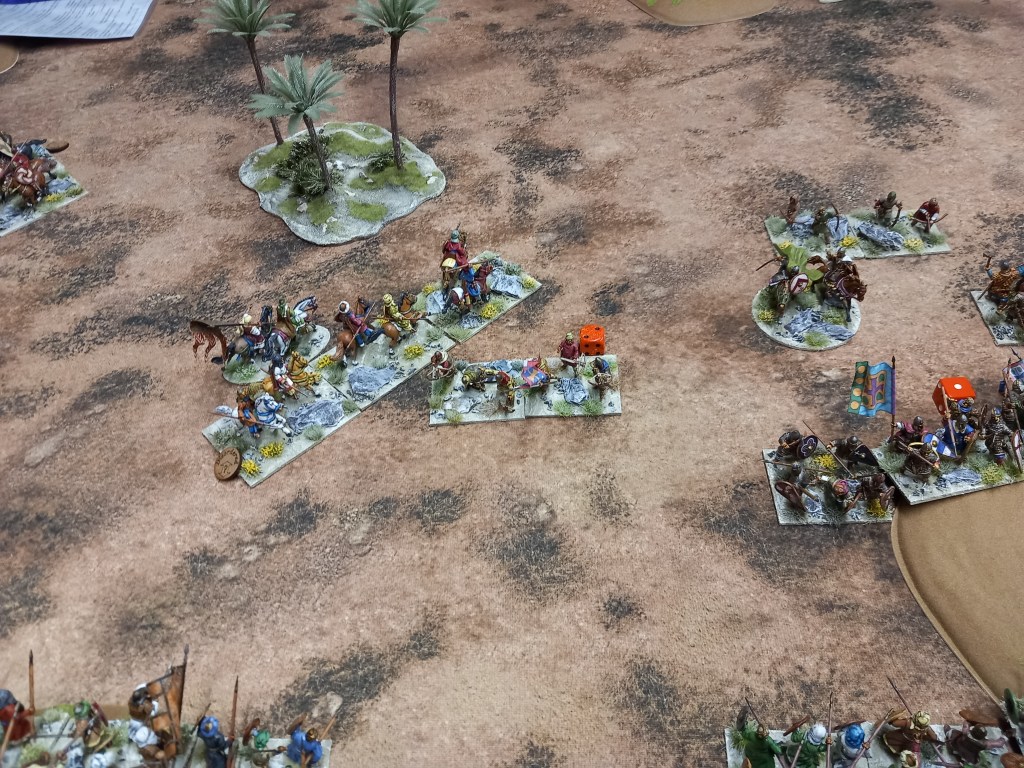
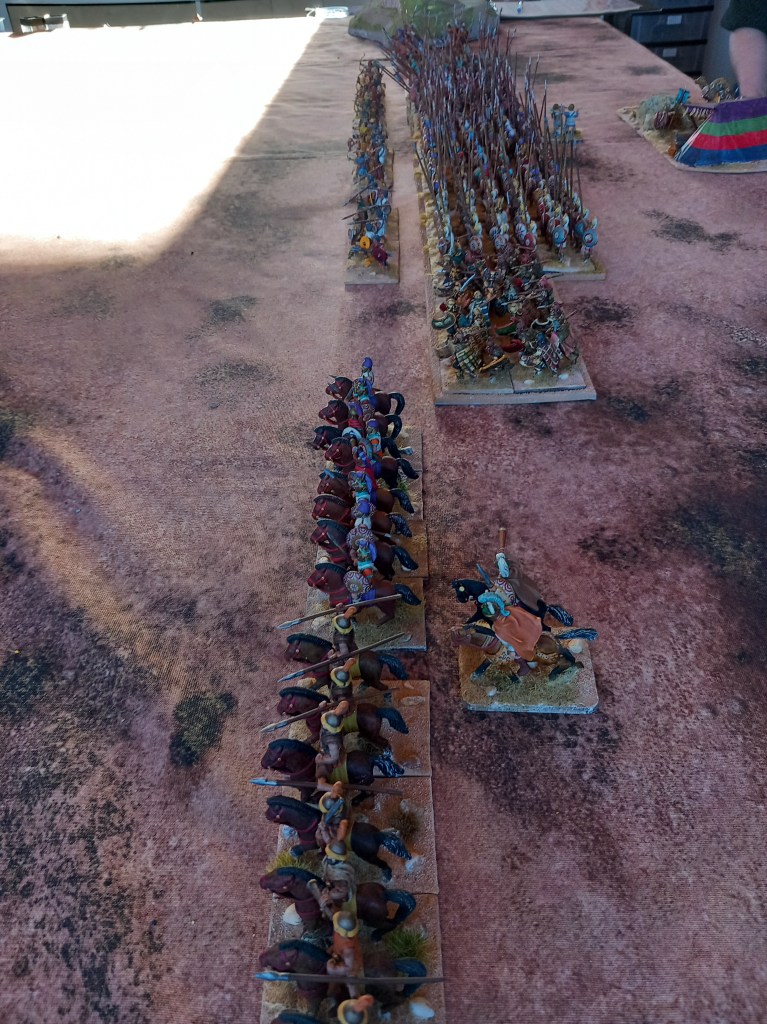
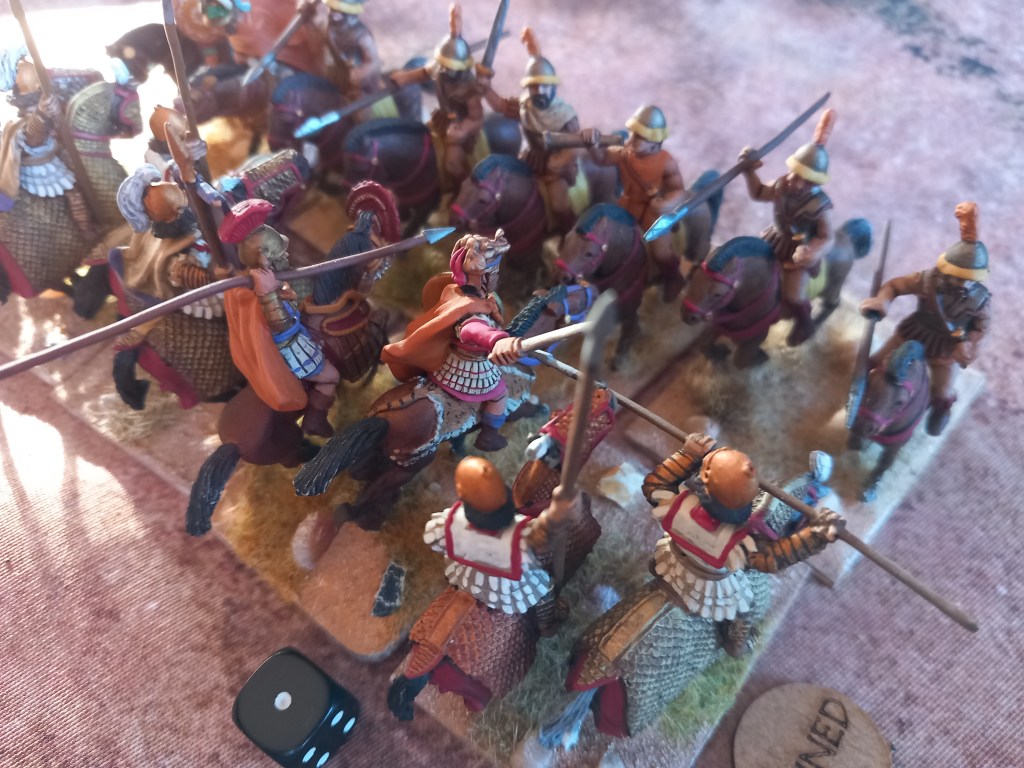
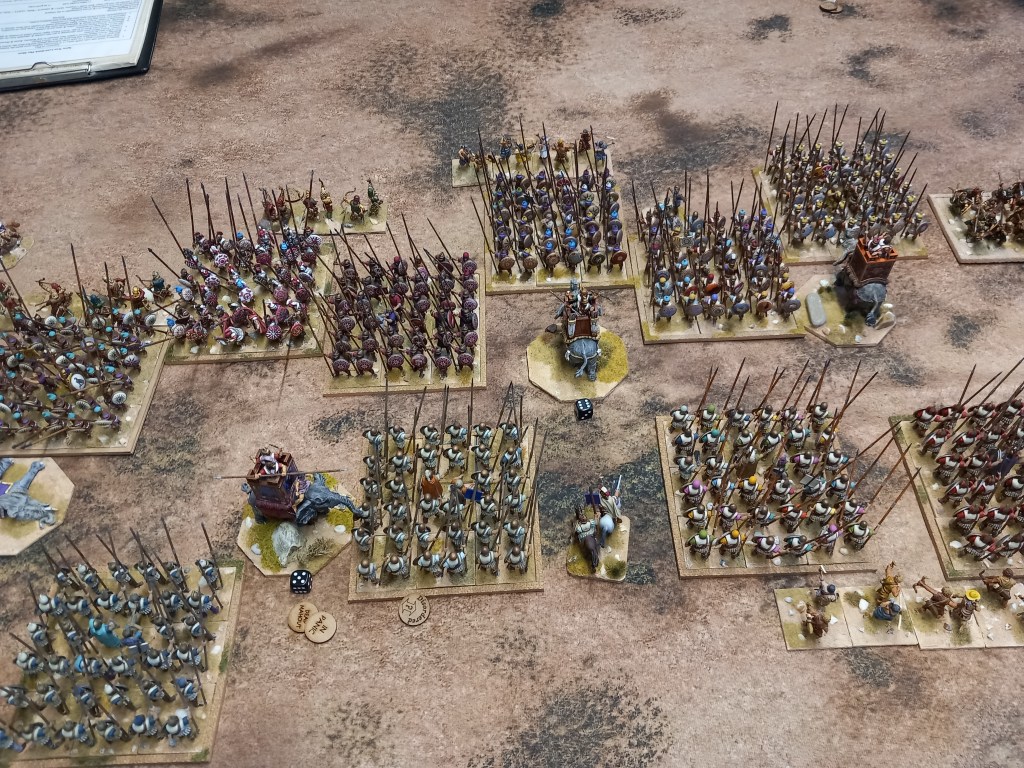
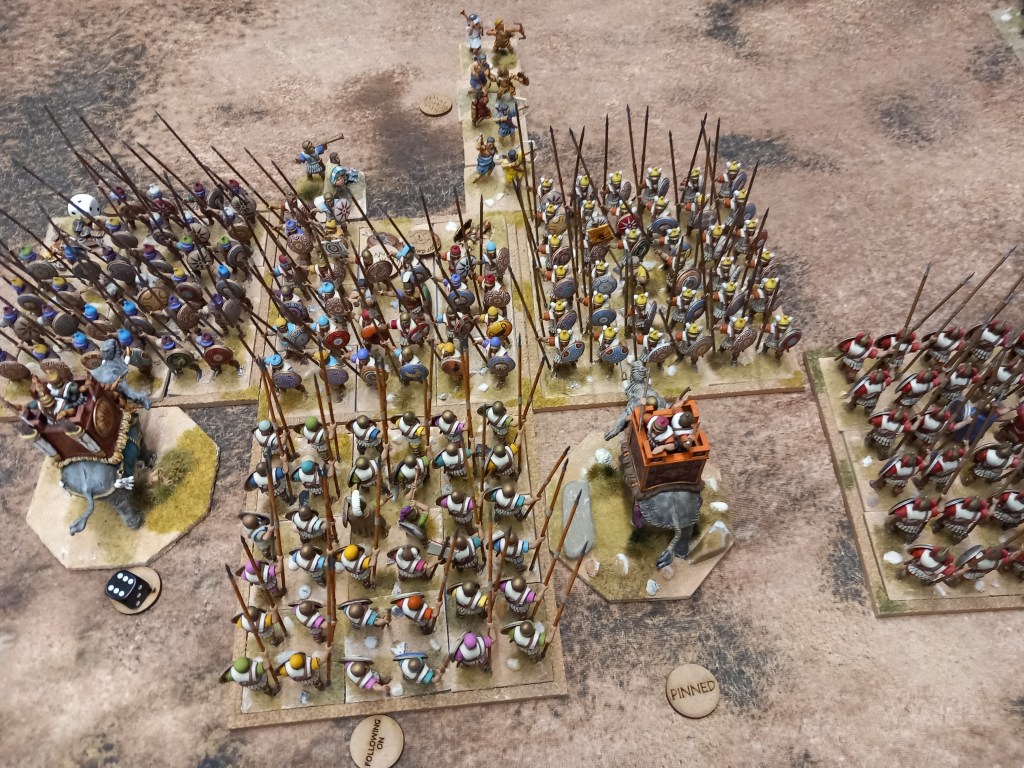
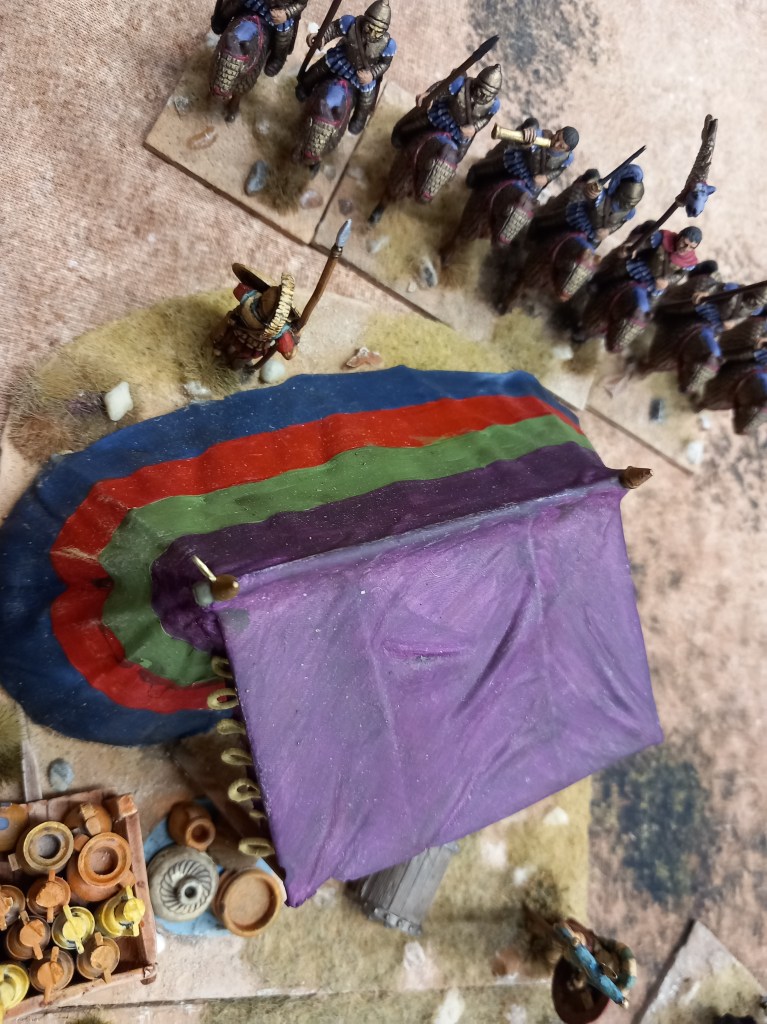
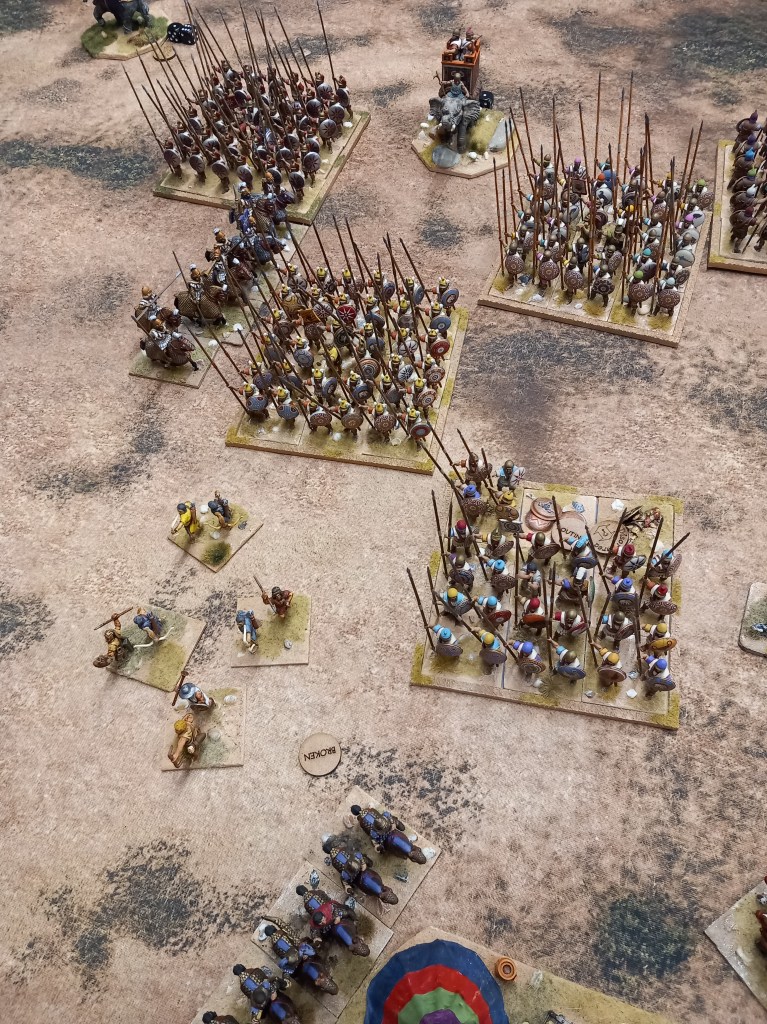
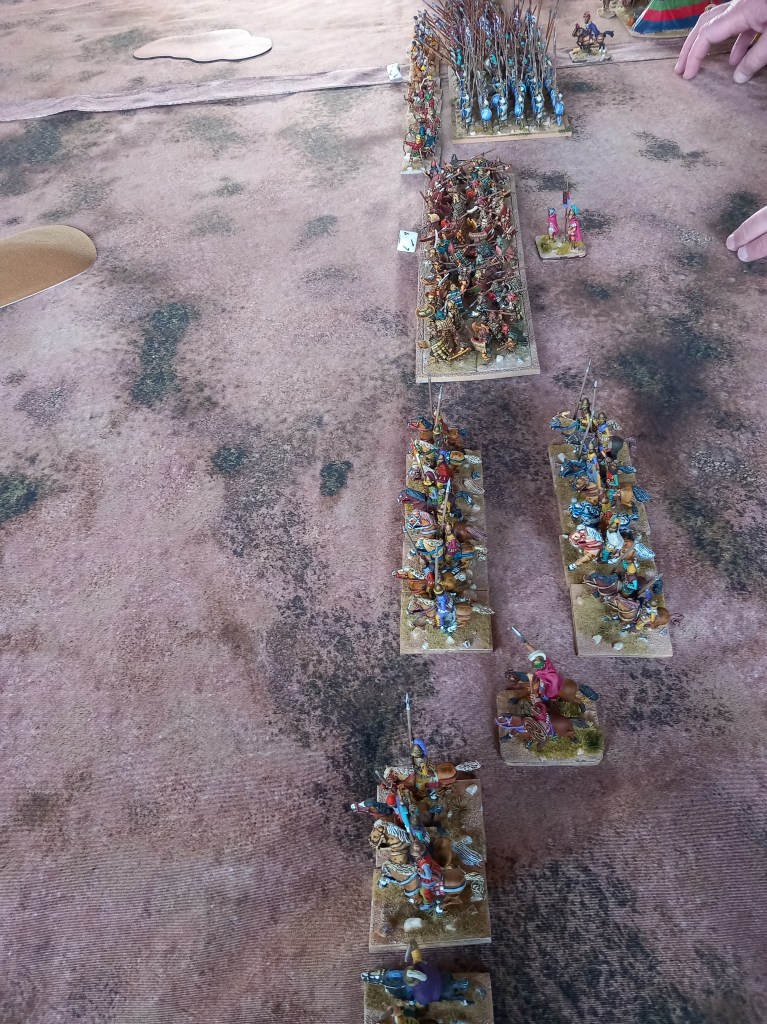
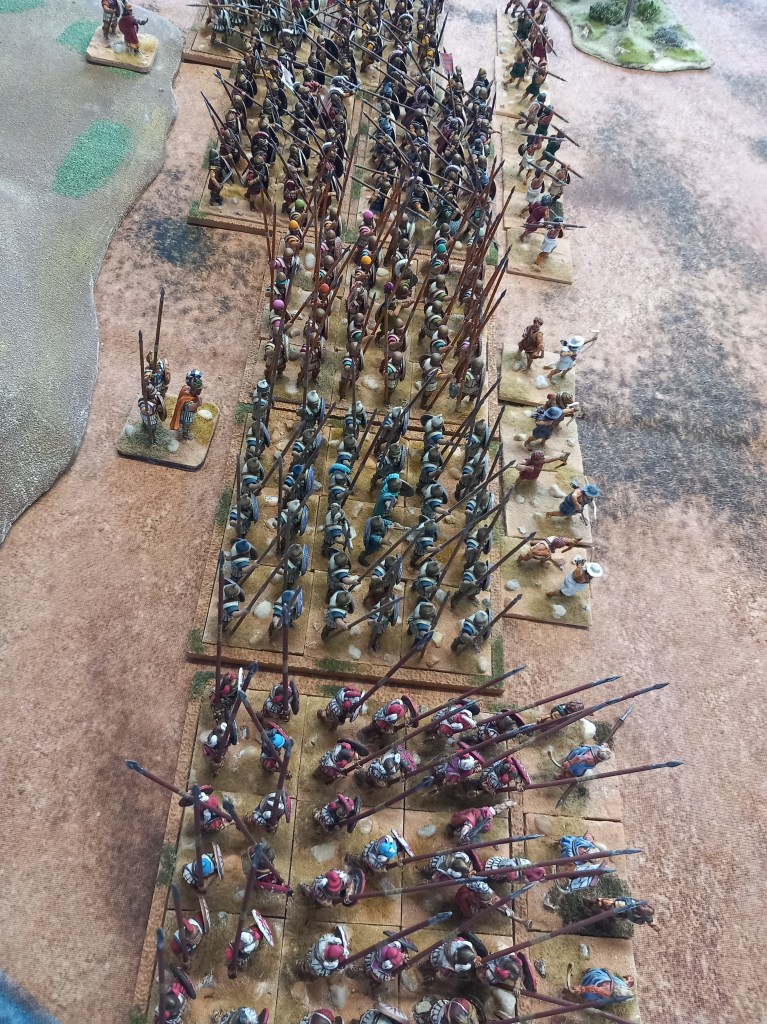
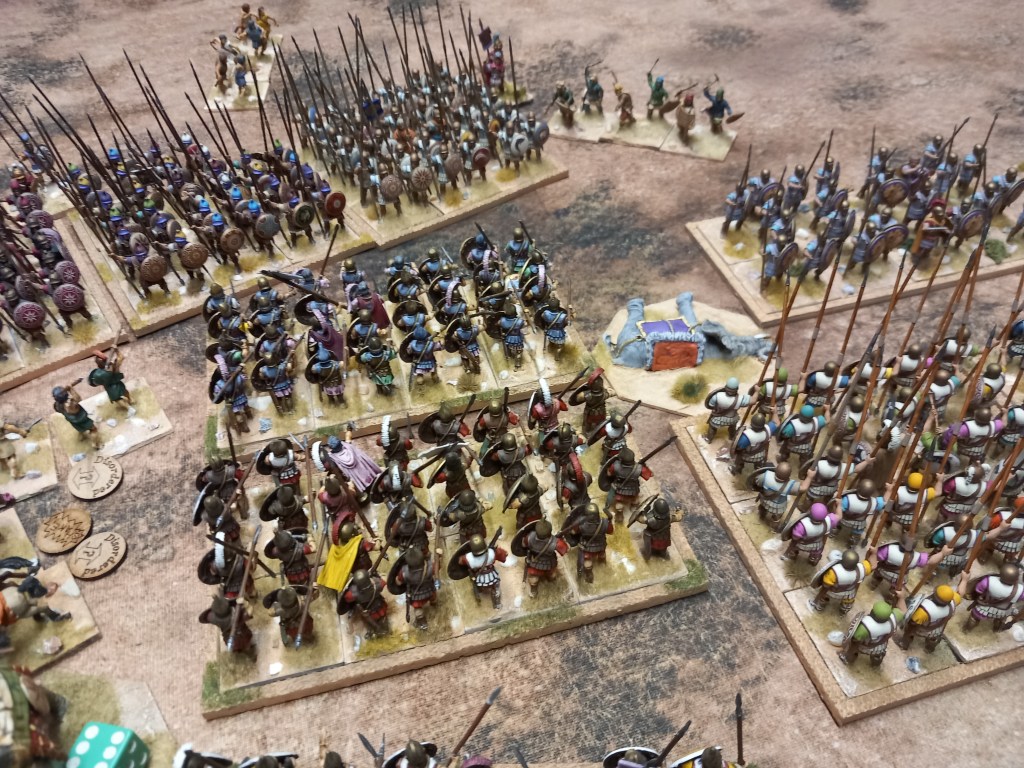
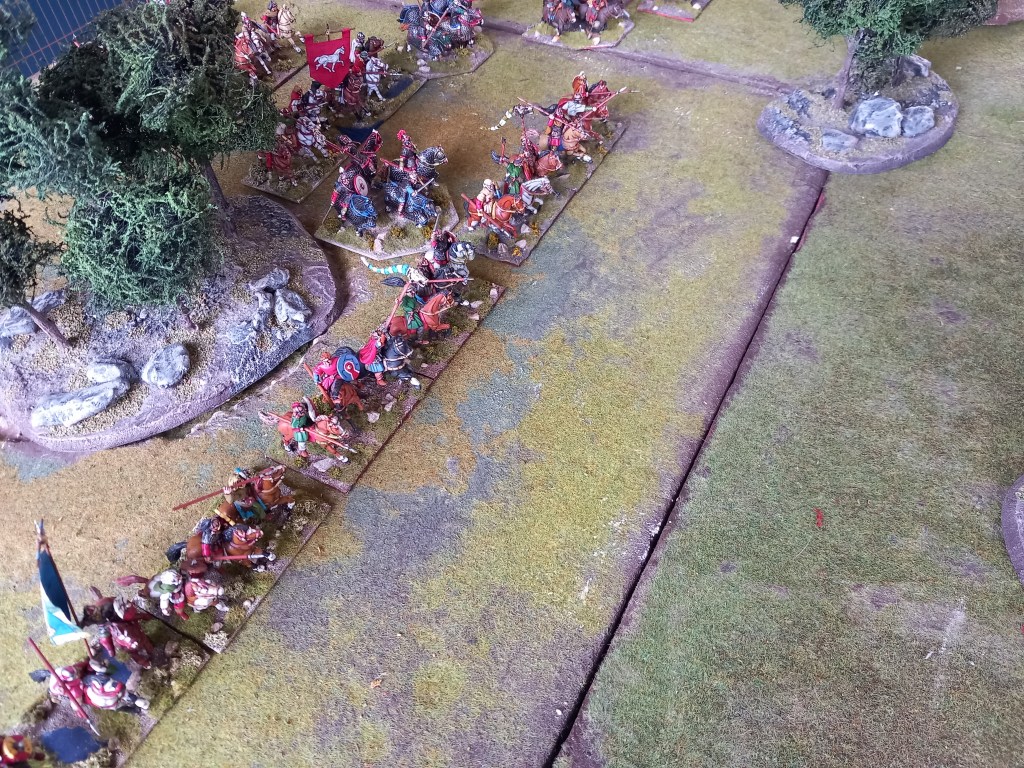
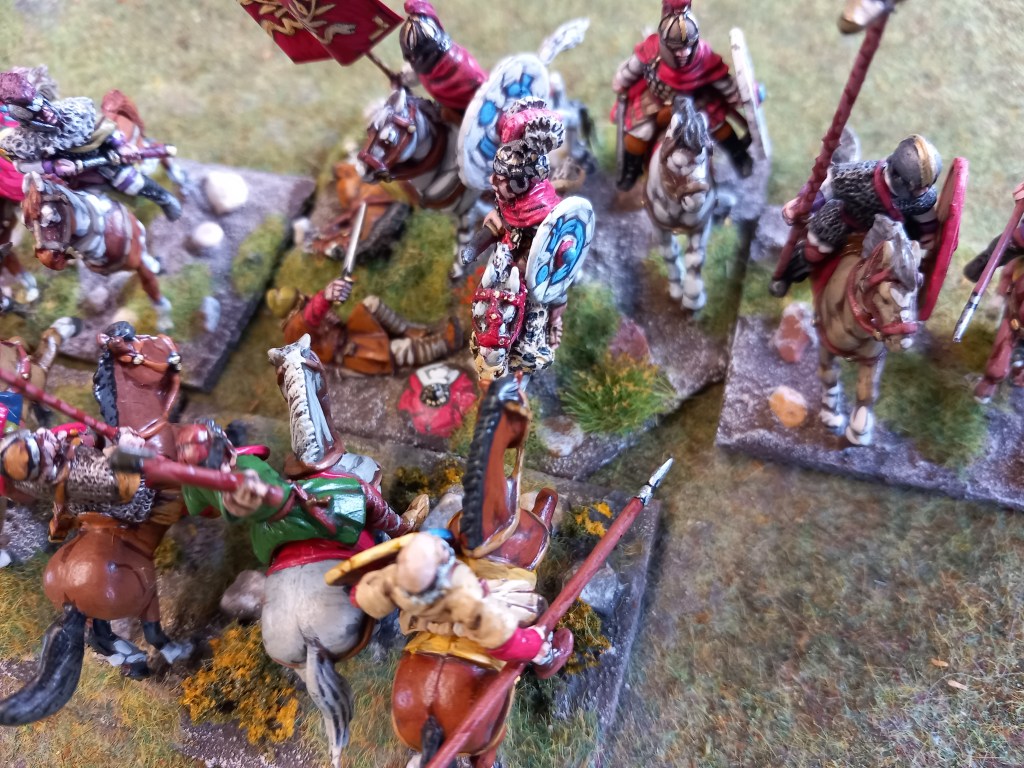
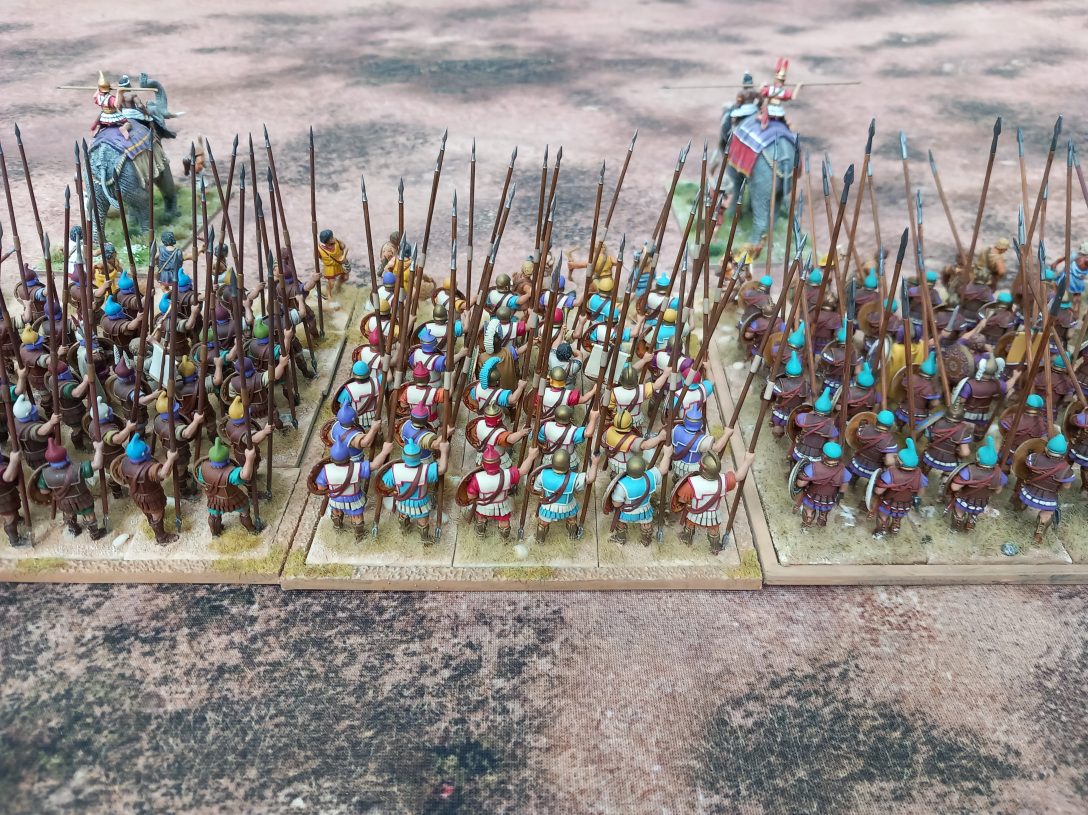
We opened the month with my personal favourite, Successors. For this one we had, Imperial Seleucid under Seleucus III facing down Ptolemaics under Ptolemy II Philadelphus around the time of the Syrian Wars.

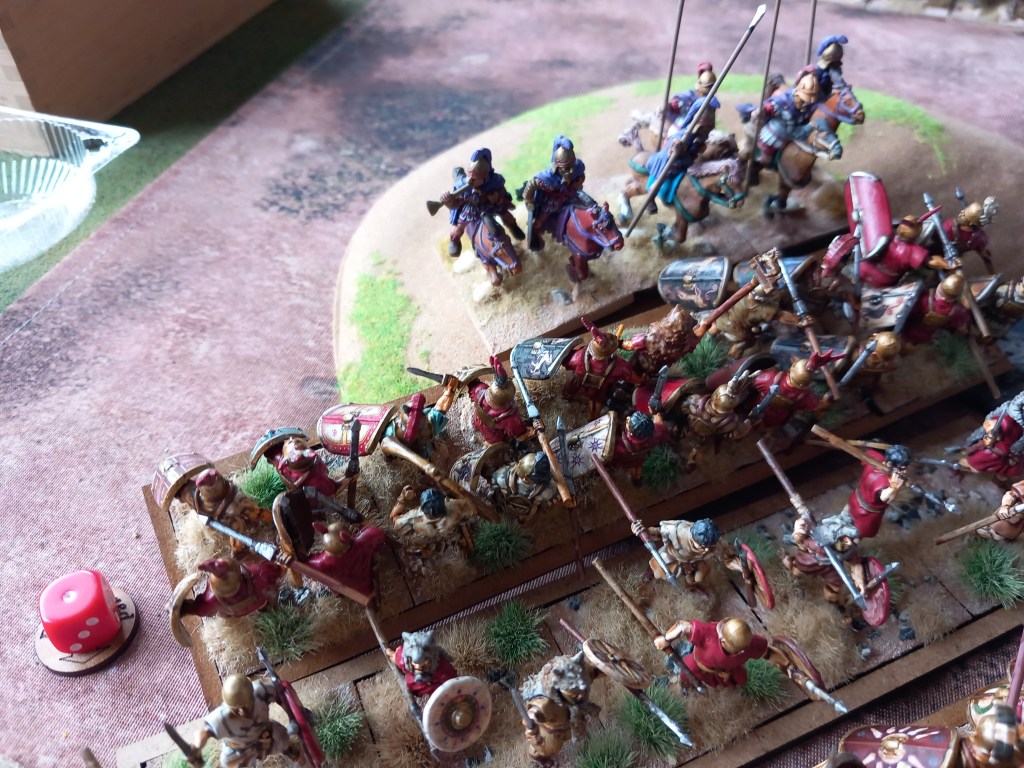
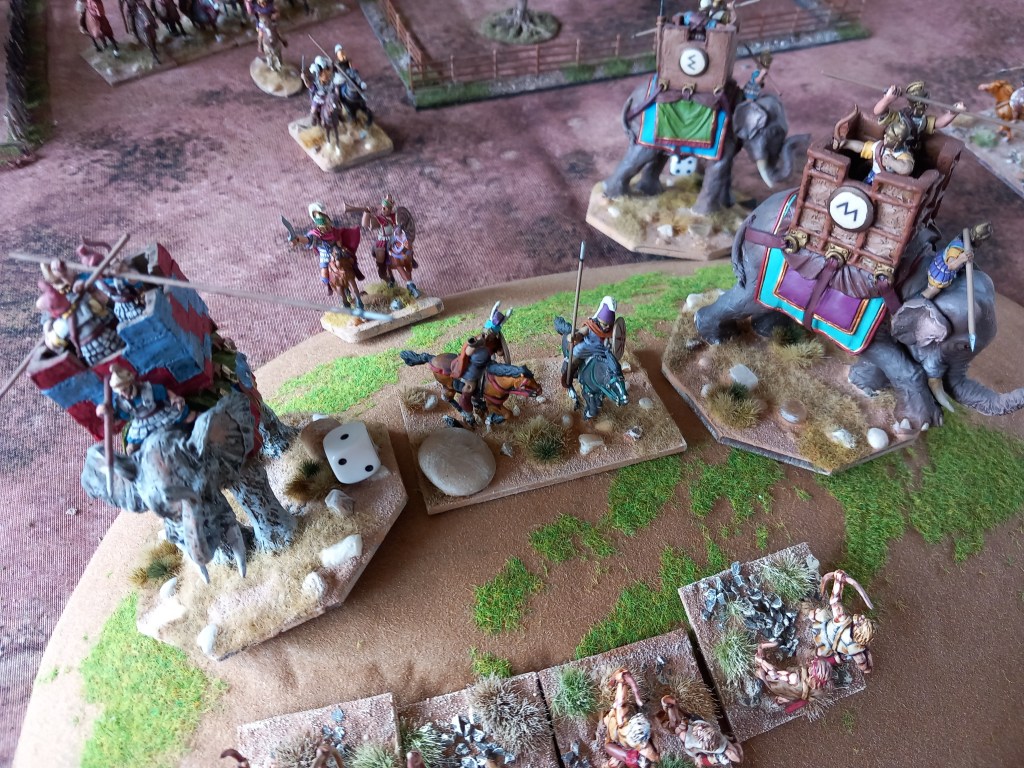
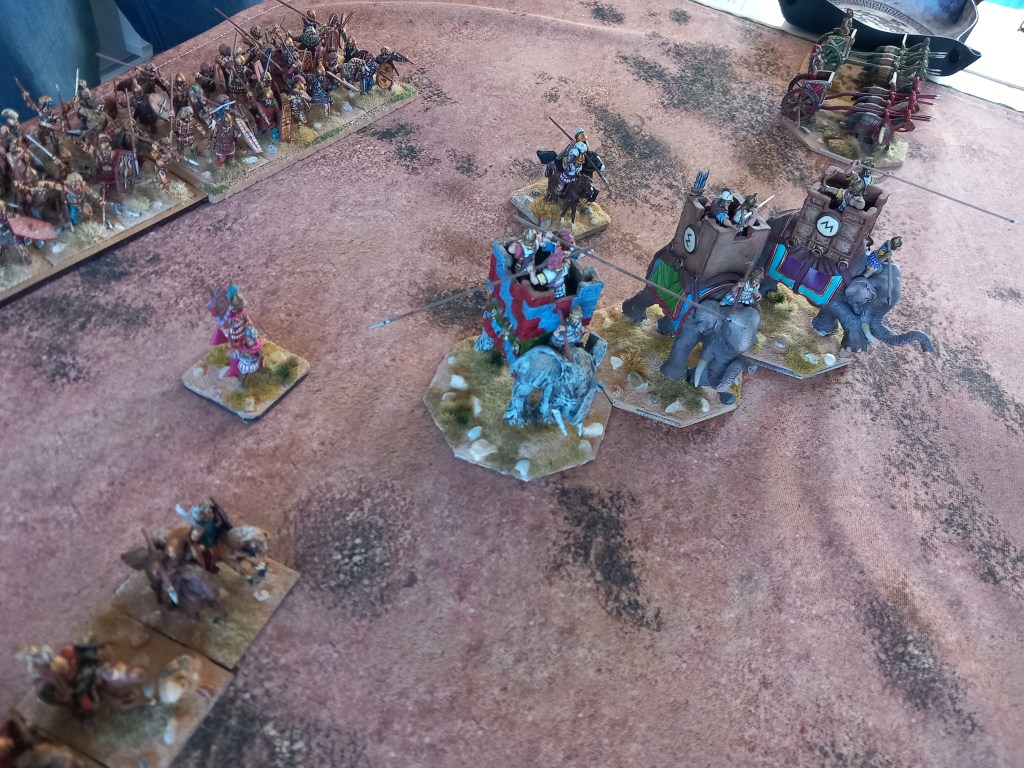
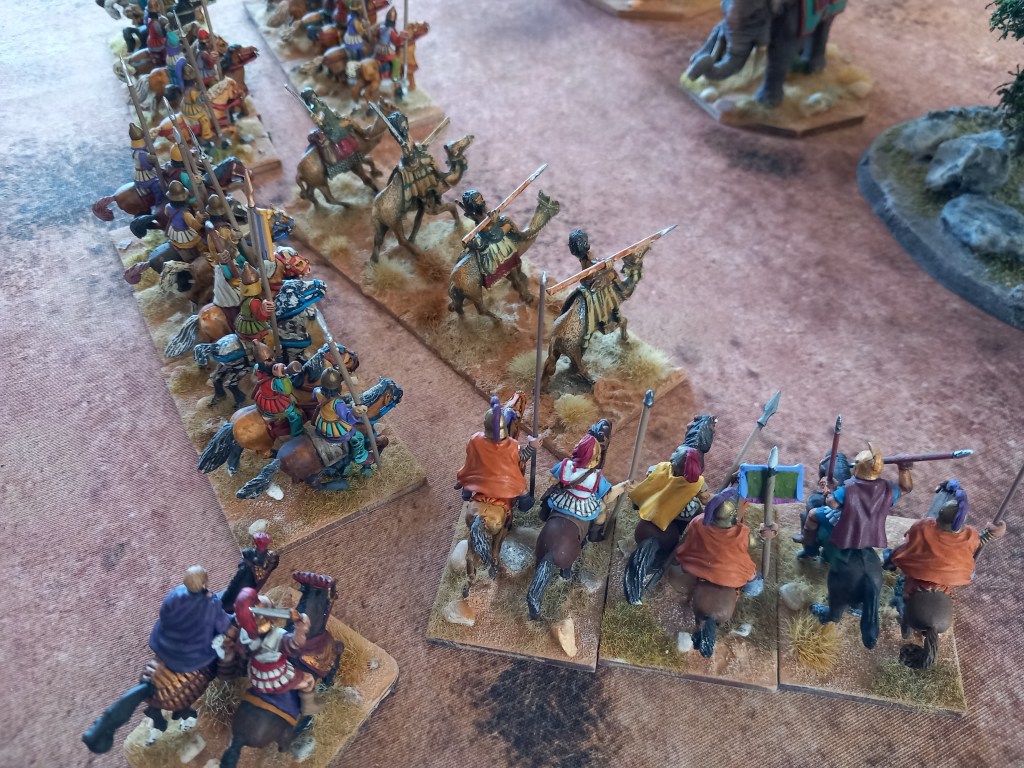
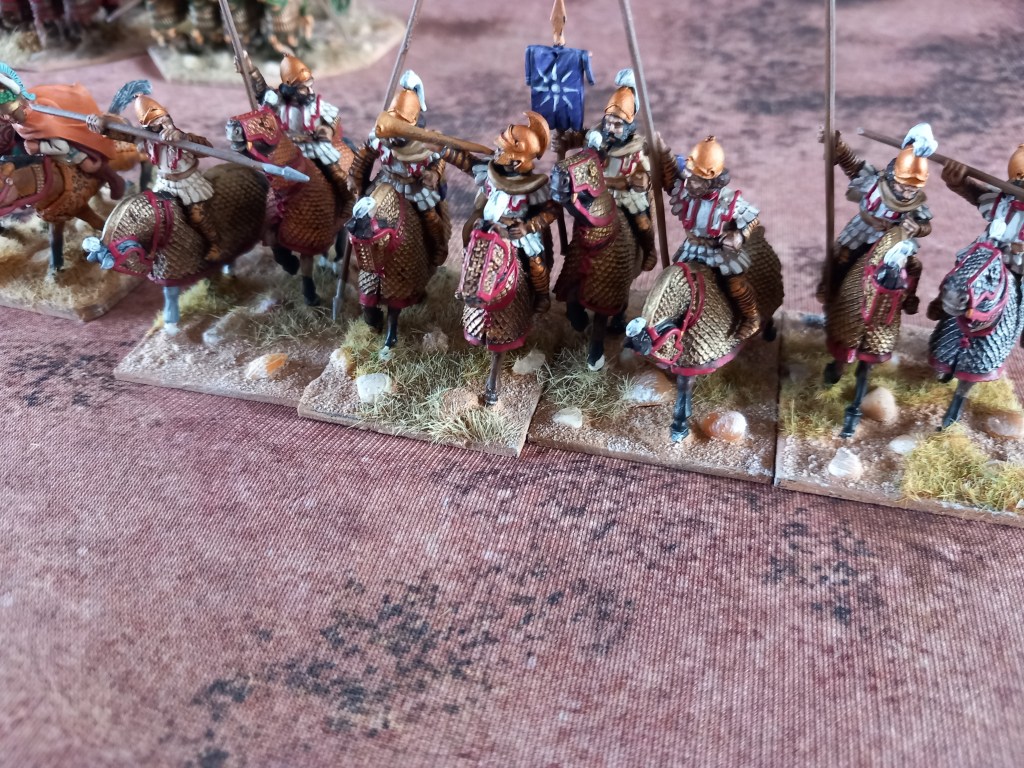
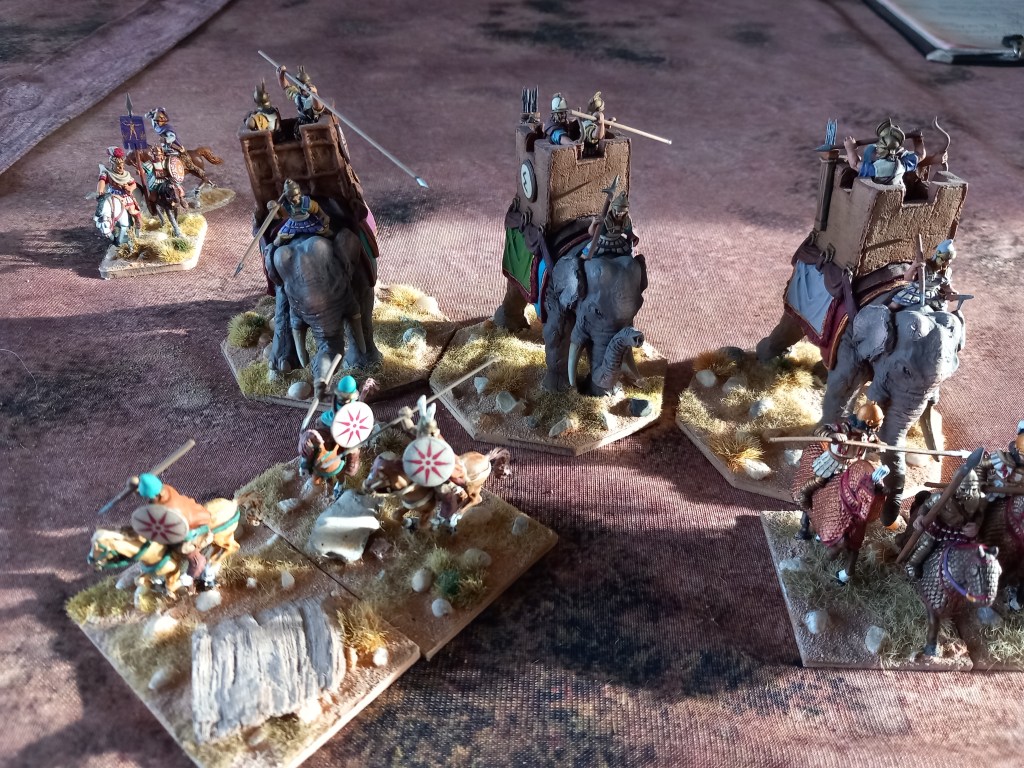
The Seleucids were light on pikes having just the Silver Shields and one other but had the full range of exotics – scythed chariots & elephants, some decent cavalry and those wild Galatians (foot and horse), plus of course sundry skirmish types. The pike deployed in the centre screened by skirmishers, the good horse deployed on the right and the elephants, chariots and Galatians out on the left.

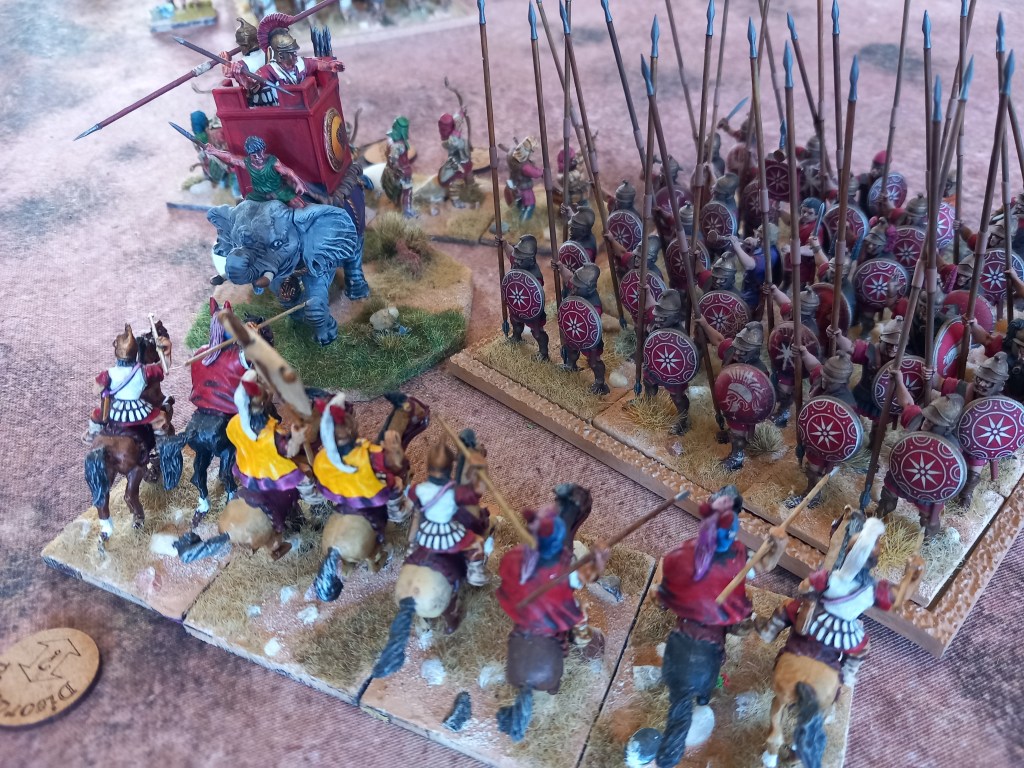
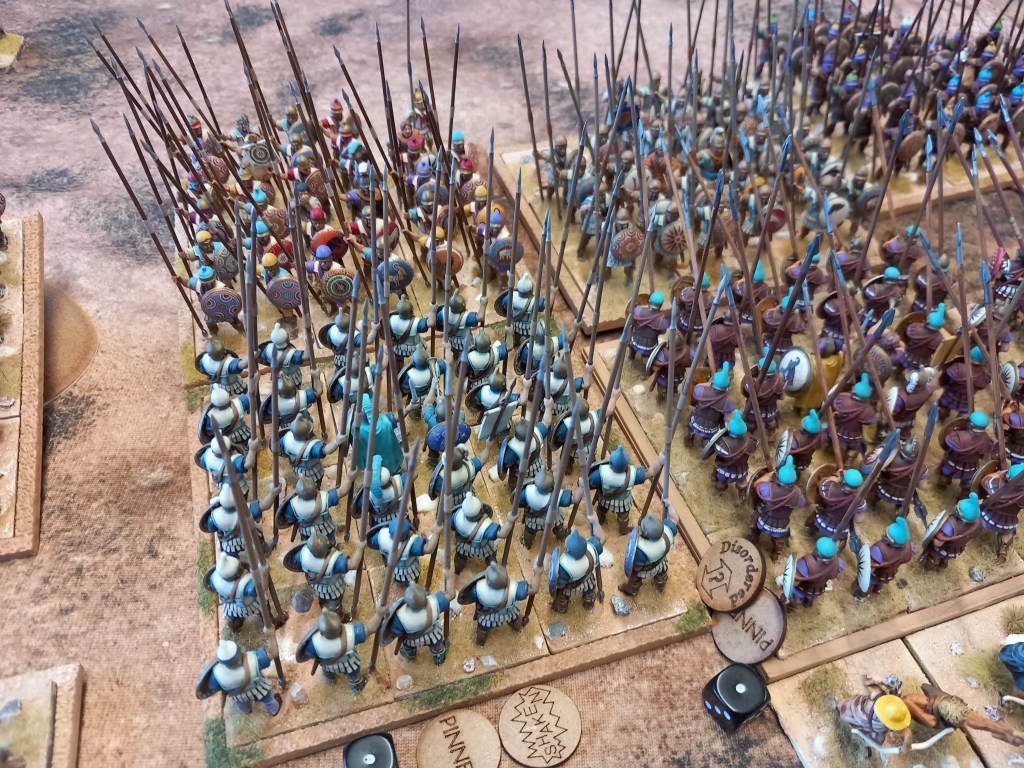
The Ptolemaics were heavy on pikes, four settler units and the Agema, far more cavalry but more variable in quality and a lot of skirmishers. When deployed all the cavalry were on the right, the settler pike took the centre with their sole elephant squadron out front along with some skirmishers while the left was curiously held by the Agema pike and a unit of Thureophoroi screened by more skirmishers.

We opted to use the terrain and scouting sections from the rules rather than just bang the armies down on the plain and this should have favoured the Ptolemaics with their superior scouting strength but they fumbled and ended up with a terrain board that helped rather than hindered the Seleucids.

Being inferior in numbers the Seleucids opted to hold back their pikes and rely on the exotics to make a mess of the massed Ptolemaic cavalry wing while their own cavalry swung round a convenient ravine to menace the centre. Some of this worked ๐Ÿคจ

The Seleucid elephants managed to get themselves between two woods which had the effect of drawing the Ptolemaic cavalry into a funnel of disorder while out on the extreme edge of the wing the chariots did exactly what they were supposed to do, charge in, crash, cause casualties and become inconvenient wreckage.

Sticking with the Ptolemaic right, the chariots soon shot their bolt (as expected) but the Greek and Thessalian cavalry took losses and more importantly were slowed down.

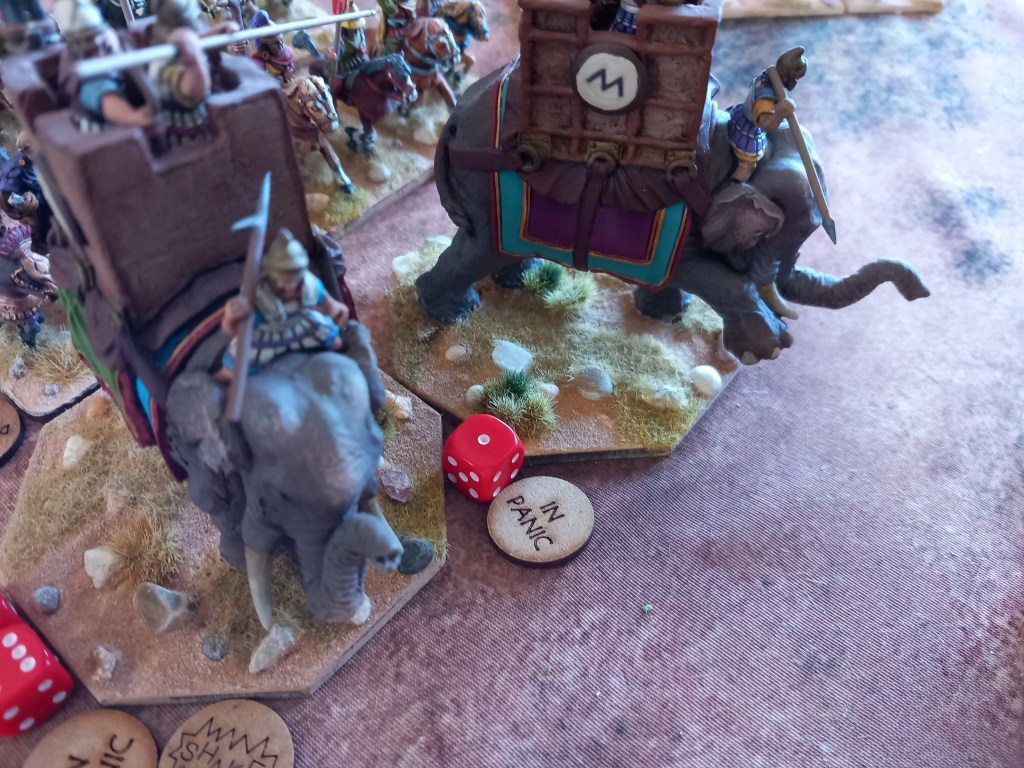
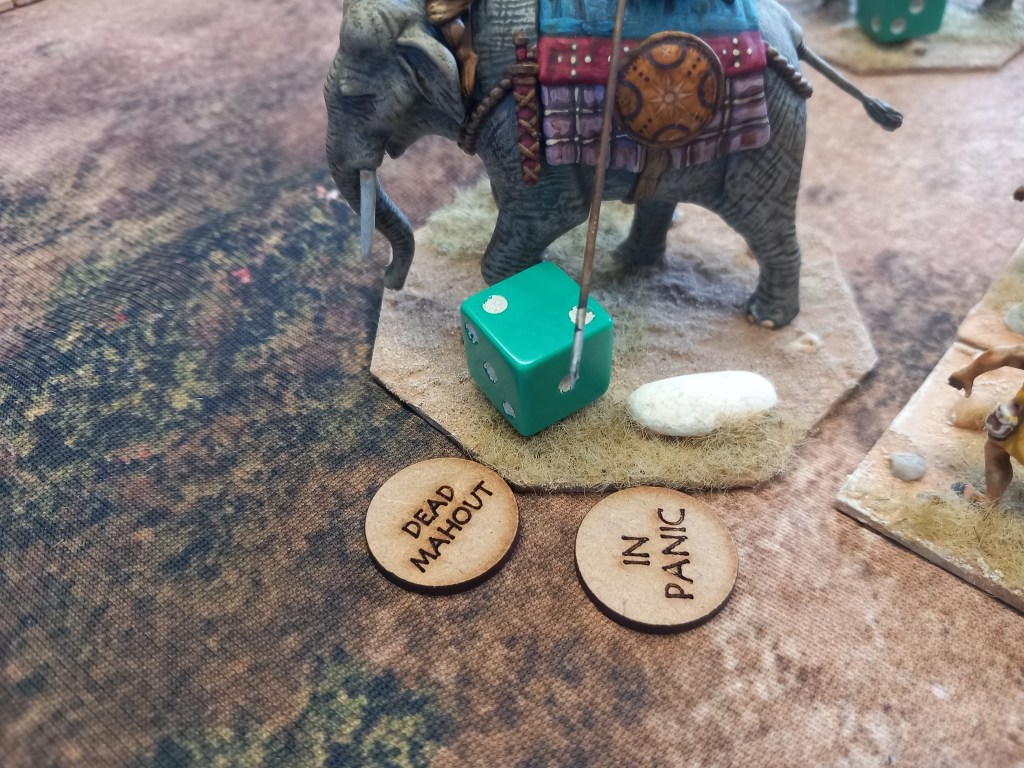
The Seleucid elephants had a good game, they frightened the children (oh no, sorry, the horses), had their mahouts killed and went into panic, rampaging about randomly – exactly what you want to see ๐Ÿ˜‚

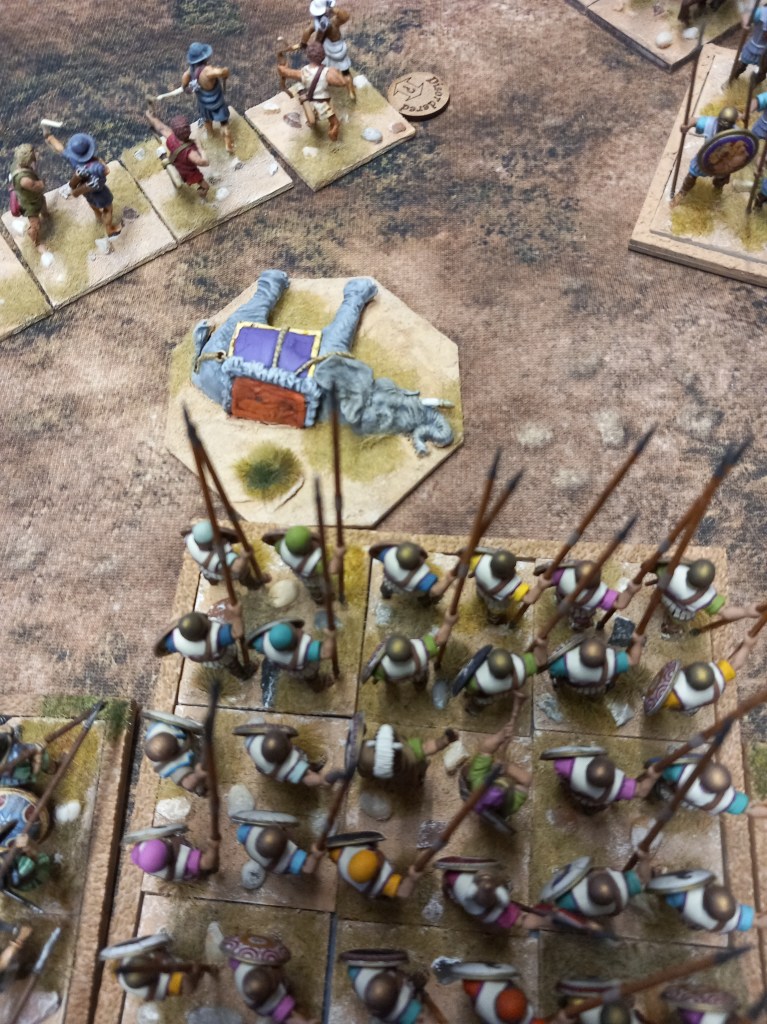
Ultimately the elephants died but their nuisance value had allowed the Galatian warbands to get up and get stuck in. The Galatians in fact had their best game so far, they duffed up a settler pike battalion and routed it, they saw off charges by both the Agema and the veteran Thessalian cavalry and killed the leader of the cavalry wing which paralysed it for the rest of the game. Result!

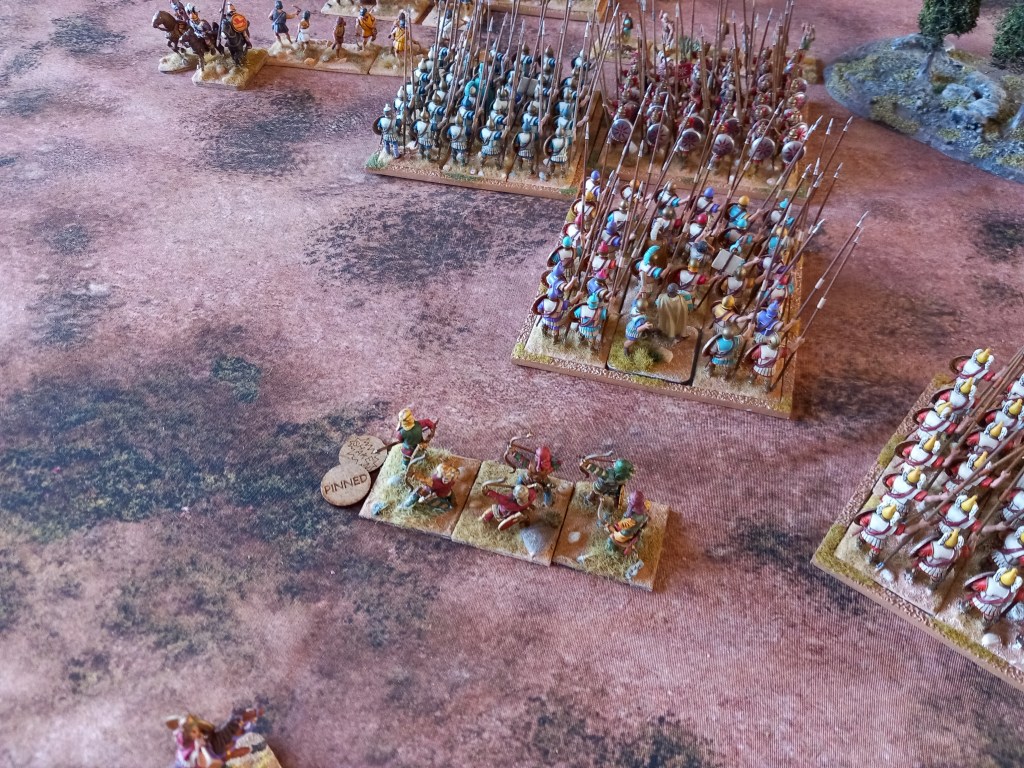
In the centre the Ptolemaic pike mass moved confidently forward but slowly (fairly obviously) and given the decision by the Seleucid general to hang back their only bright spot was the success of their Rhodian and Cretan mercenaries in driving off the opposition skirmishers.

Out on the Seleucid right the cavalry didn’t have the battle they hoped for, the rather odd deployment of Thureophoroi, pike and elephant initially worked and both Seleucid Xystophoroi regiments were seen off, one by the Thureophoroi and one by a combination of pikes and elephant. Unfortunately the Seleucid Hetairoi regiment sneaked through and opportunistically charged a shaken and disordered settler pike battalion and routed it – the stars really did align for that combat.

As we approached the end the Silver Shields were unleashed and……..failed to charge! What an embarrassment ๐Ÿคฃ

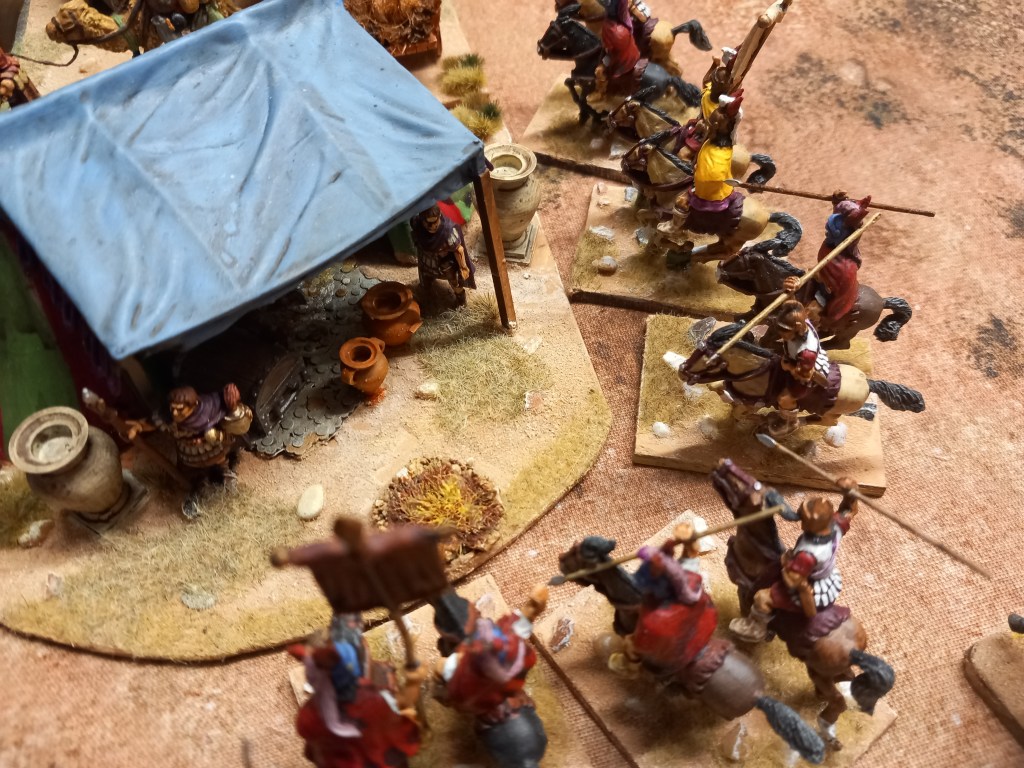
The embarrassment of the Silver Shields not withstanding it was clearly a Seleucid victory, the Ptolemaic cavalry were paralysed and the settler pike were not having a good day.

Could it have gone differently? I think yes. The terrain decisions by the Ptolemaic general were definitely a factor effectively limiting the ability of the big cavalry wing to do anything and having all the cavalry eggs in one basket as it were definitely was a tactical limitation for the Ptolemaics. But so what, we had a fun game and that is what matters.

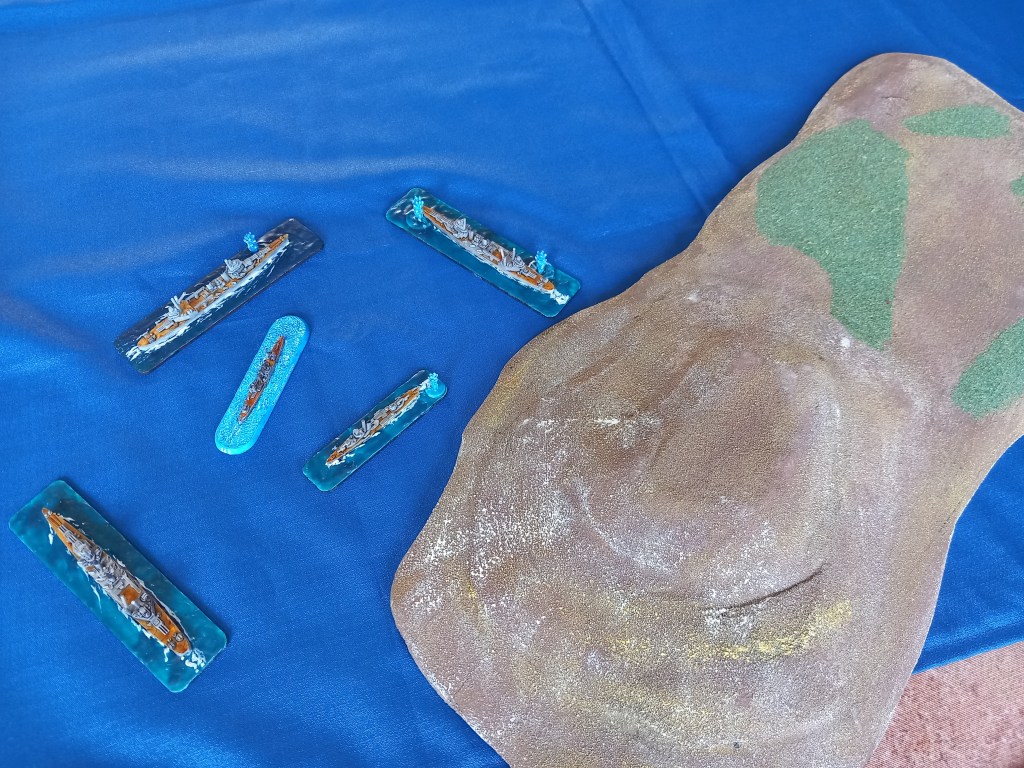
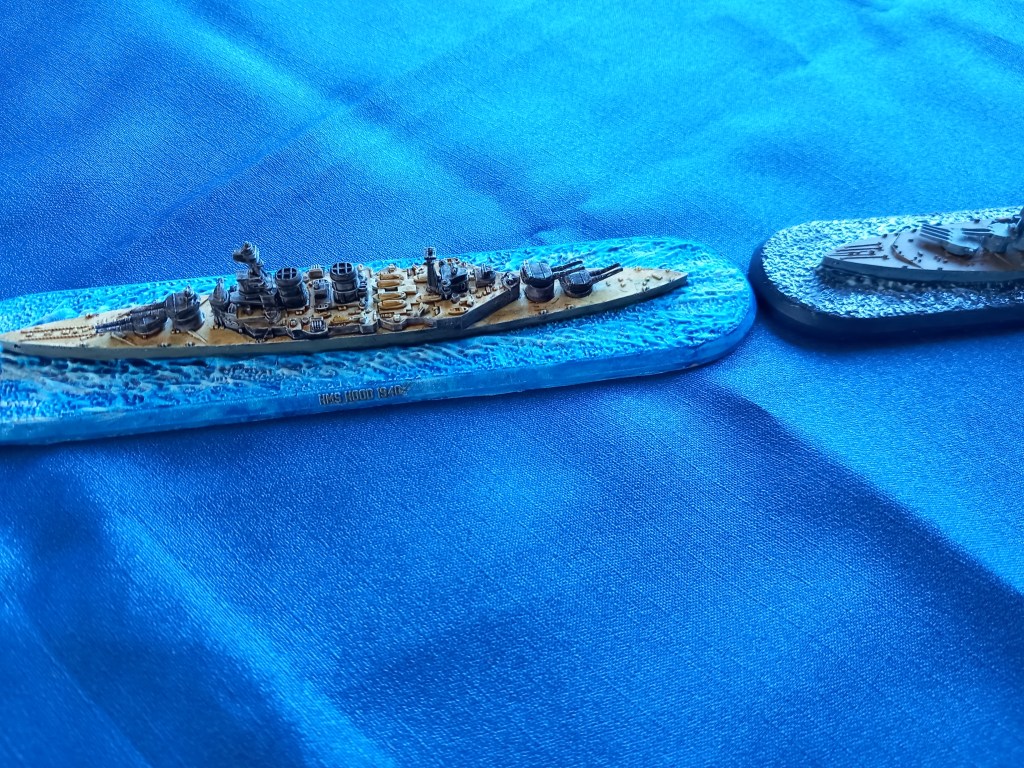
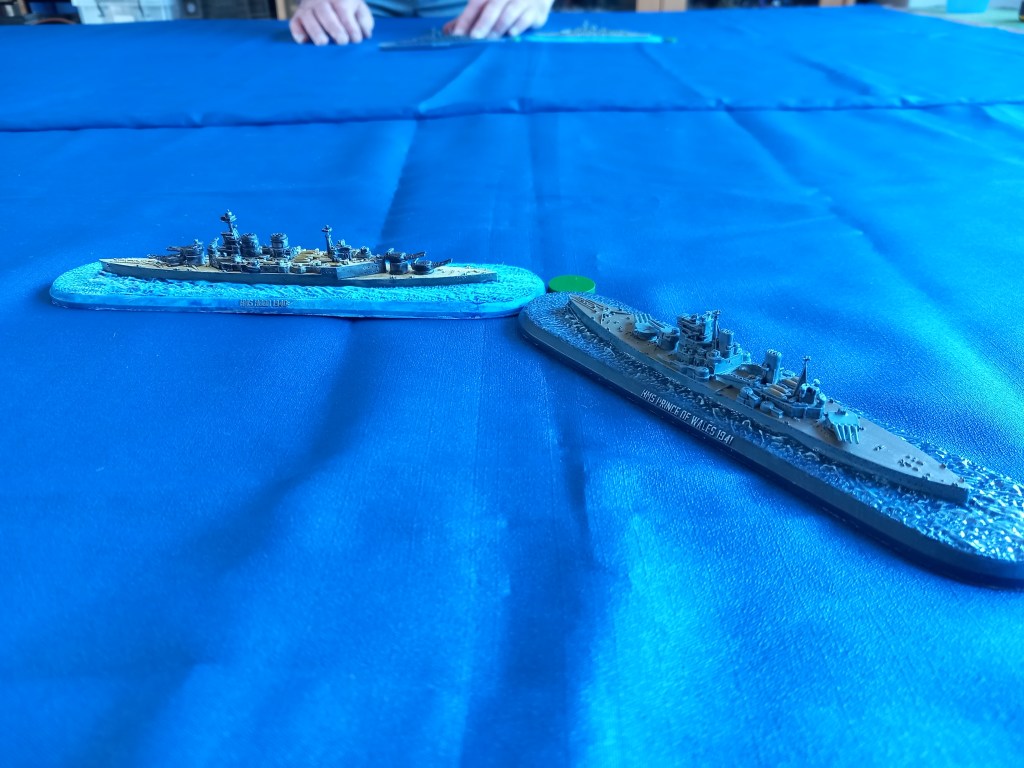
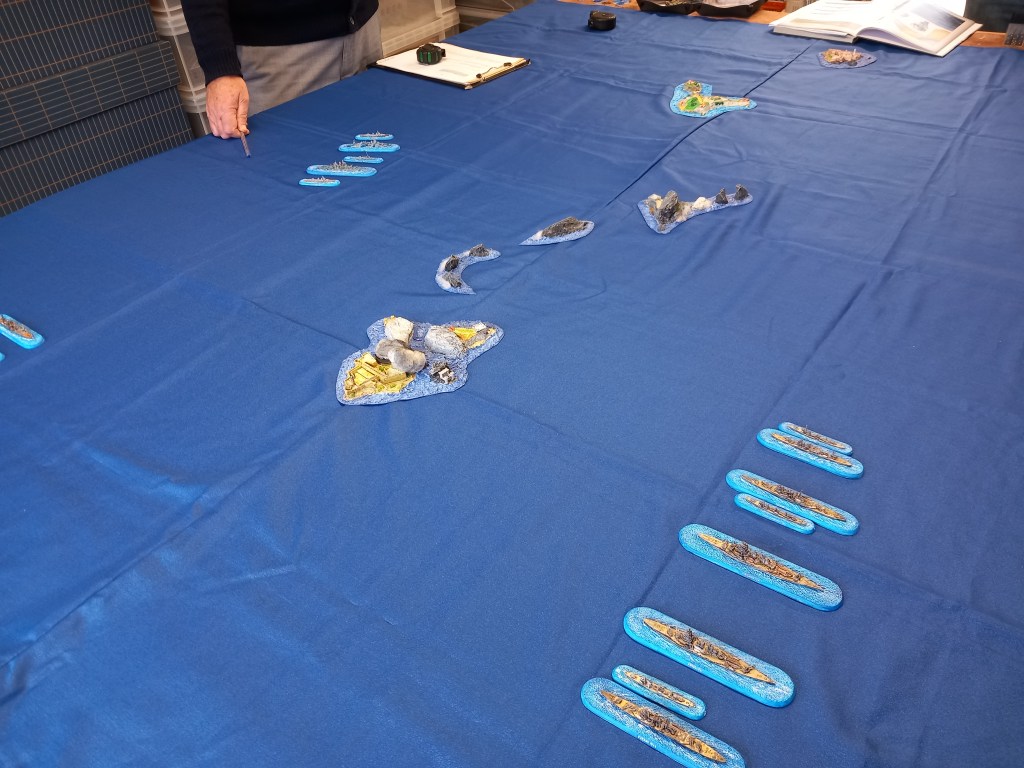
Next up was another Victory at Sea game but not the war in the Pacific this time instead we fought the Battle of the Denmark Straits. Yes two ships per side and that’s it ๐Ÿ˜ฒ

Gerard came up with an intriguing little scenario for us and it really worked. First off we didn’t know what action we were doing until we were allocated sides and then we had restrictions on what we could see, what we knew and what we could do, all reflecting the original action.

Fairly obviously this wasn’t going to last us all day so we had one game in the morning, broke for lunch and then swopped sides for the afternoon session, sometimes it pays to go small.

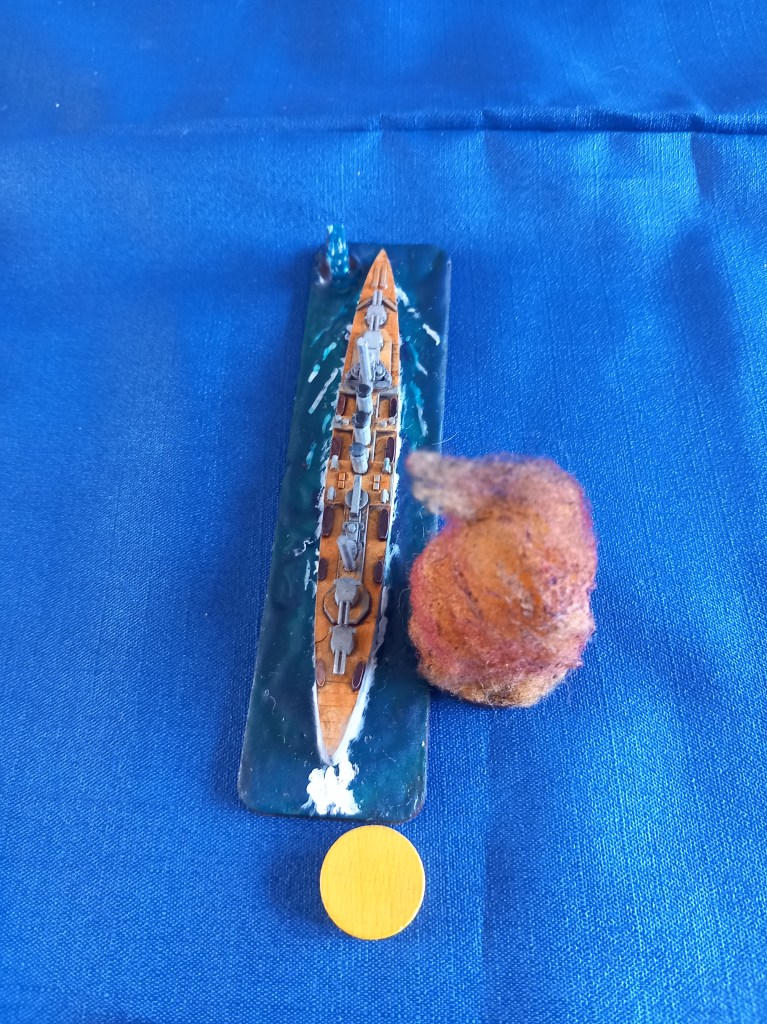
In the first session the Hood was sunk quite early on in a repeat of history and Prince of Wales had its rudder jammed so was reduced to steaming in circles as the Bismarck sailed away with minimal damage leaving behind Prince Eugen at the bottom of the straits.

In our second game the British co-ordinated their efforts a lot better and zeroed in on the Bismarck ultimately crippling it to such an extent that all it could do was sail back up the straits into the arms of patrolling destroyers. The Prince Eugen was ultimately sunk.

This second game was a far more hard fought fight and at the end both Hood and Prince of Wales had serious damage but were still in the fight. A really good game and different.

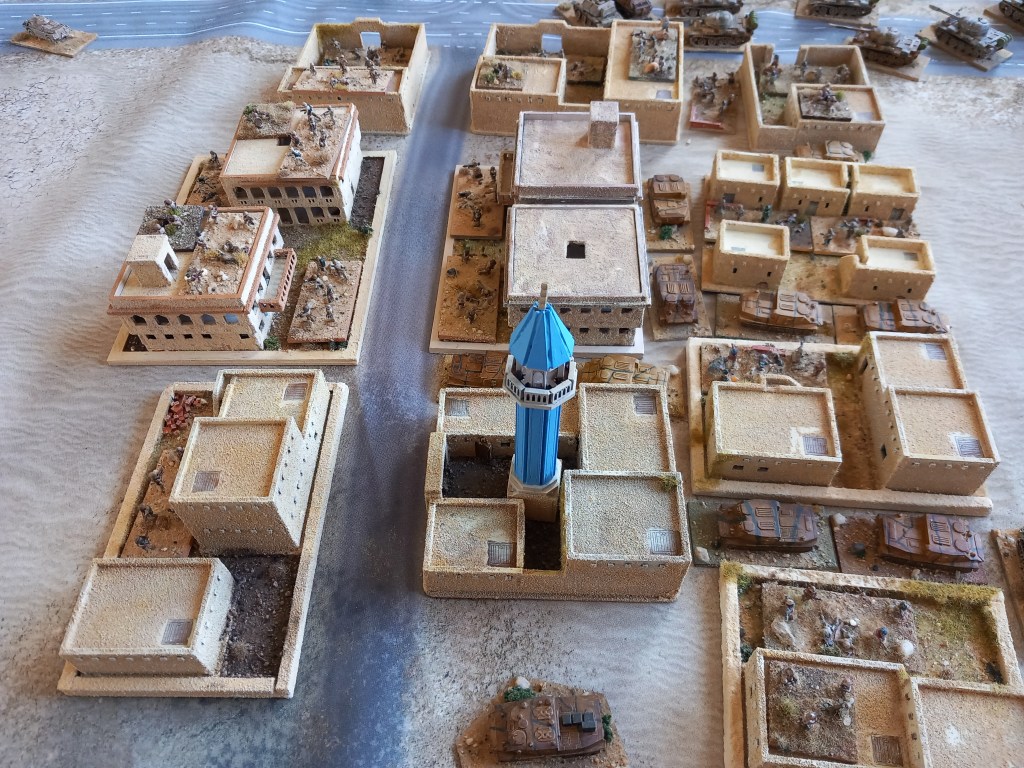
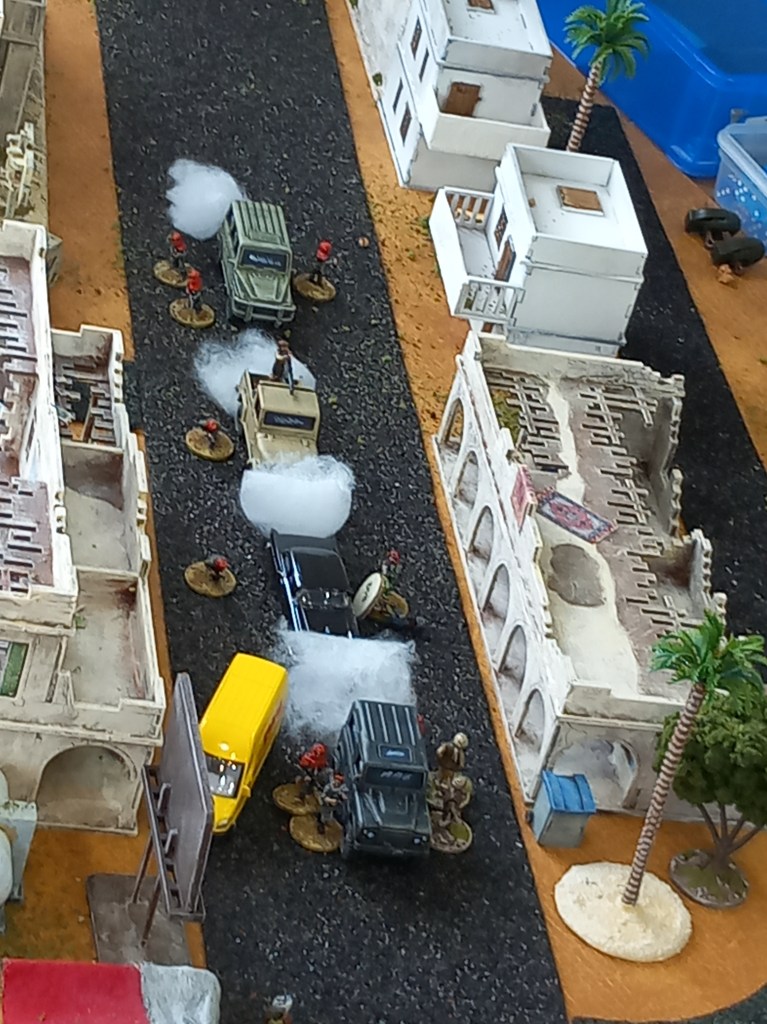
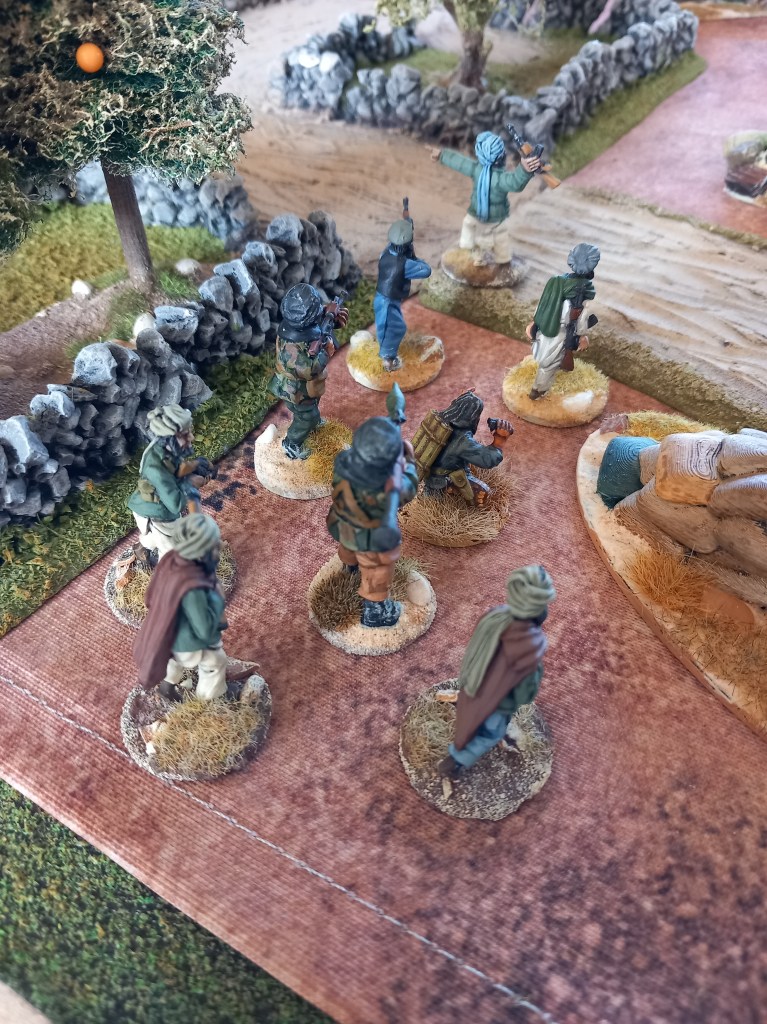
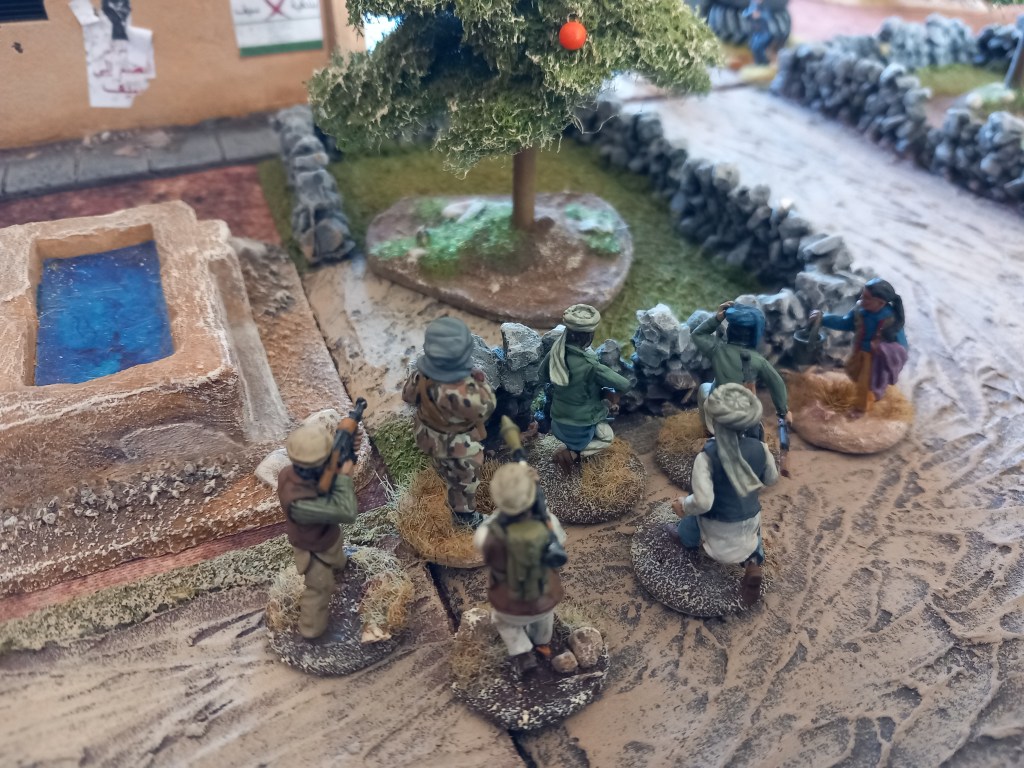
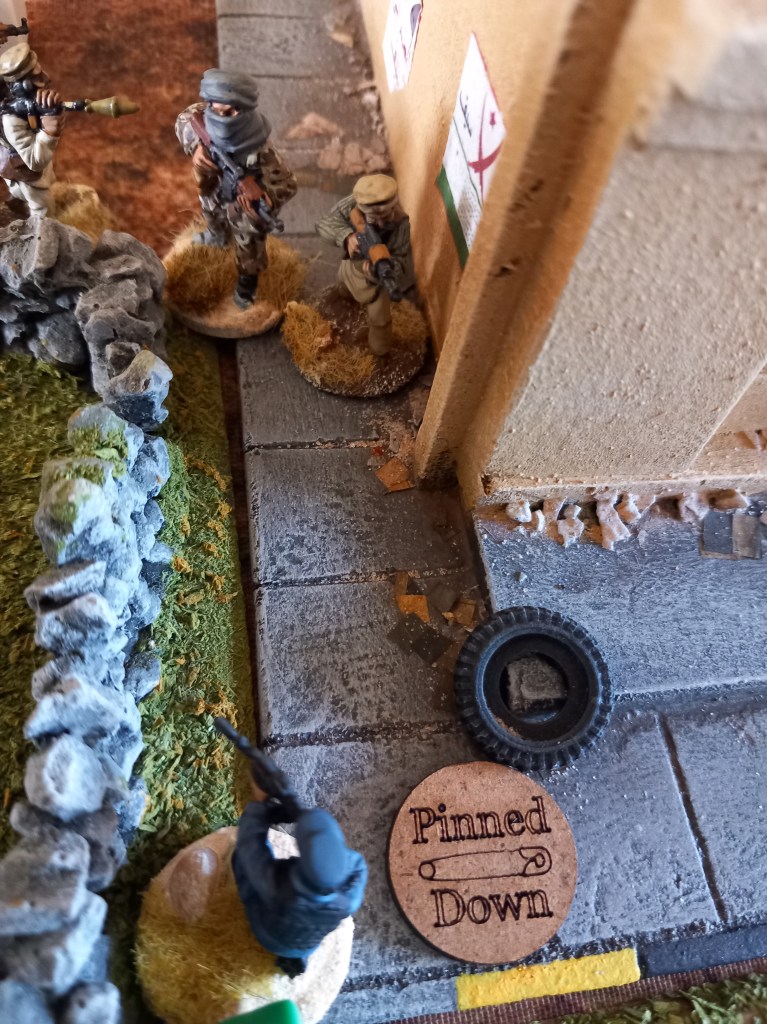
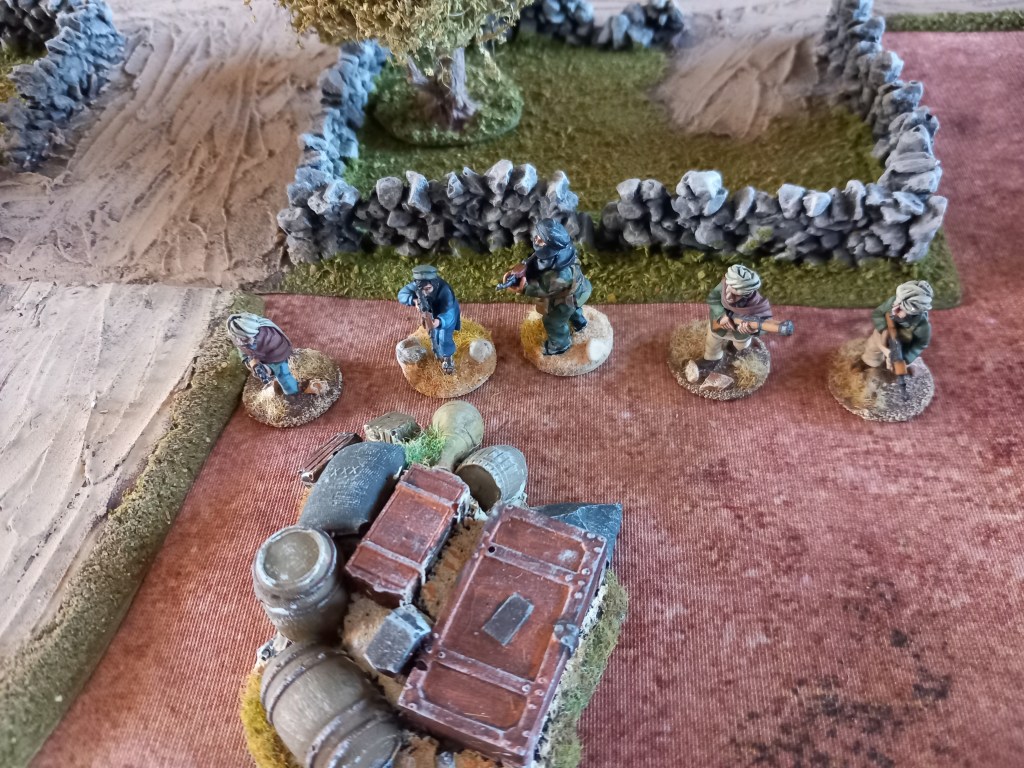
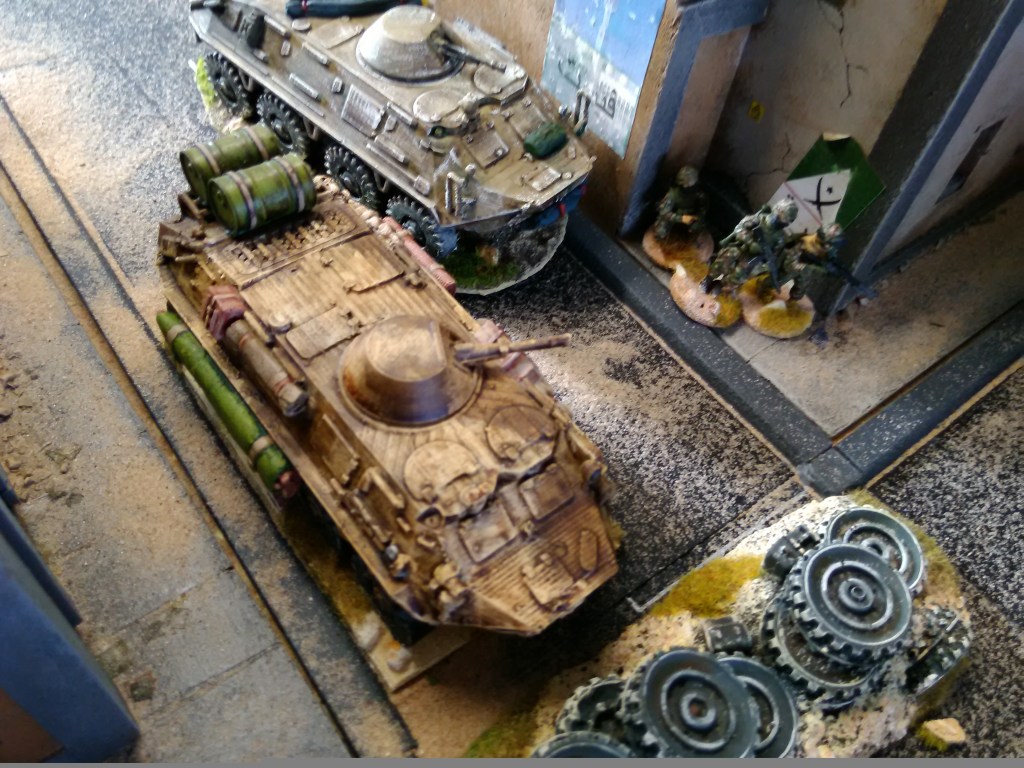
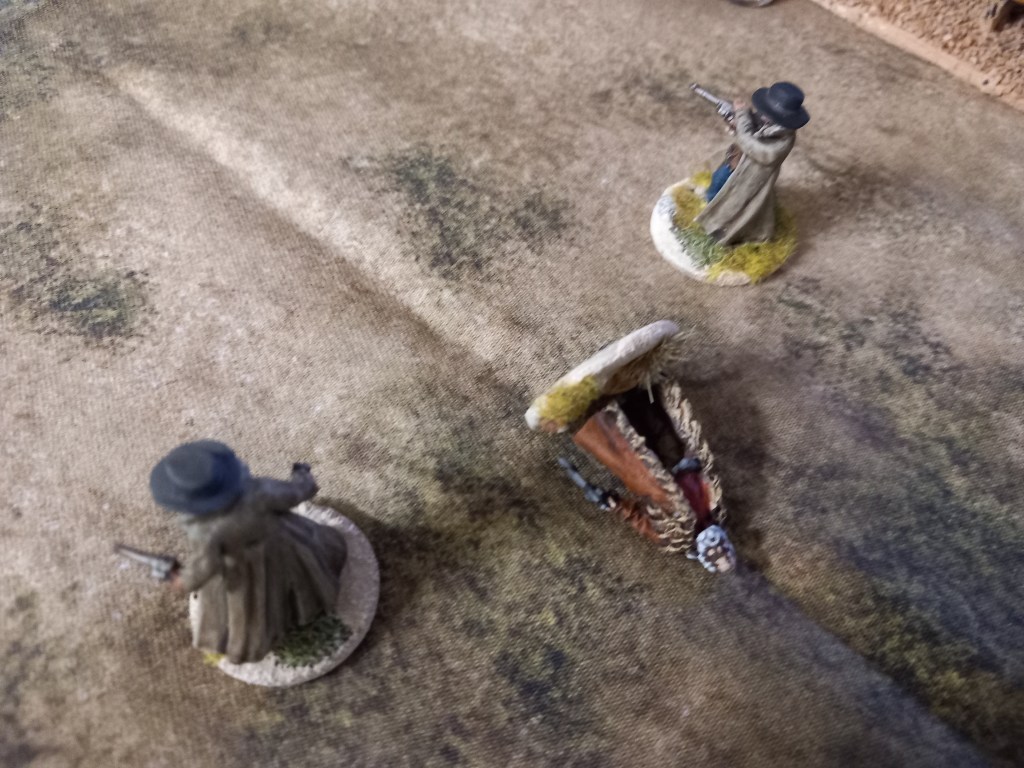
Our third game of the month was a welcome return to the skirmish genre, this time we dusted off the Soviet Afghan collection and put together a mujahedeen attack on police and army units on the edge of a town.

The police started the game on duty outside the station, across the road was a government official and his bodyguards, inside the police station an army unit was resting prior to going out on patrol. The mujahedeen started at randomly generated points around the table edges.

One squad of Mujahedeen advance through an orchard.

A second squad nears the edge of the police station, local boy offers water fresh from the well. Have they been spotted?

Shots fired!

No need for cover now.

The army opens up from the police station – this is getting serious now!

This guy tried to three times to blow open the doors to the government building. Literally couldn’t hit a barn door ๐Ÿ˜‚๐Ÿคฃ

OK this isn’t looking too good. Time to change sides?

Government official makes a quick exit.

“He got away!” Mujahedeen withdraw with no casualties. Afghan police 3 x KIA, 1 captured. Afghan army 1 x KIA. It was nice to get one of the many skirmish collections out but truth is some of them need to be sold on now, just taking up too much space.

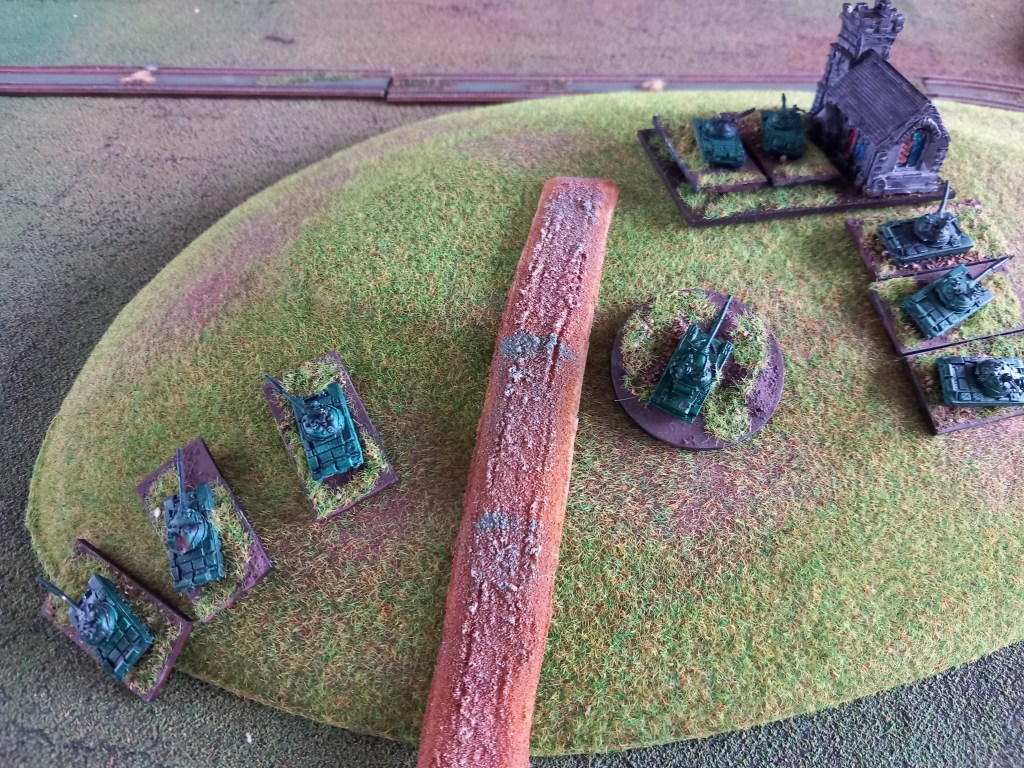
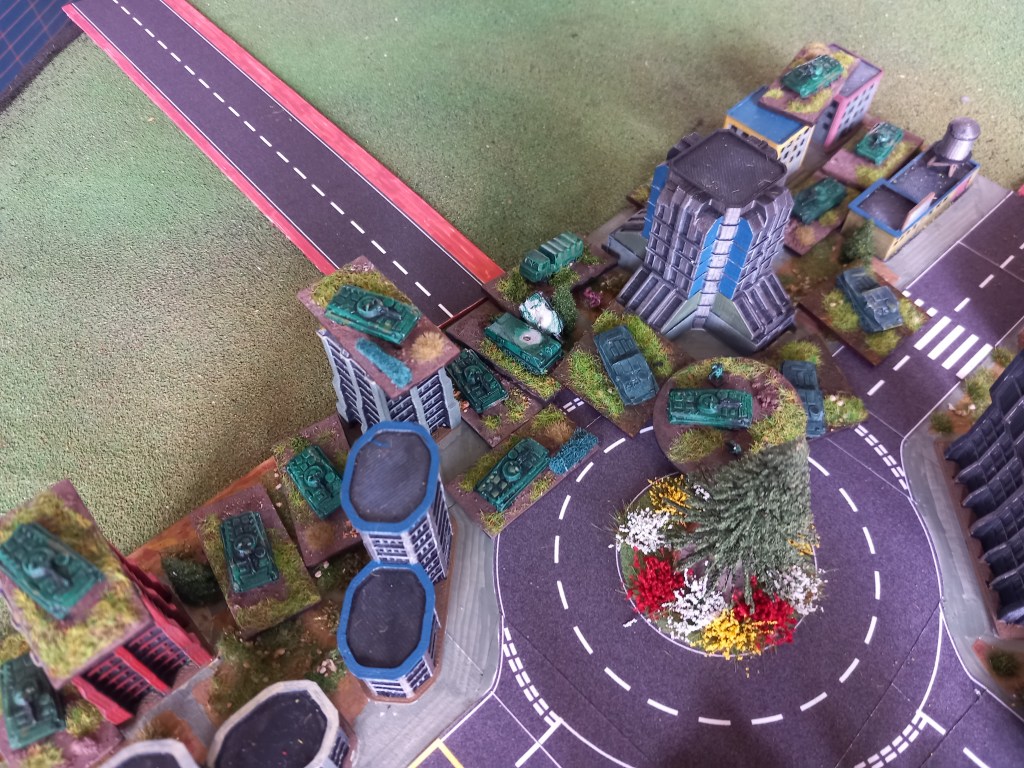
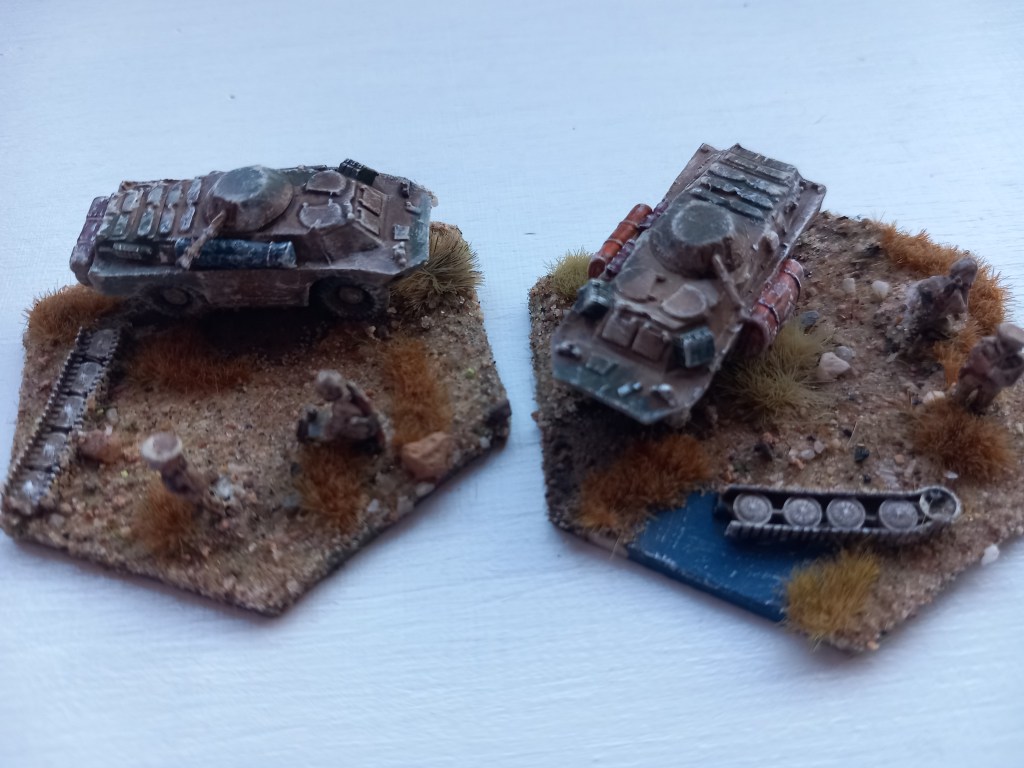
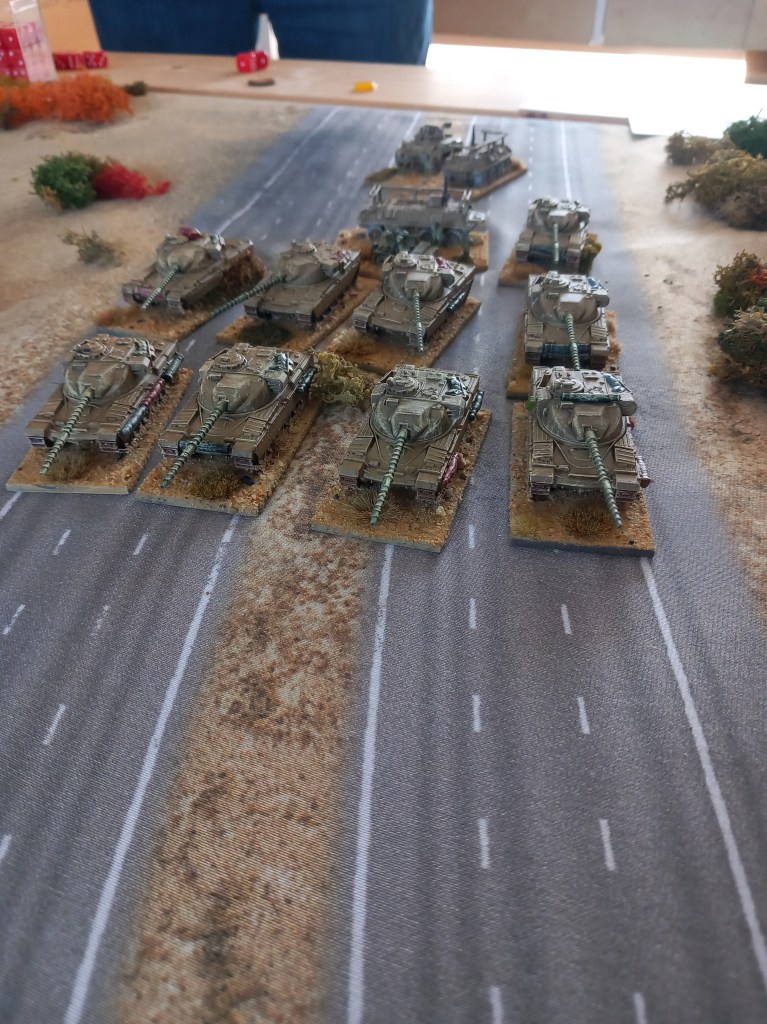
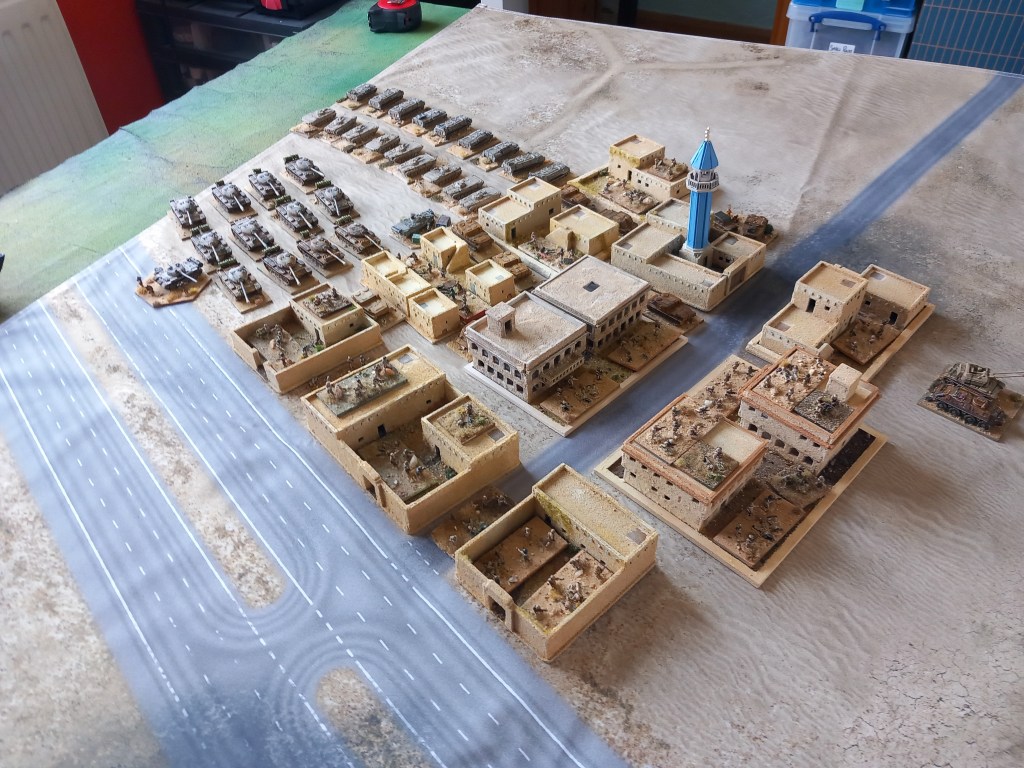
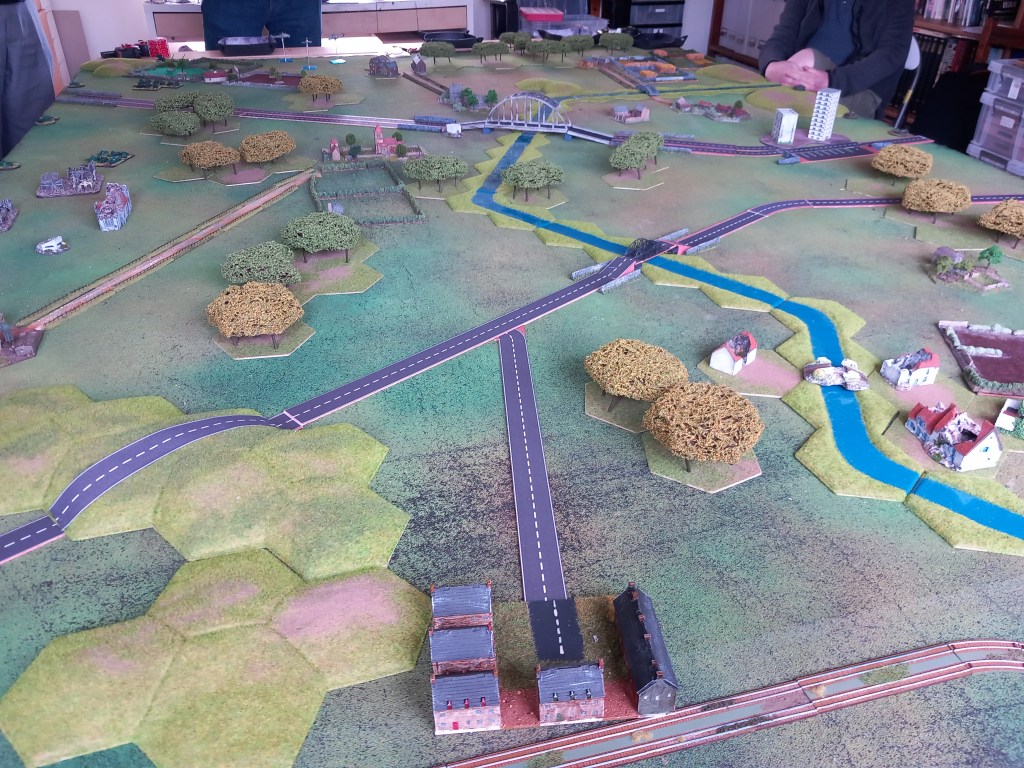
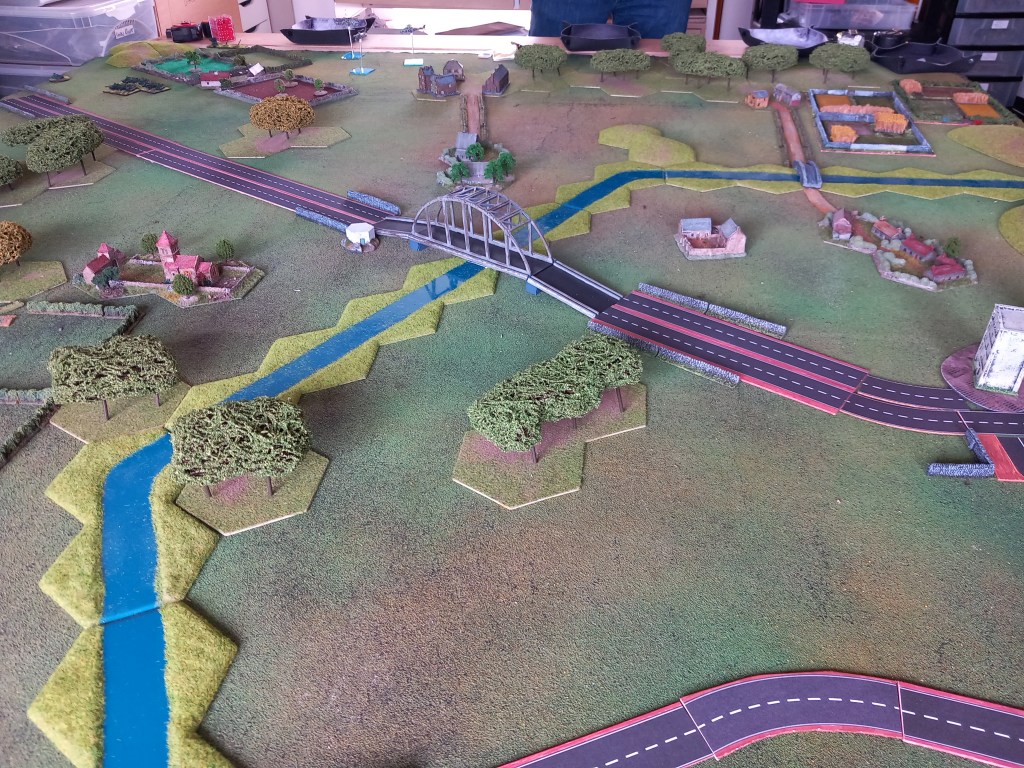
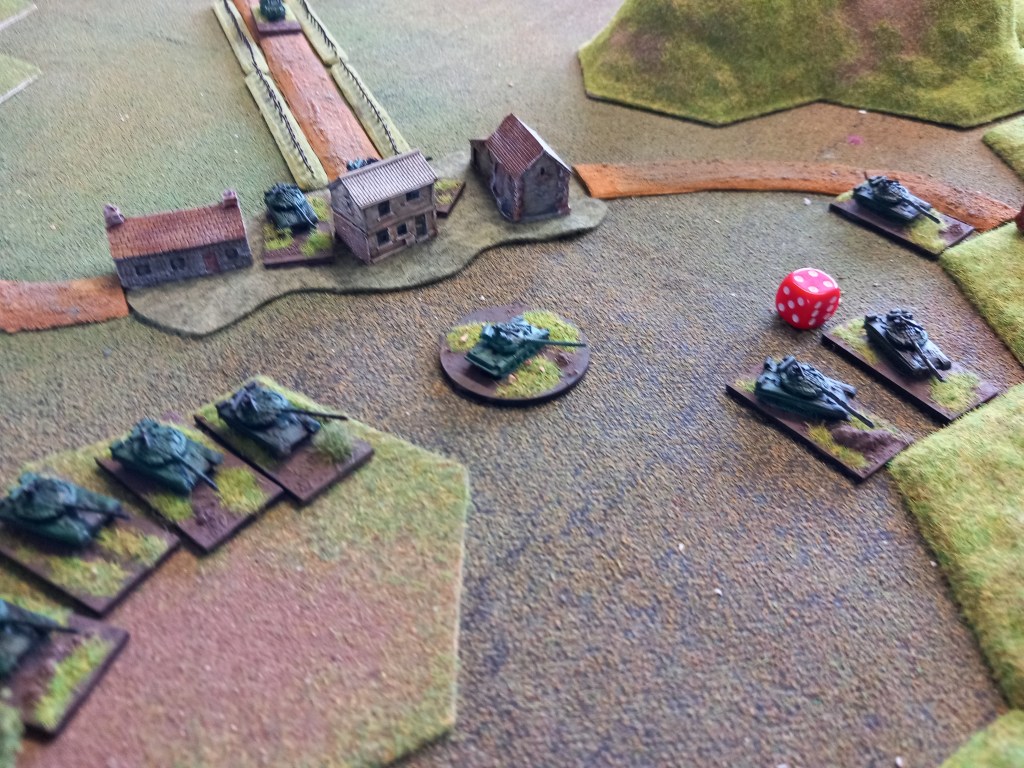
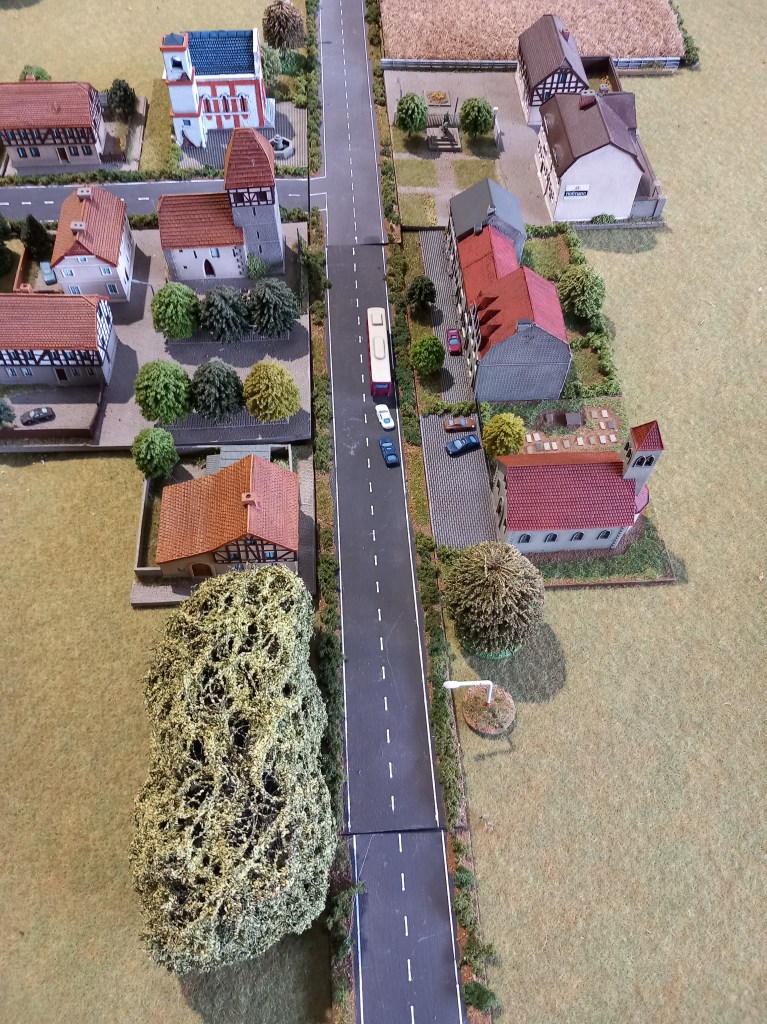
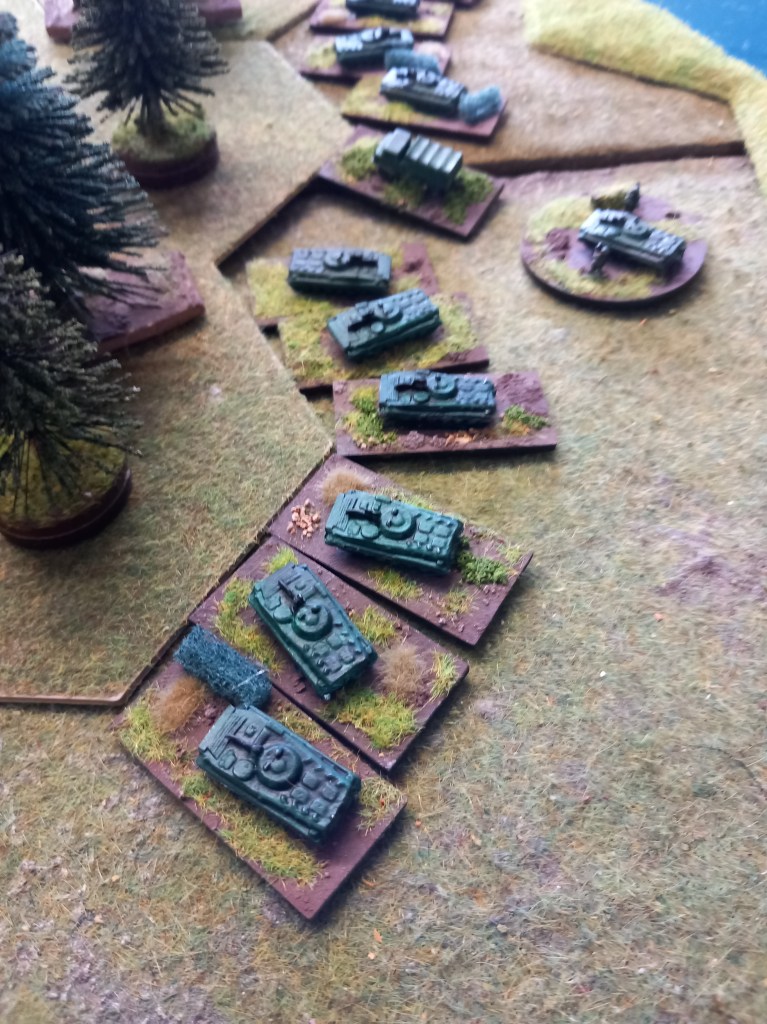
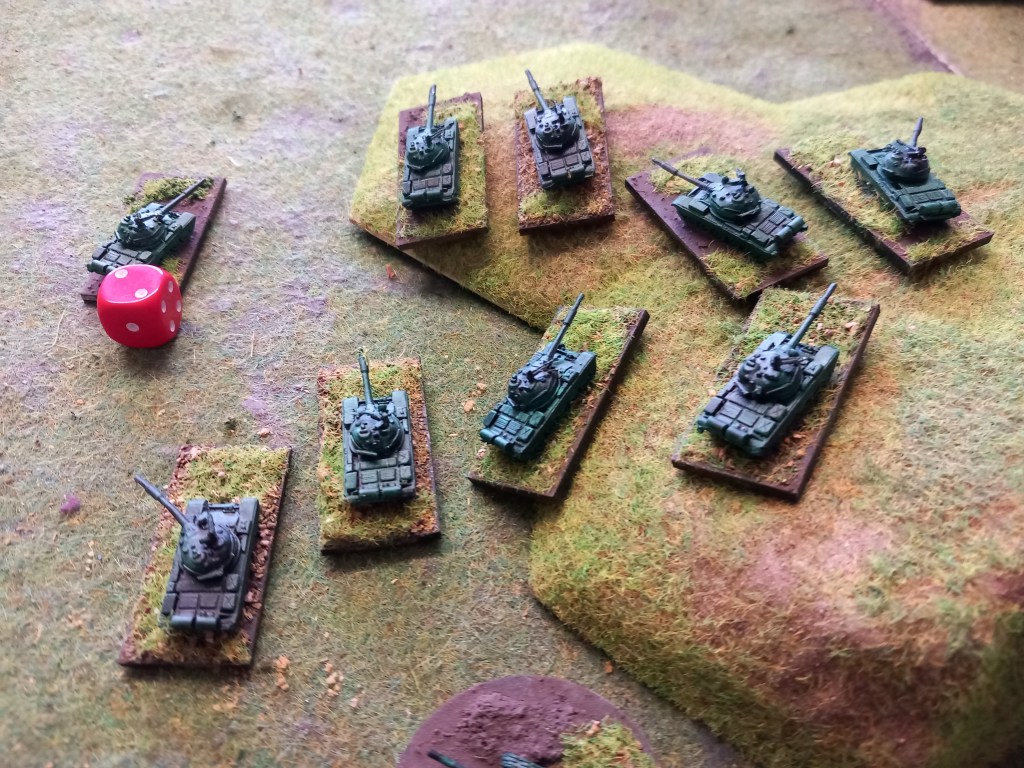
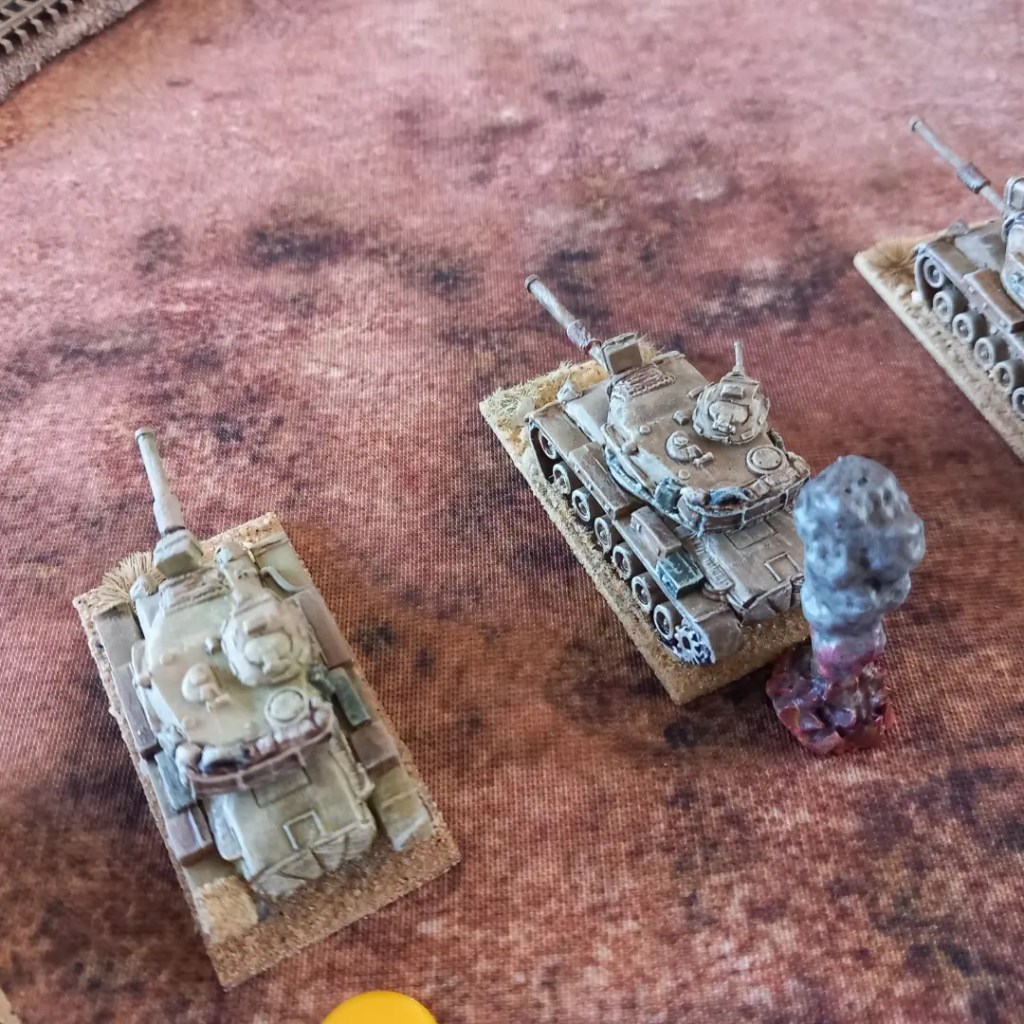
Next was another in our relatively new 6mm Cold War project this time giving the newly painted BAOR their first outing.

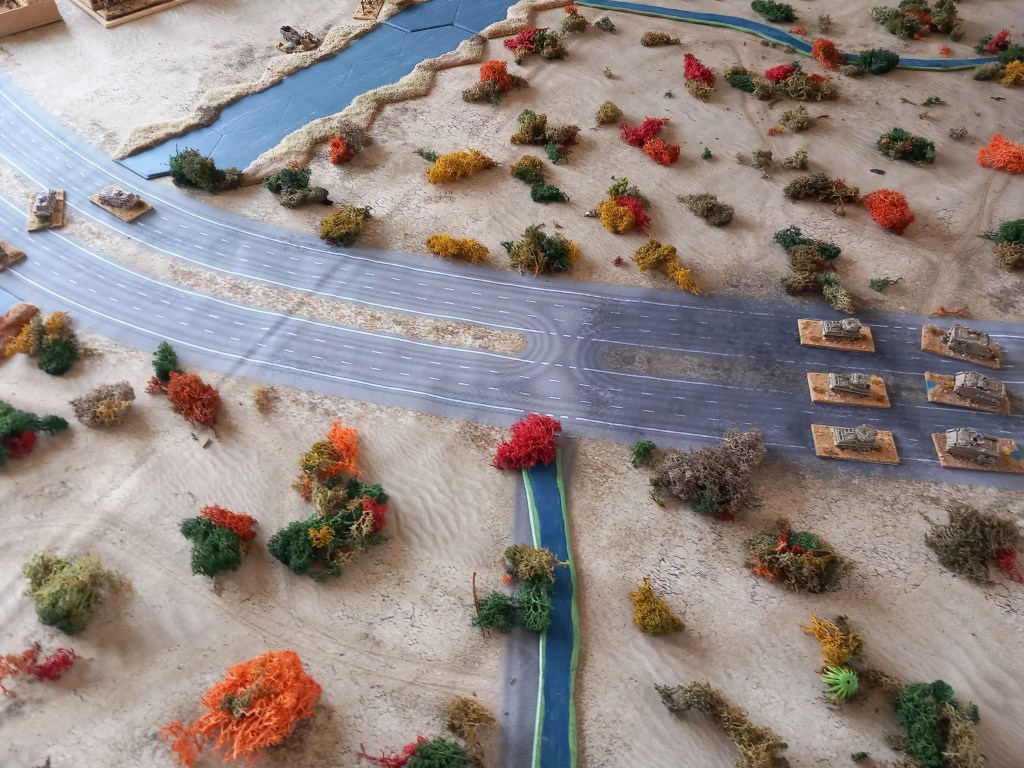
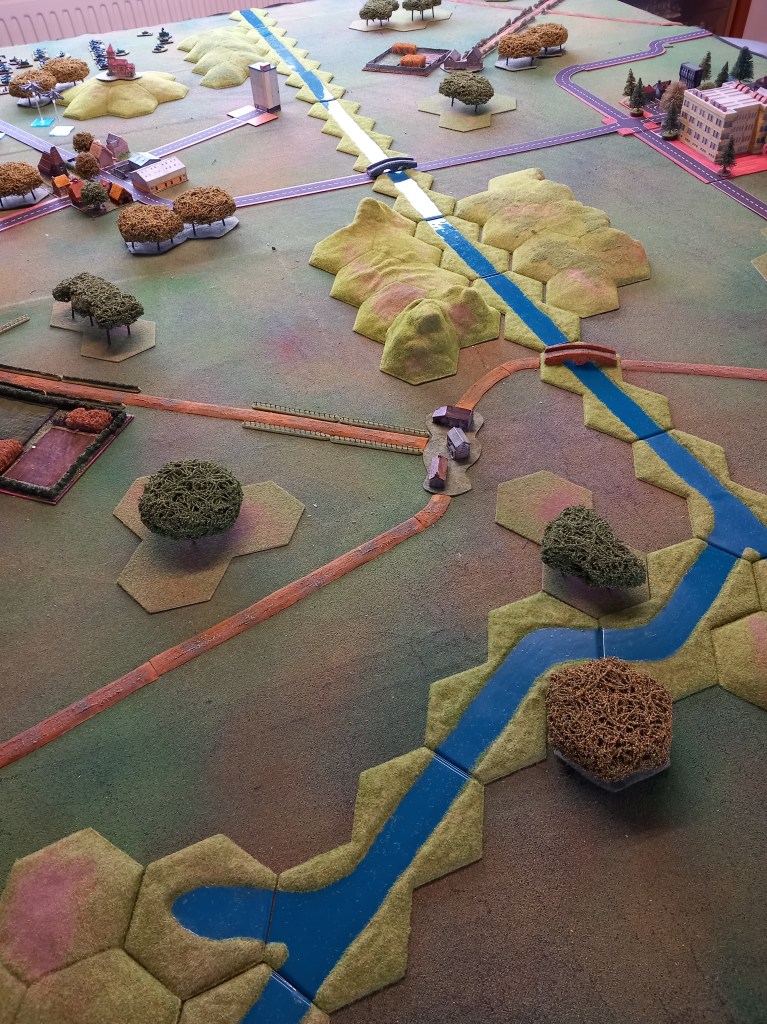
Like our March game this was another riff on the narrative in Jim Storr’s, ‘Battlegroup’. This time the 7th Armoured Brigade has been rushed forward from the divisional reserve to stop the Soviet 7th Guards Tank Division crossing the river Innerste.

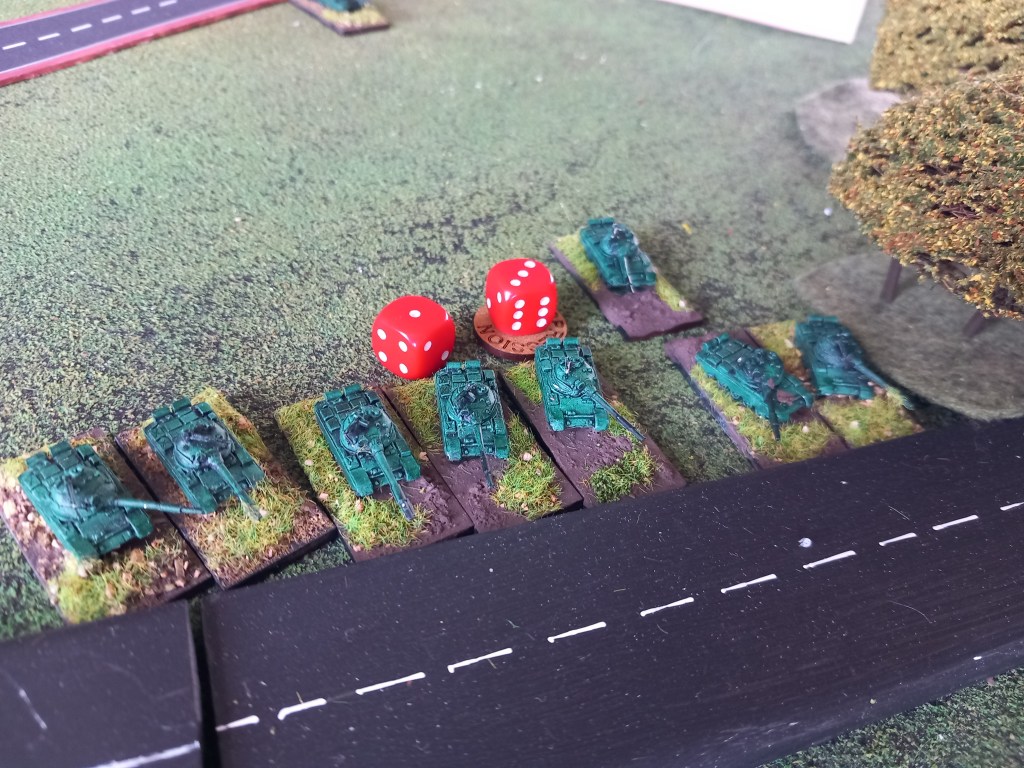
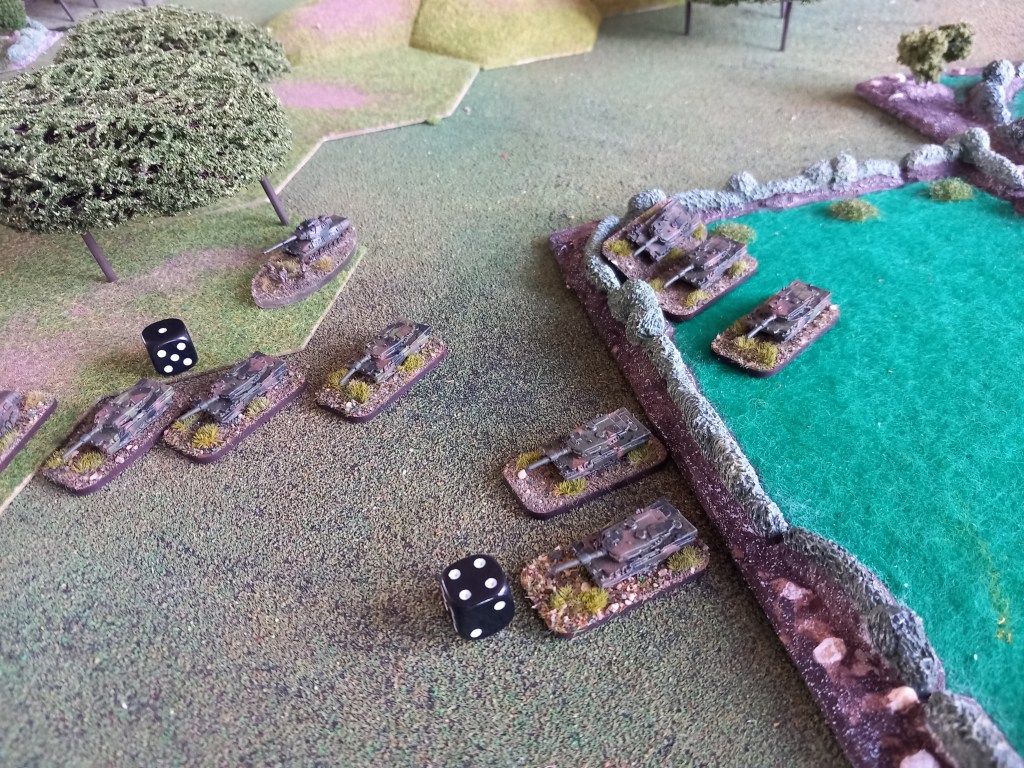
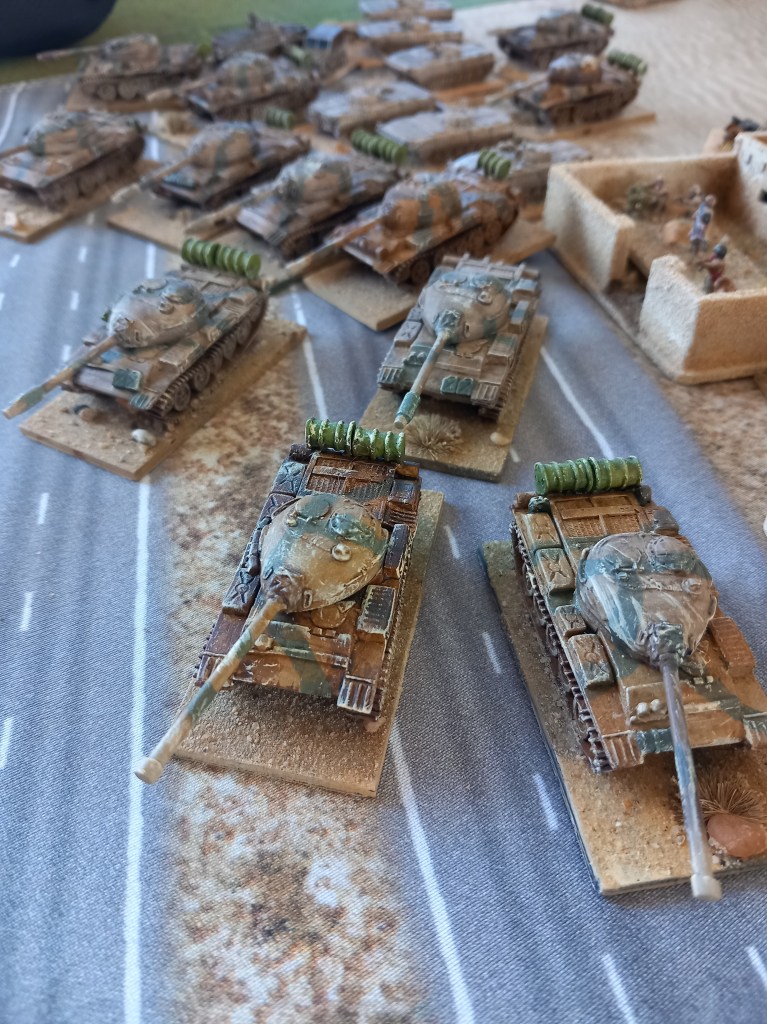
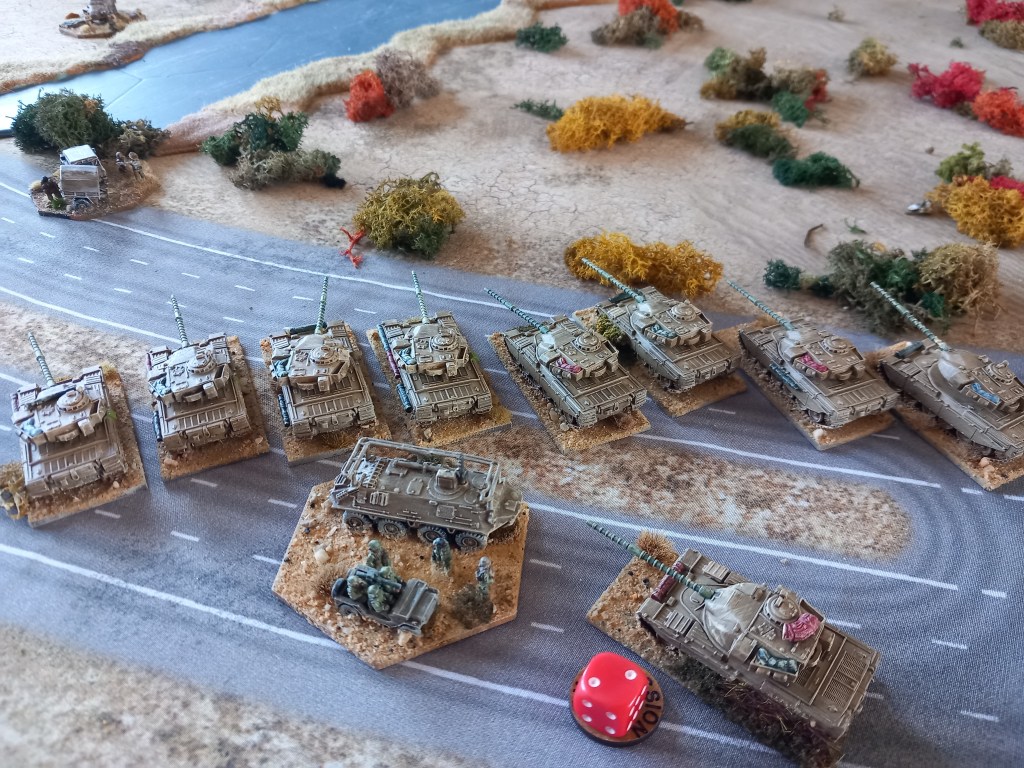
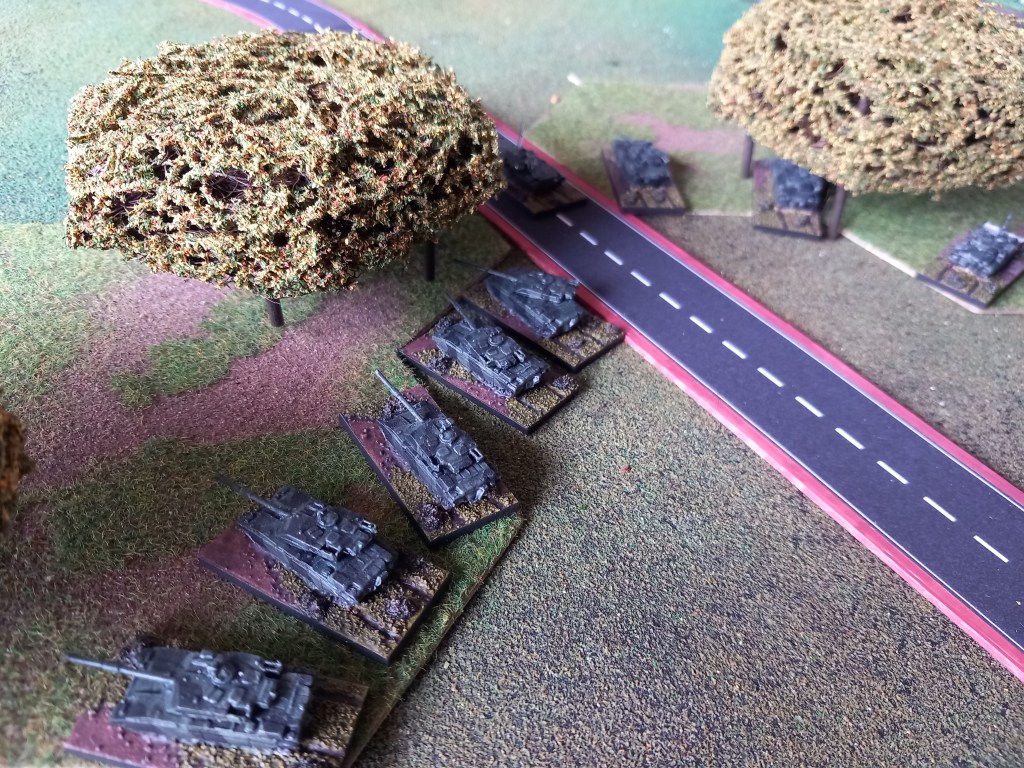
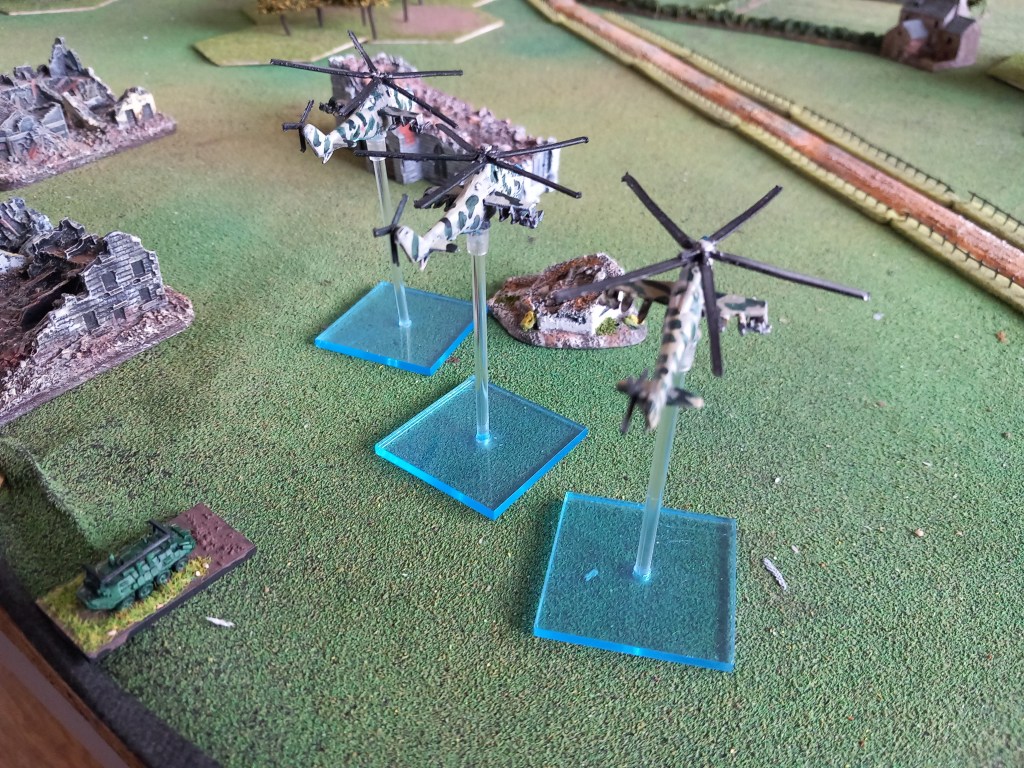
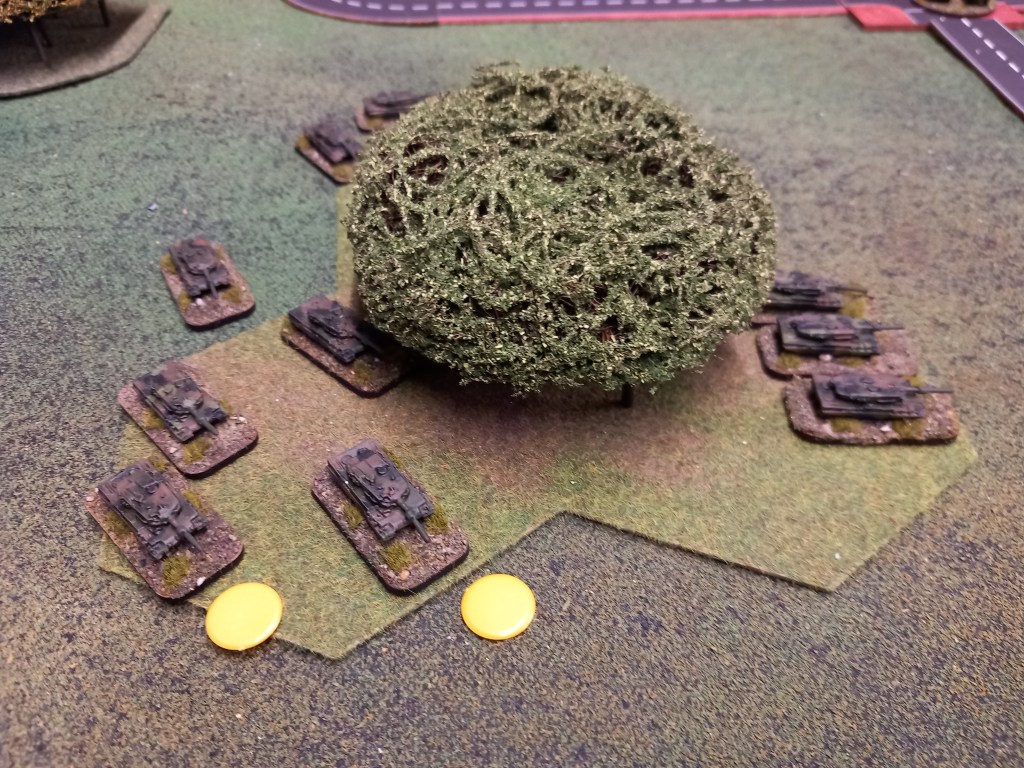
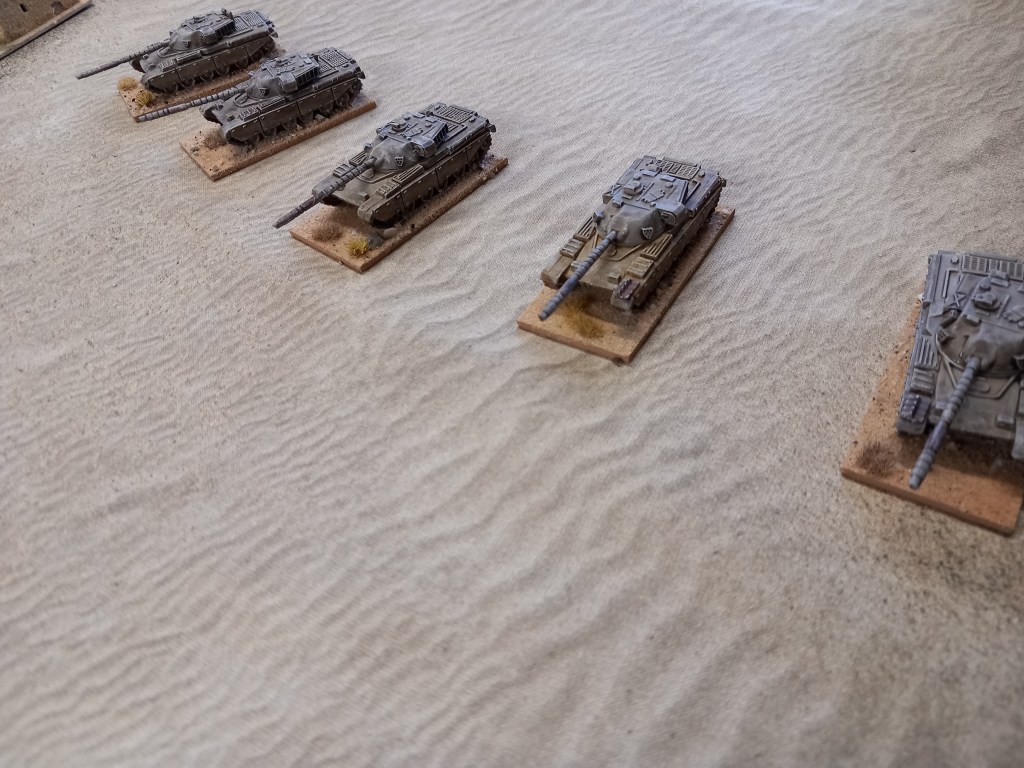
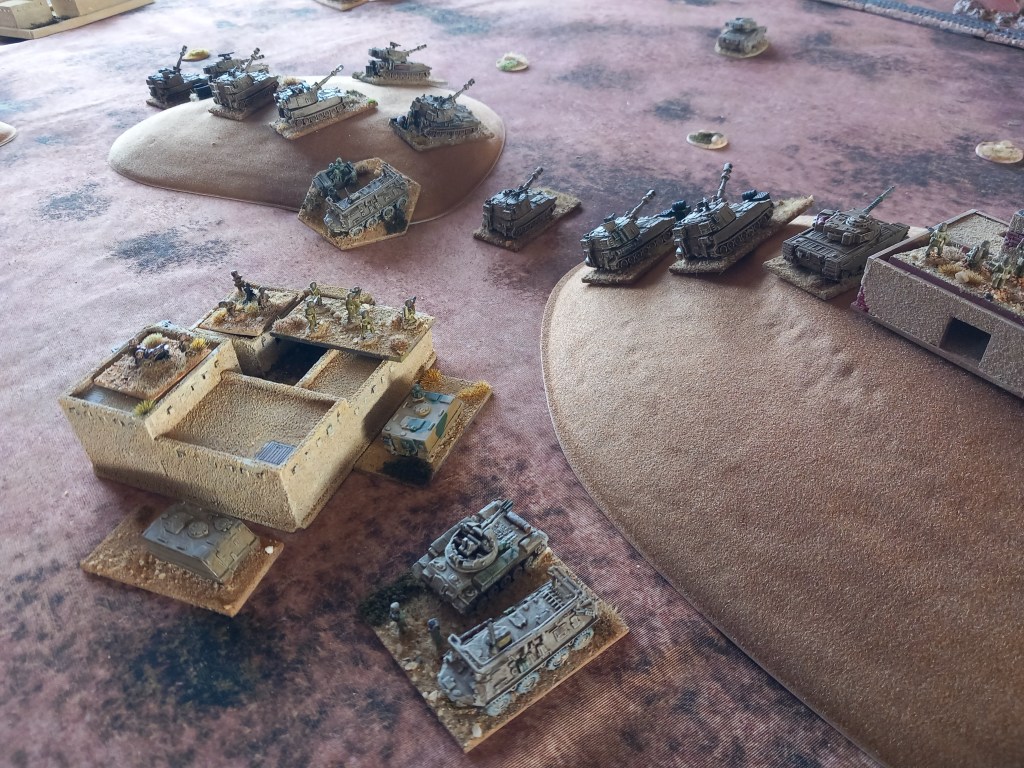
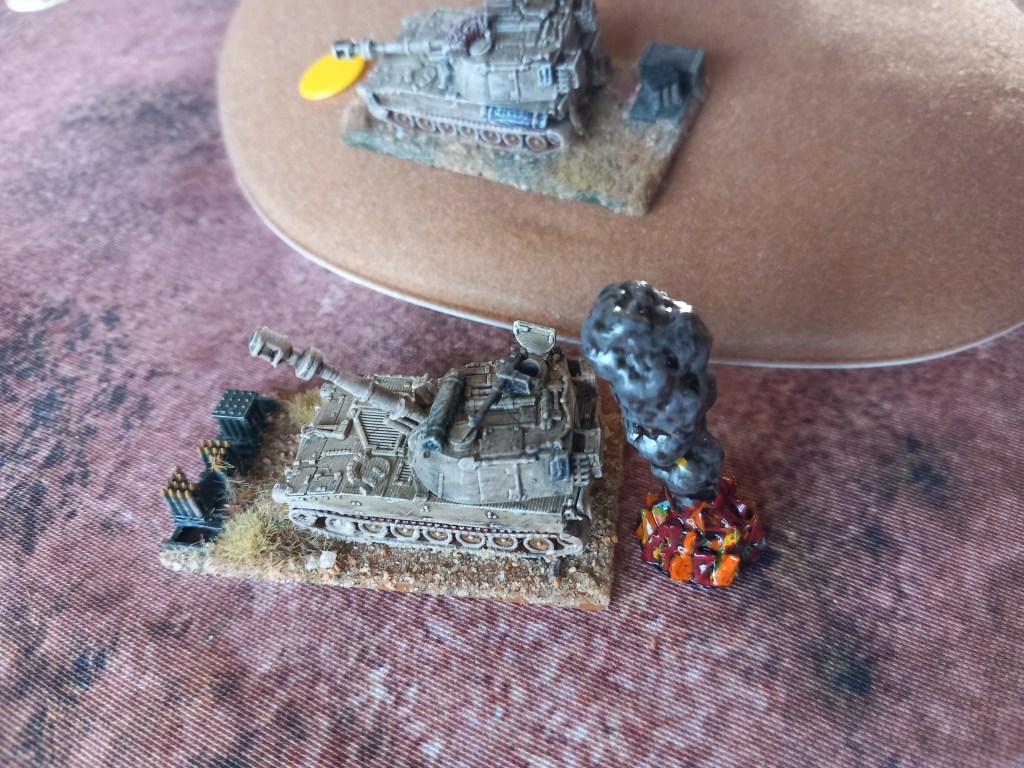
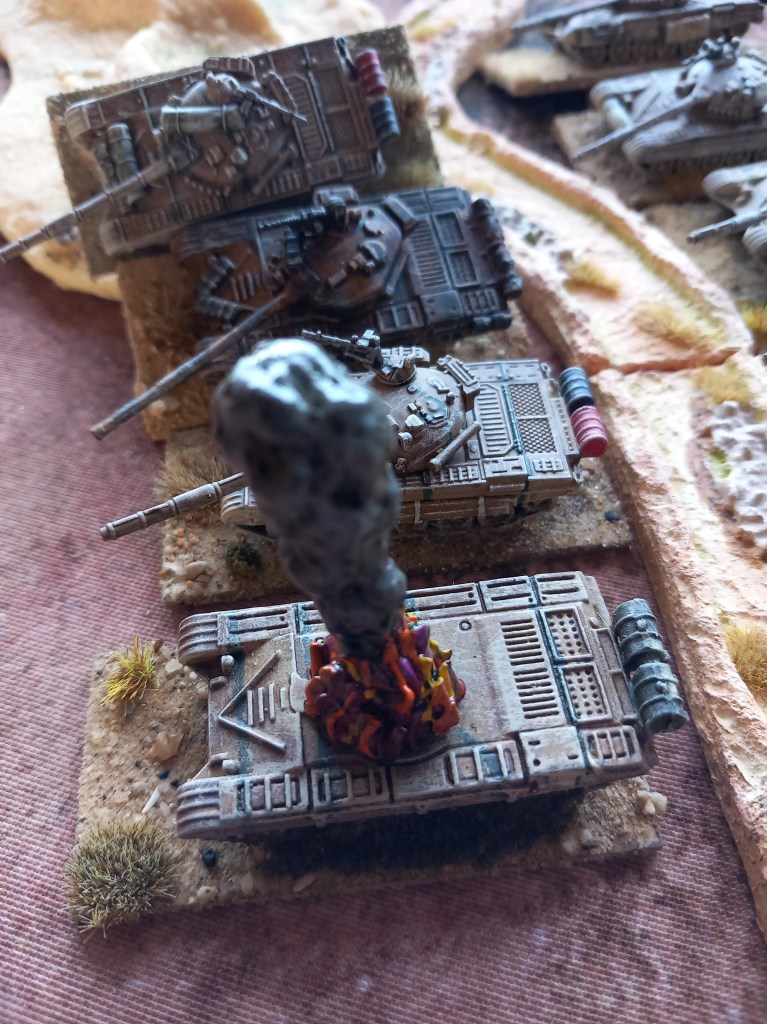
The game was essentially an encounter game with battalions deploying to the table based on successful command rolls. The BAOR deployed one Chieftain brigade and one Challenger brigade along with a mechanised infantry brigade and some SP artillery. The Soviets deployed three tank battalions, one T80 and two T62, one of which was under strength, plus a trio of HINDs. Both sides had off table artillery.

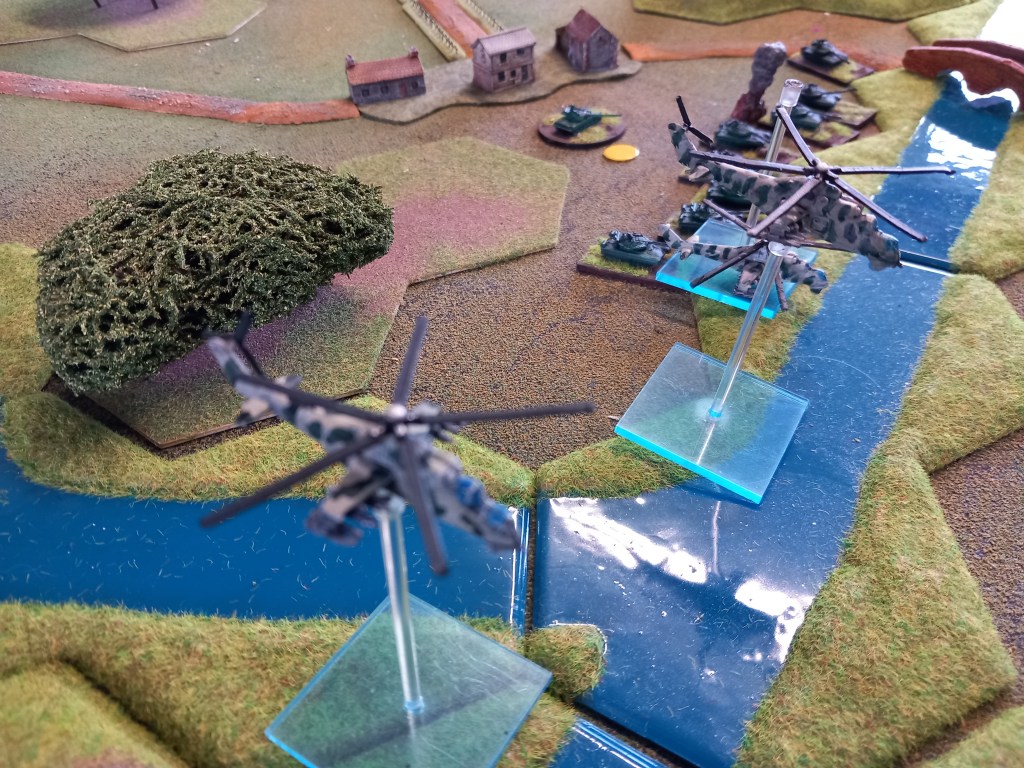
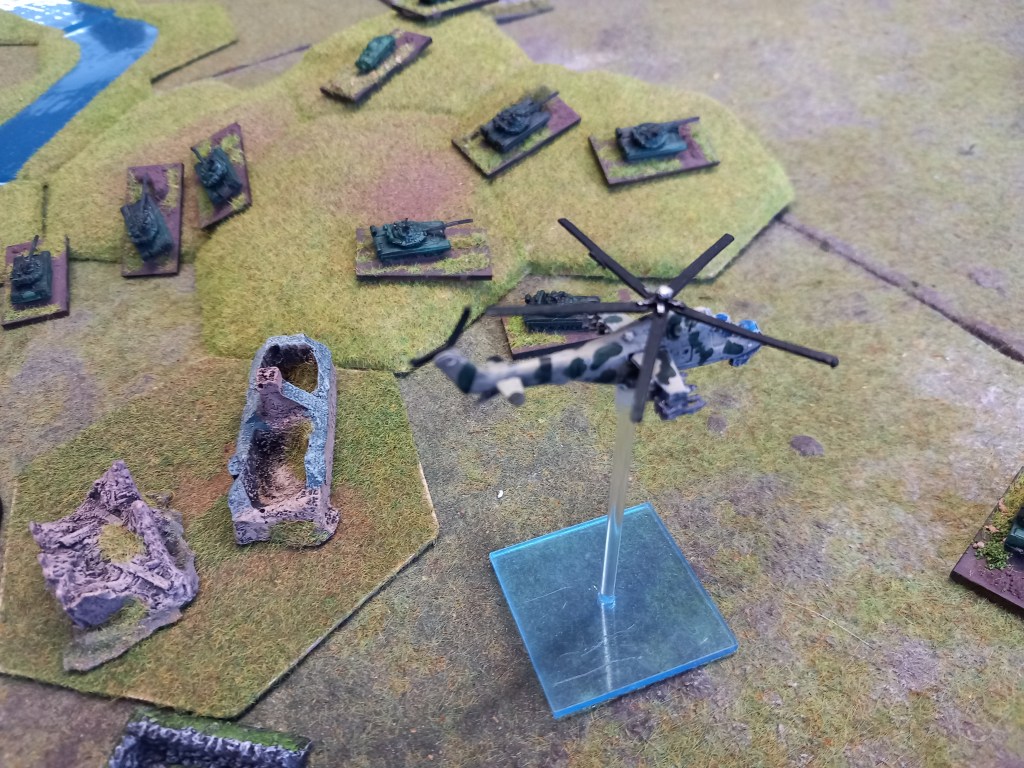
The HINDs deployed early and, as usual, caused some heart stopping moments for the Brits – these damm things really are difficult to deal with.

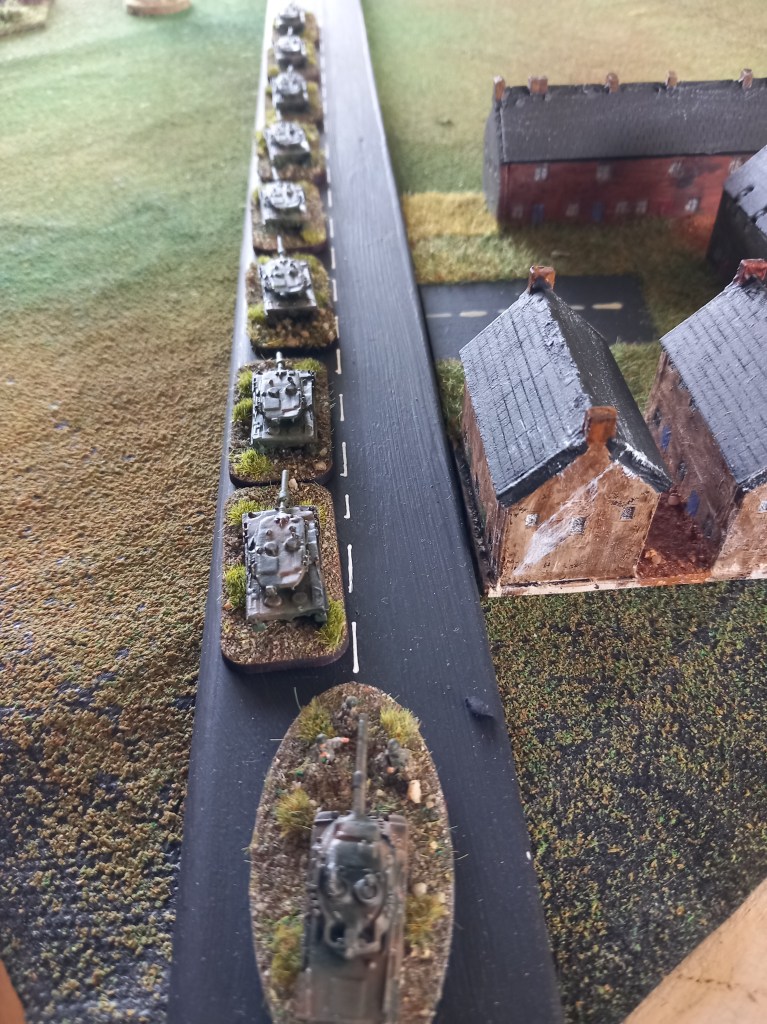
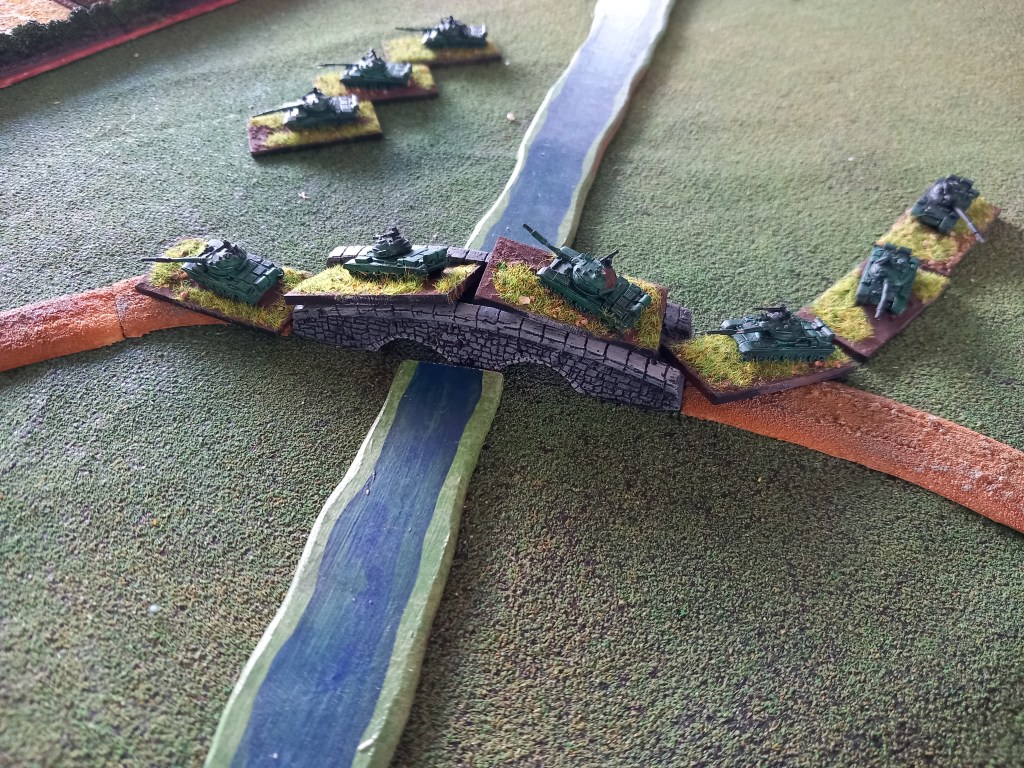
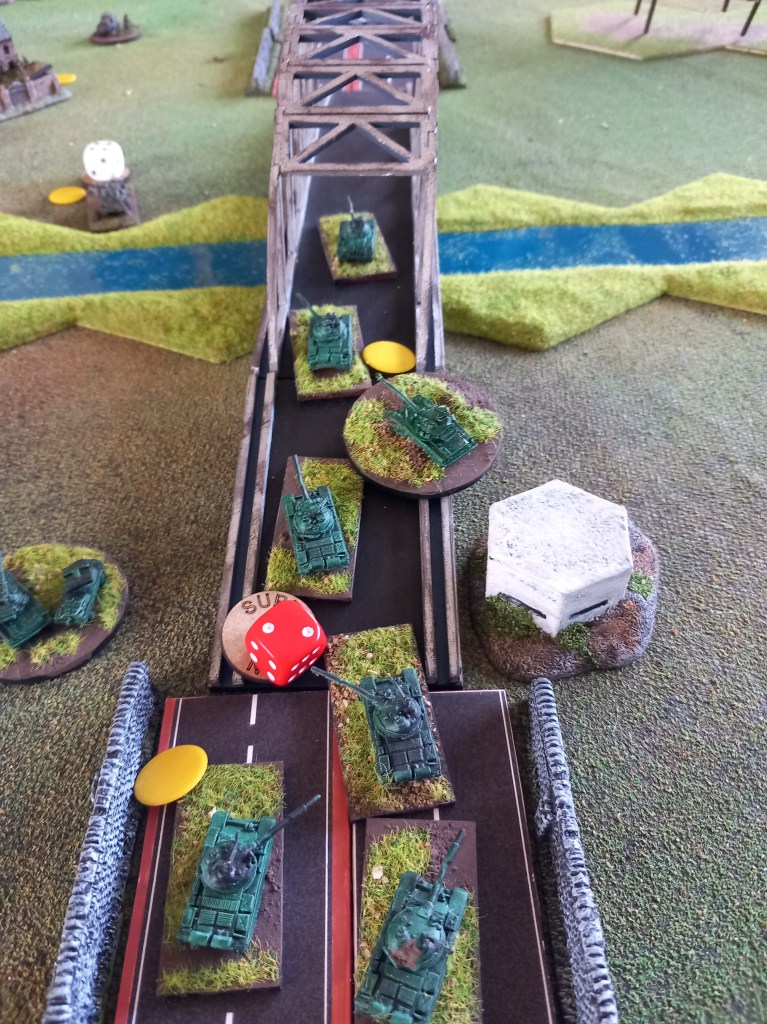
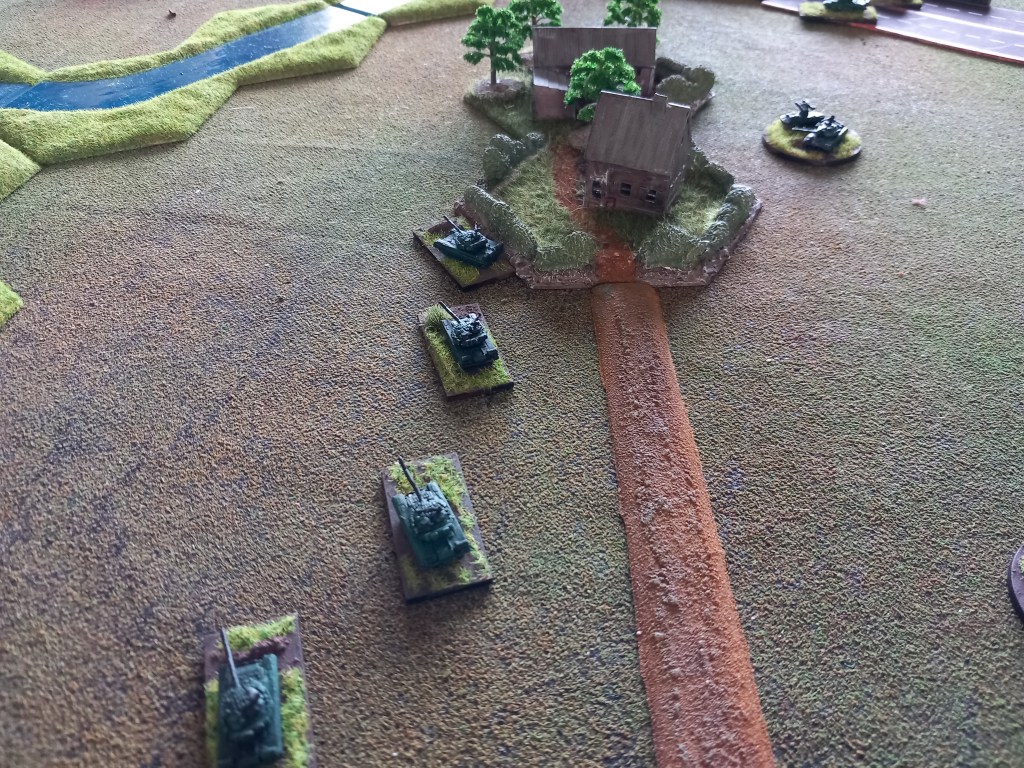
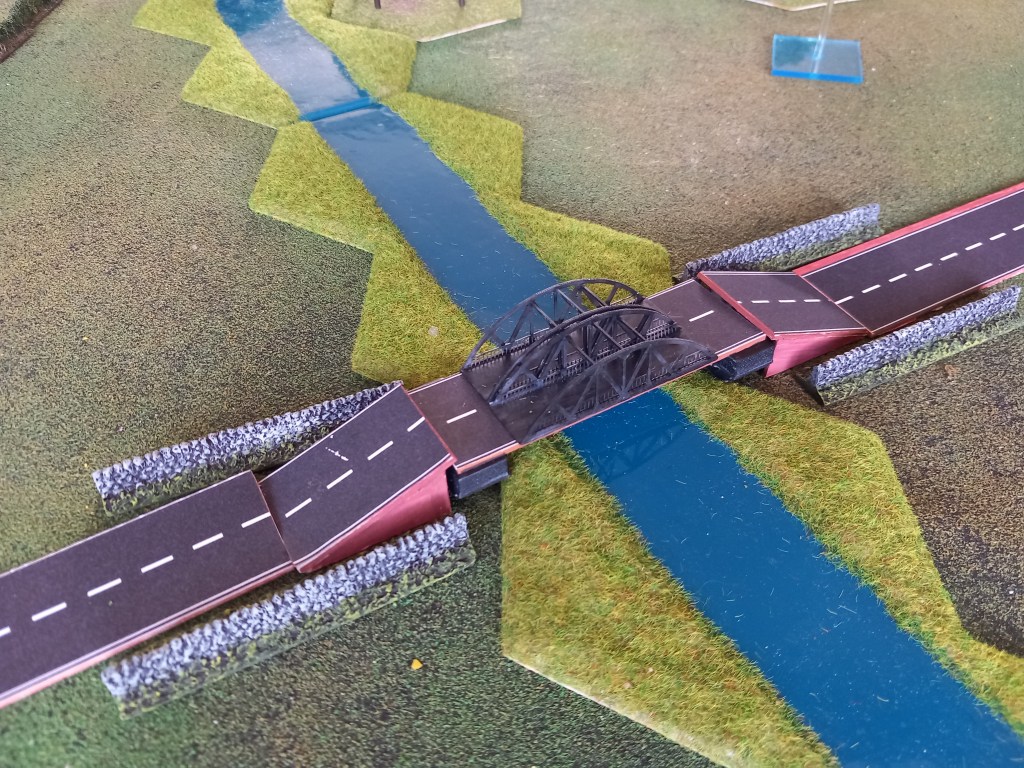
As the Brits obligingly sat back the Soviets made a dash for the main suspension bridge.

Some decent shooting from infantry LAWs stops the Soviets on the bridge.

British infantry occupy villages on their side of the river.

Soviet advance continues.

The second bridge, ripe and ready for the taking.

Ultimately the Soviets seized both bridges and the British failed their breakpoint morale role so it was on to the Wesser for the Soviets.

On reflection this wasn’t one of our better games. The British overall commander was getting to know his army and so played an overly cautious game which manifested itself in some curious deployment decisions.

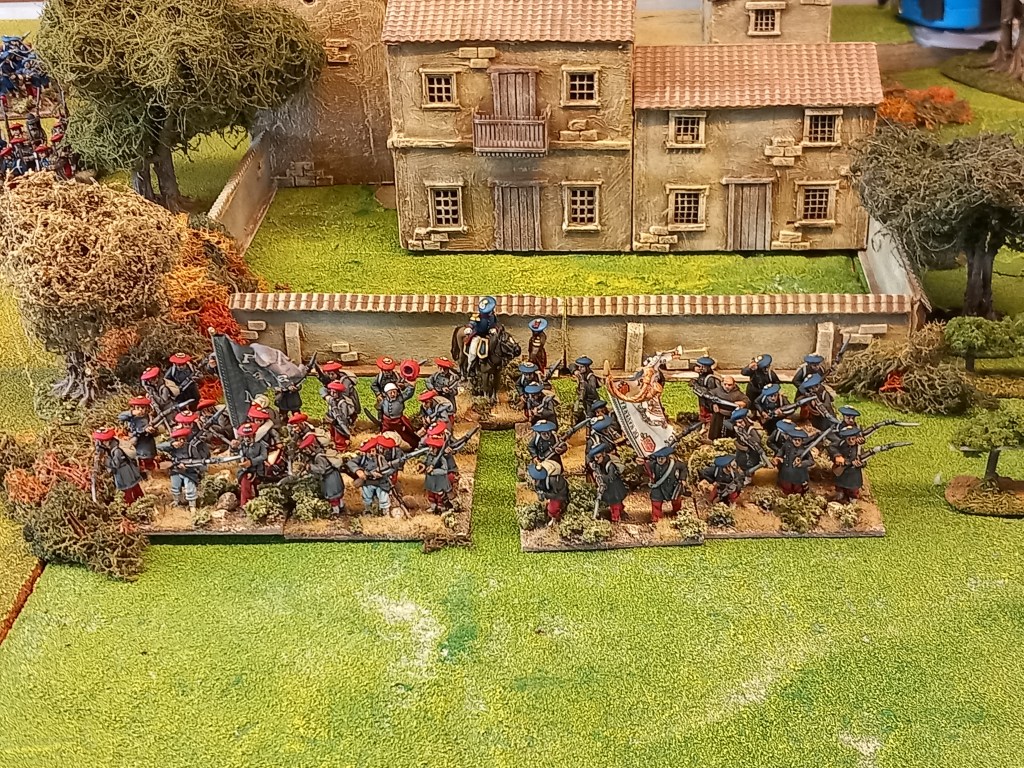
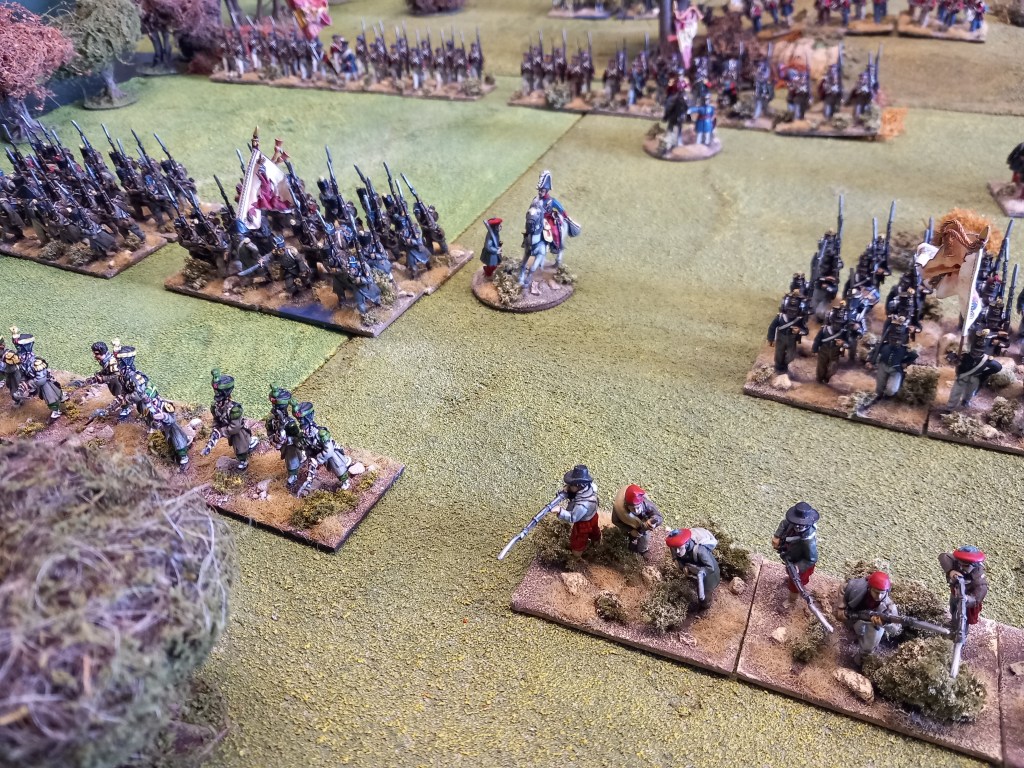
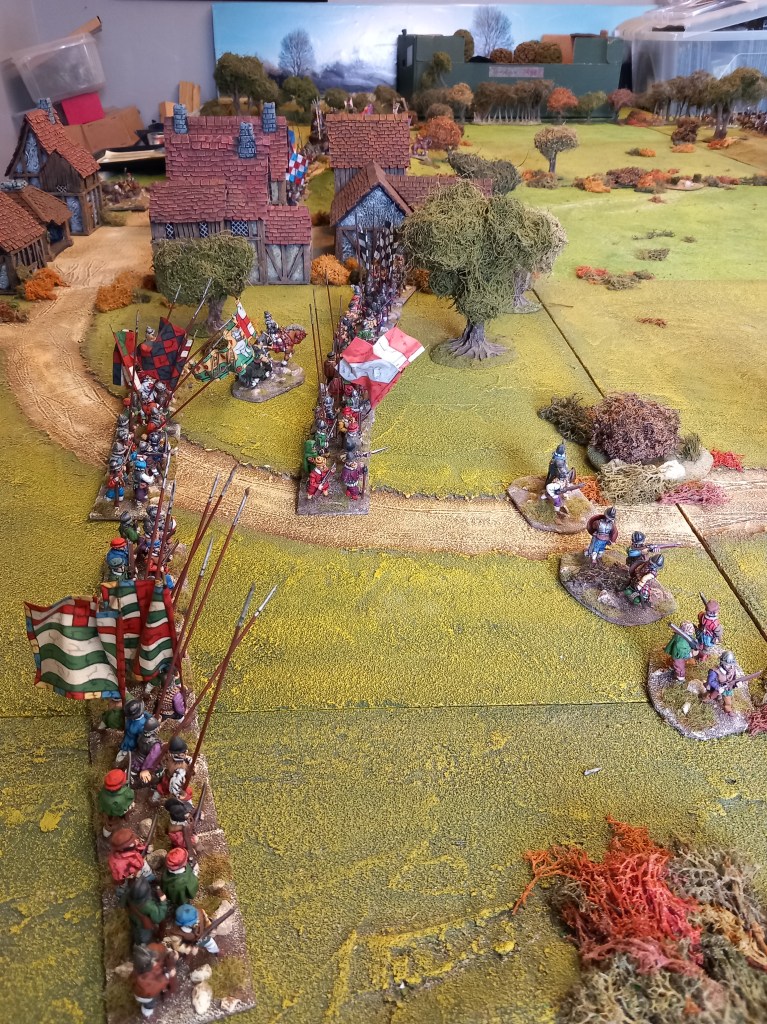
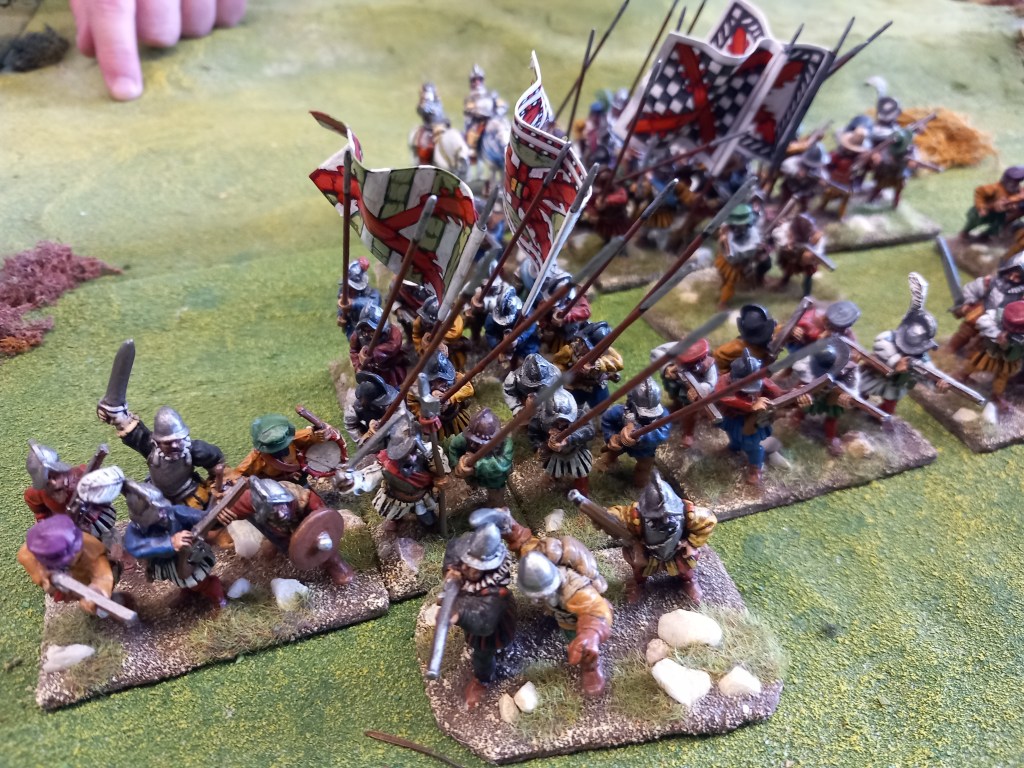
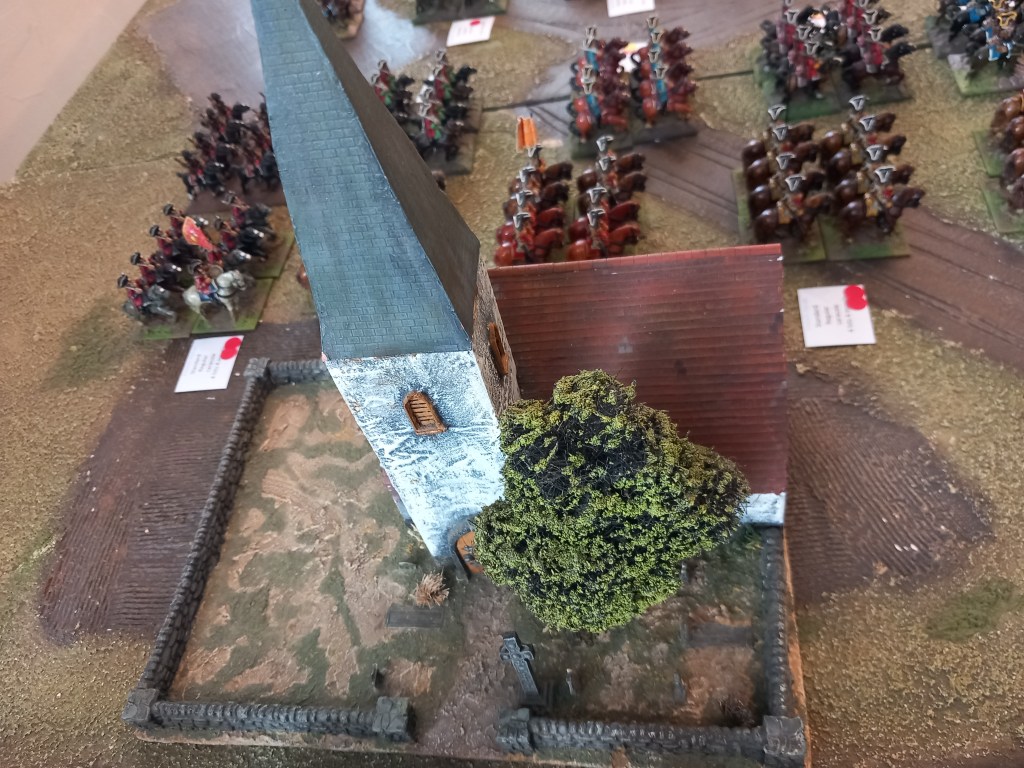
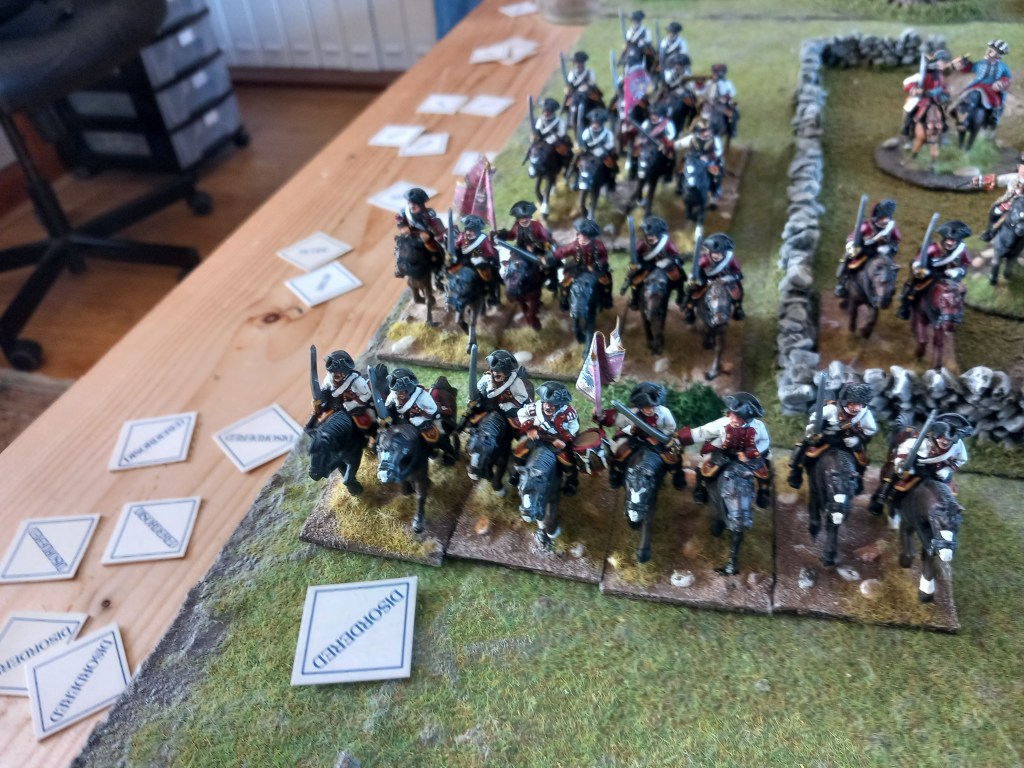
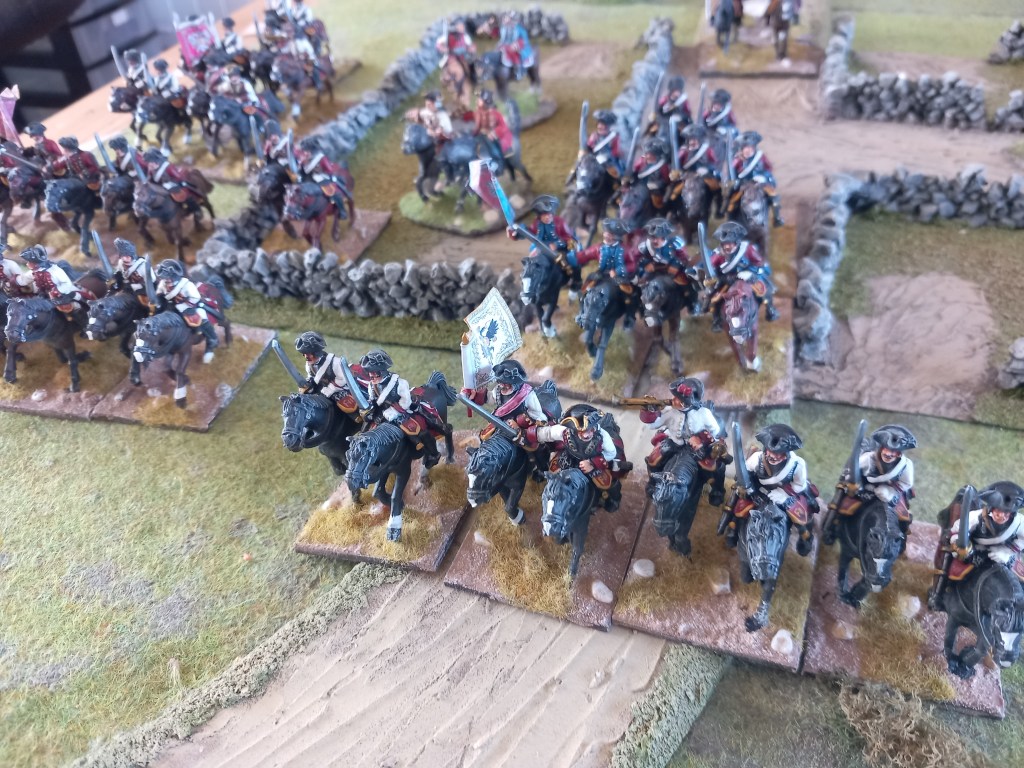
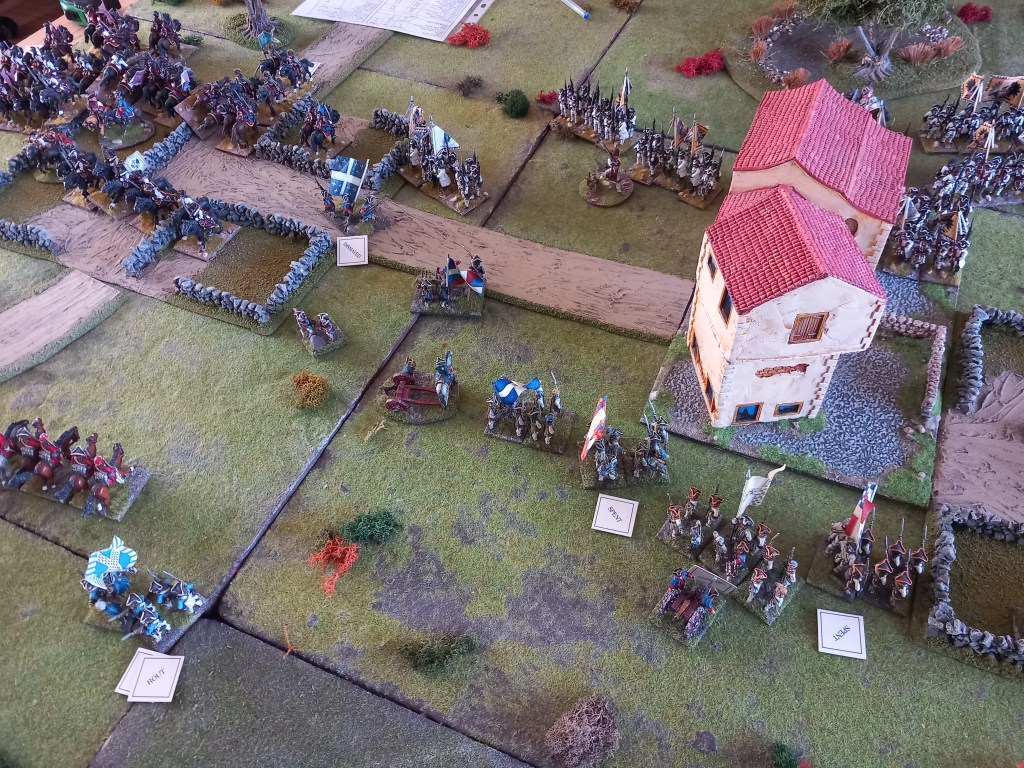
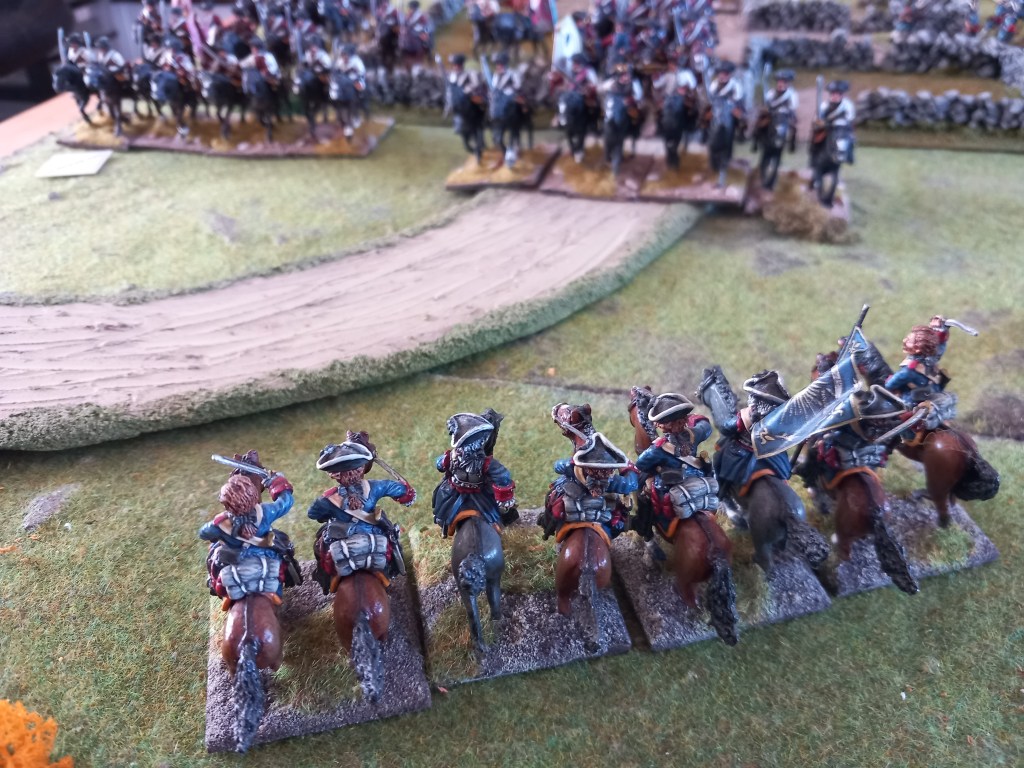
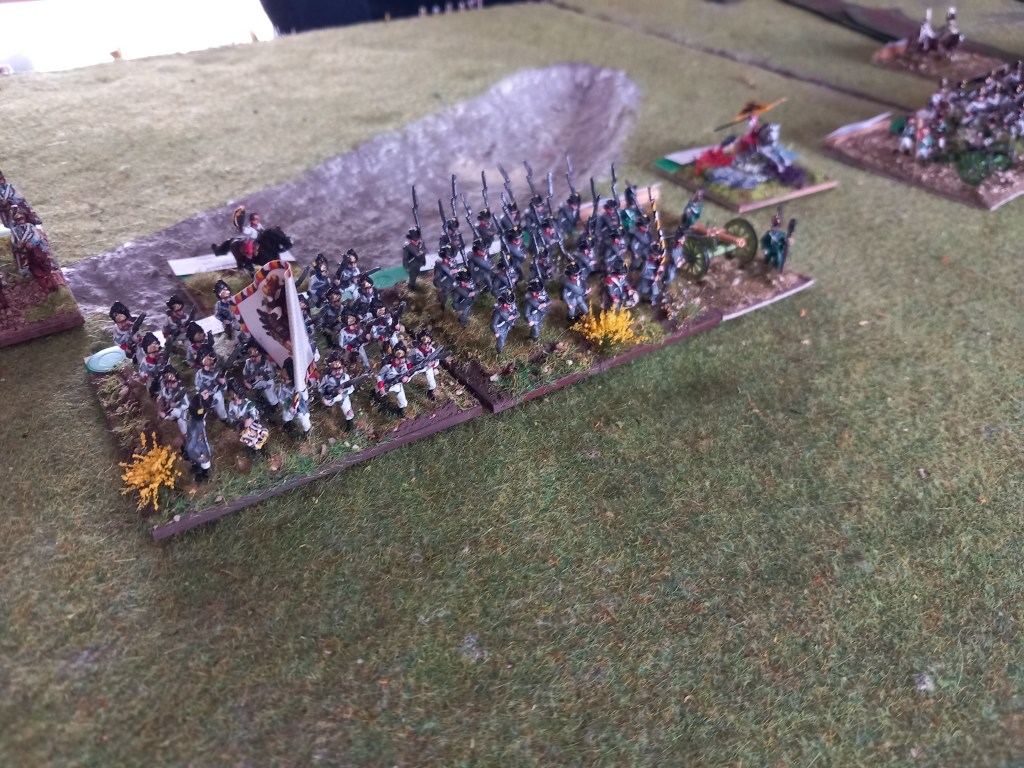
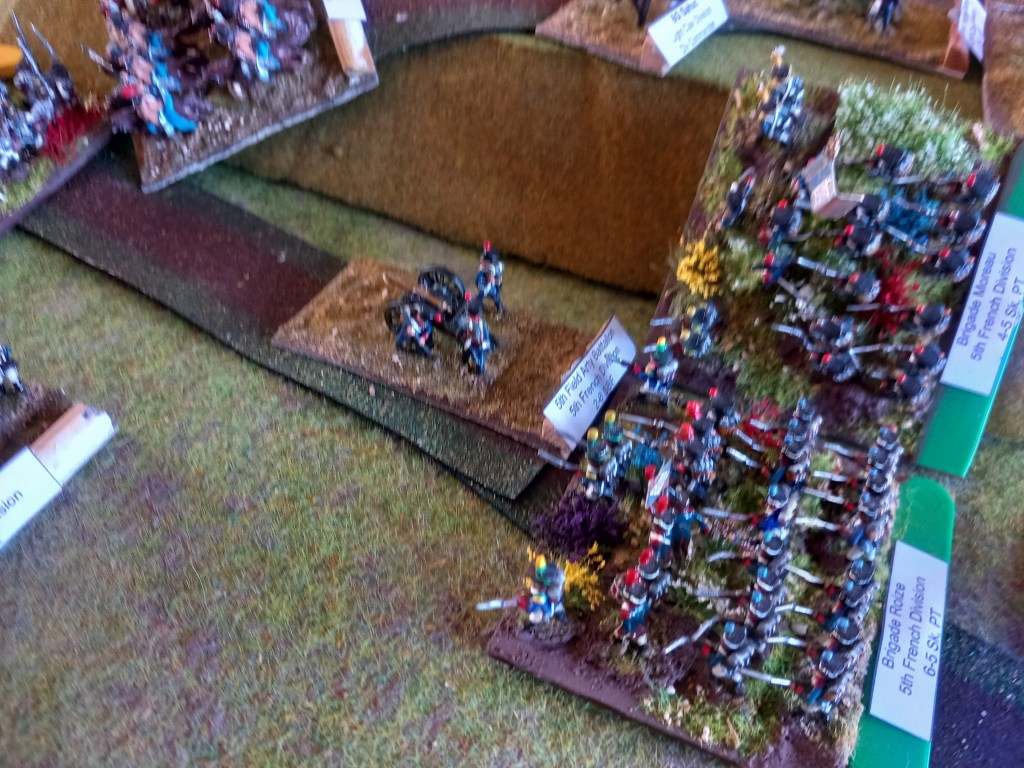
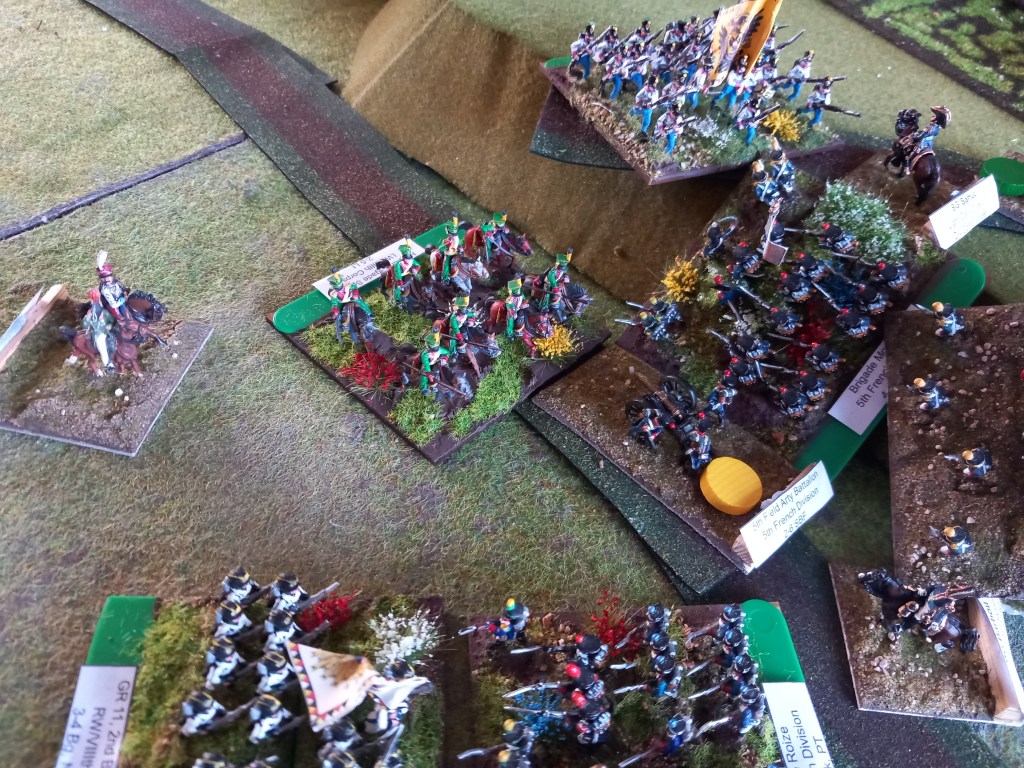
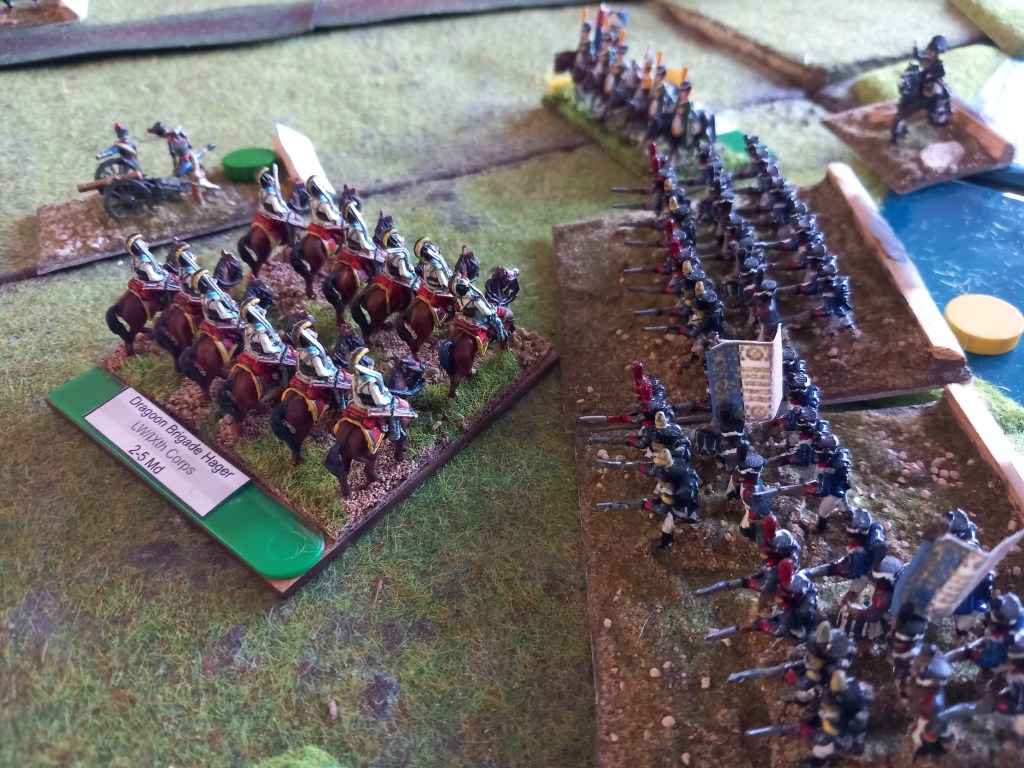
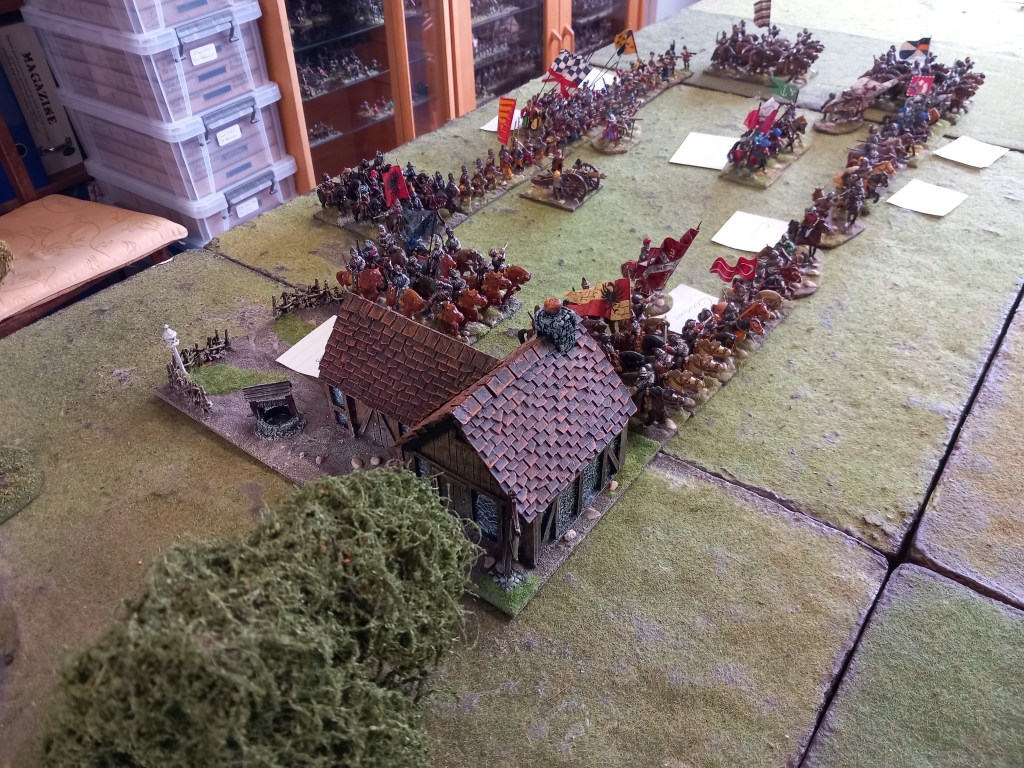
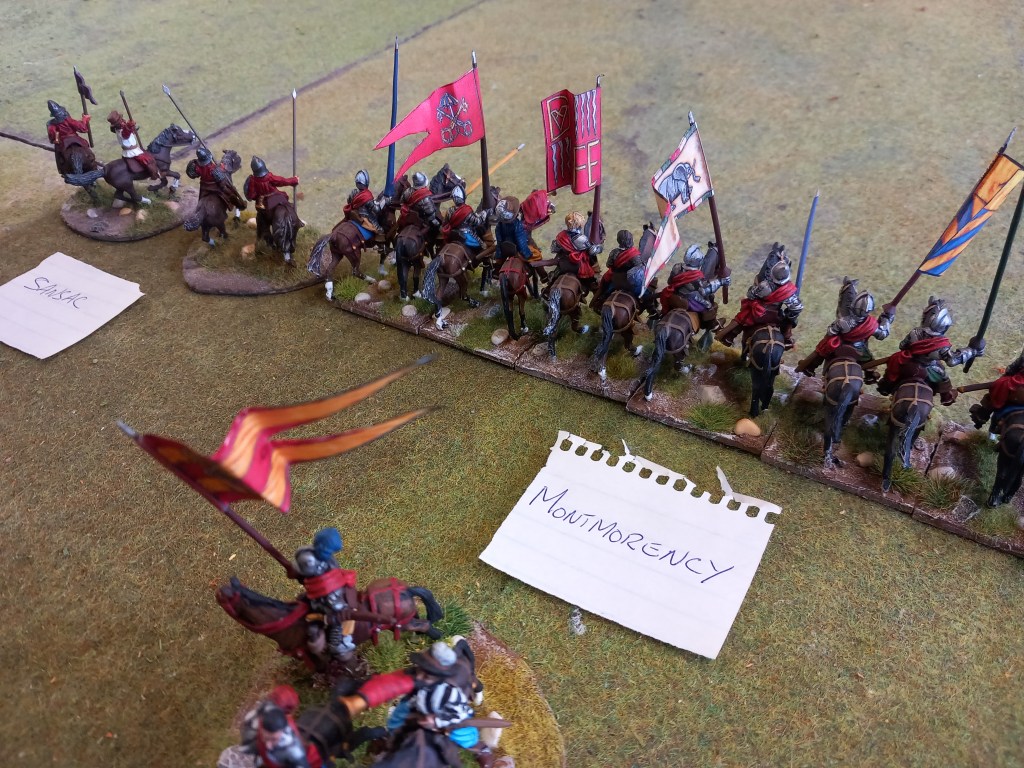
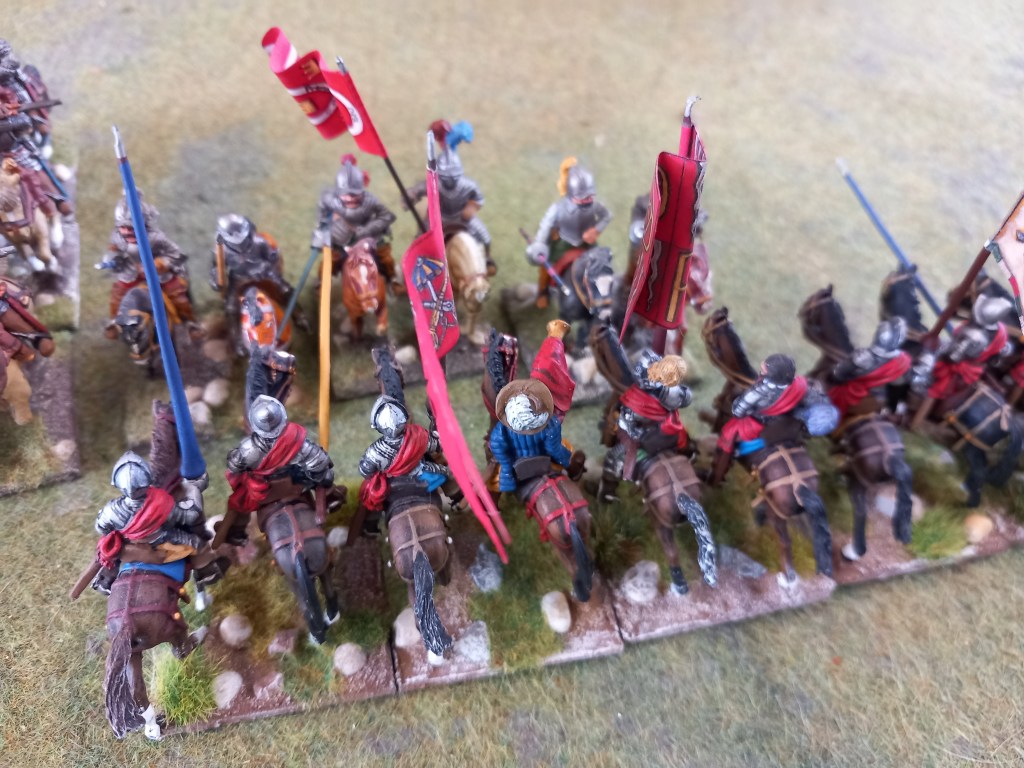
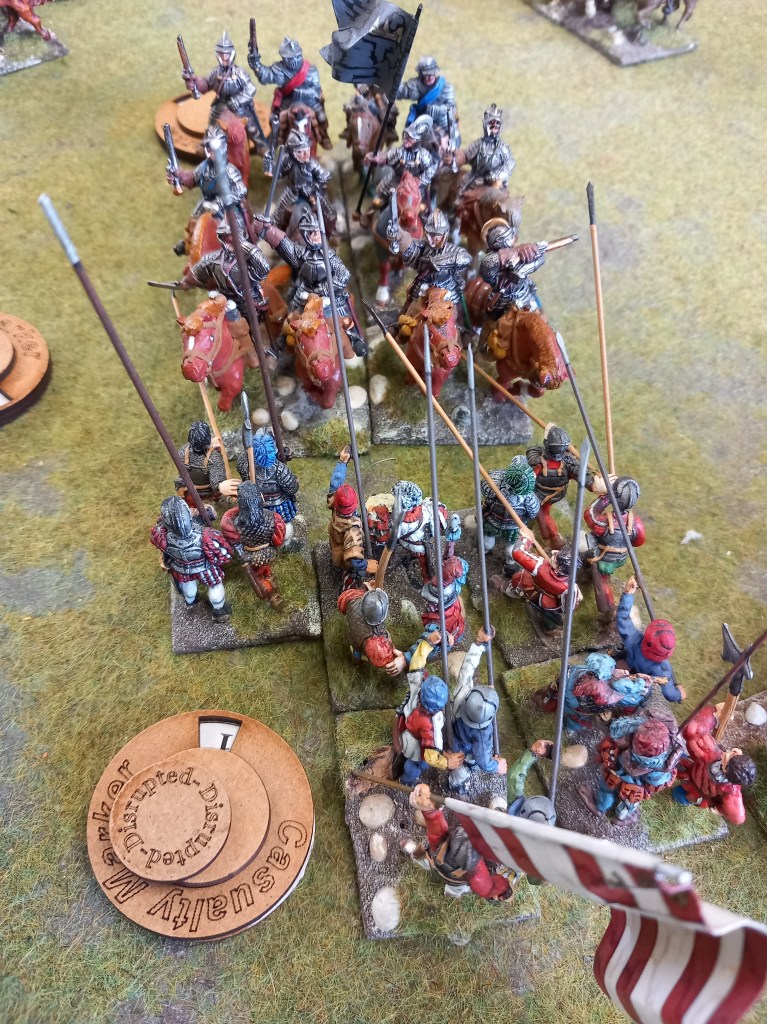
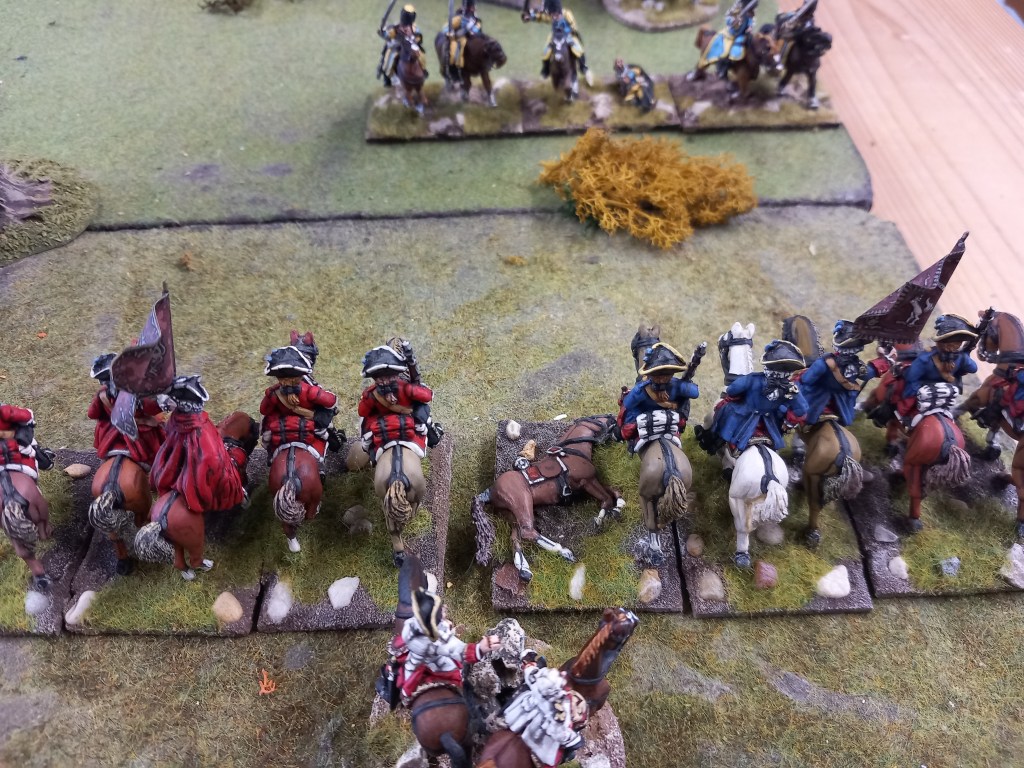
What turned out to be our final game of the month was a War of the Austrian Succession game set in northern Italy with a French army on one side and and an Austro Piedmontese army on the other approaching a town where there is thought to be a supply of shoes – sound familiar?

It wasn’t planned this way but this turned into a two day affair and it’s probably worth talking about that.

This was a lot of troops; the French fielded 6 brigades, the Austrians 5 and the Piedmontese 4, all marching to the table and in some cases getting each others way (that was the intention). What this meant was that by the end of the original day the battle had only really just got going and we were stuck with falling back on that old staple of “well I think this brigade would probably do this and that brigade would fall back…..” Then in a kind of epiphany moment, which we really shouldn’t have had to have, we realised that we could just leave the game up (because that’s what a permanent wargames room is all about ๐Ÿค”) and because we’re retired we can game whenever we damm well please! And there was me thinking we were all pretty bright blokes ๐Ÿ˜‚๐Ÿคฃ

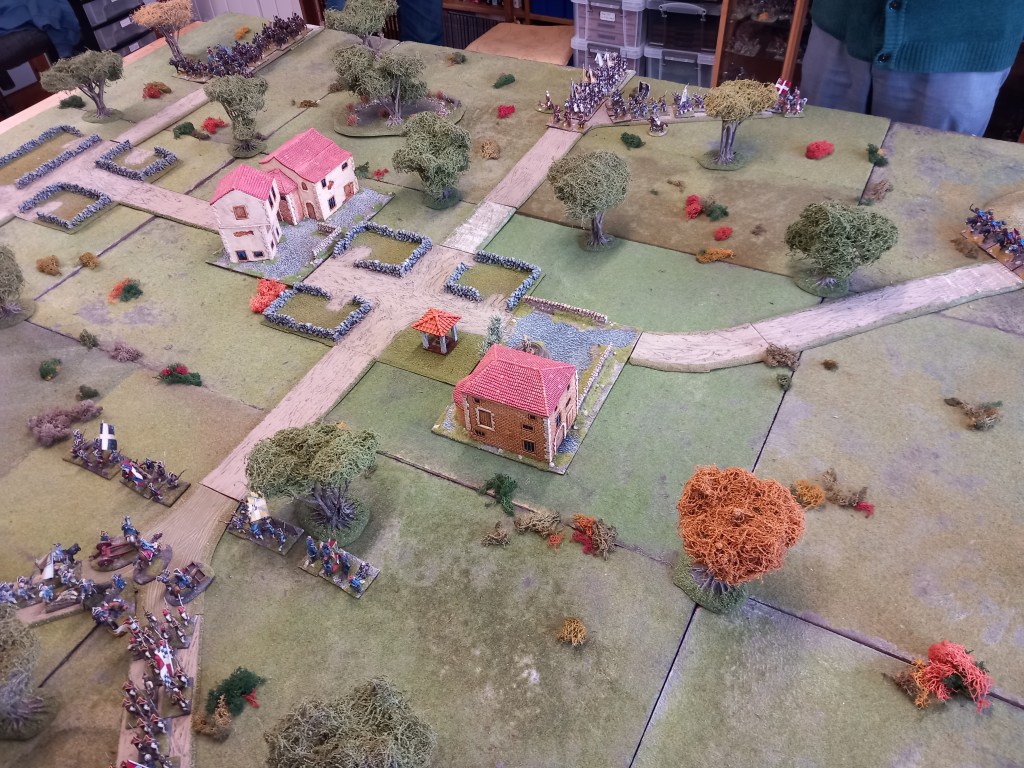
Anyway. The two brigade strong Austrian cavalry brigade marched up the right hand road aiming to pass through some walled gardens and smash some French cavalry seen deploying near some woods. On the opposite flank the Piedmontese single cavalry brigade was repeating the same scenario. In the centre all roads led to the town; the French foot had a only a single road to march down so were more strung out but there was less of them, the Austrians and Piedmontese had a road each but it met at a fork outside of the town and a road block was inevitable – the columns had to come down the road to enter the gaming area.

The first action of the game was the clash of the French and Austrian cavalry at the walled gardens. The French caught the lead Austrian dragoons as they shook out of column but failed to bounce them back and fell back themselves, a potential disaster which was rescued by the second French unit that charged in to stabilise the line and send the Austrians themselves packing. This set the tone for the whole game, the Austrians were stymied by the walls and gardens and just could not make enough headway against smaller and weaker opposition.

Out on the other wing the Piedmontese and French cavalry had a more even contest which ultimately saw the Piedmontese bounced back behind their gradually developing infantry lines which later in the game would save them.

In the centre the fight for the town was developing. The town consisted of two built up areas at the sides and one central walled garden area into which the French were establishing themselves just ahead of the Austro-Piedmontese who had been held up by the now infamous fork in the road.

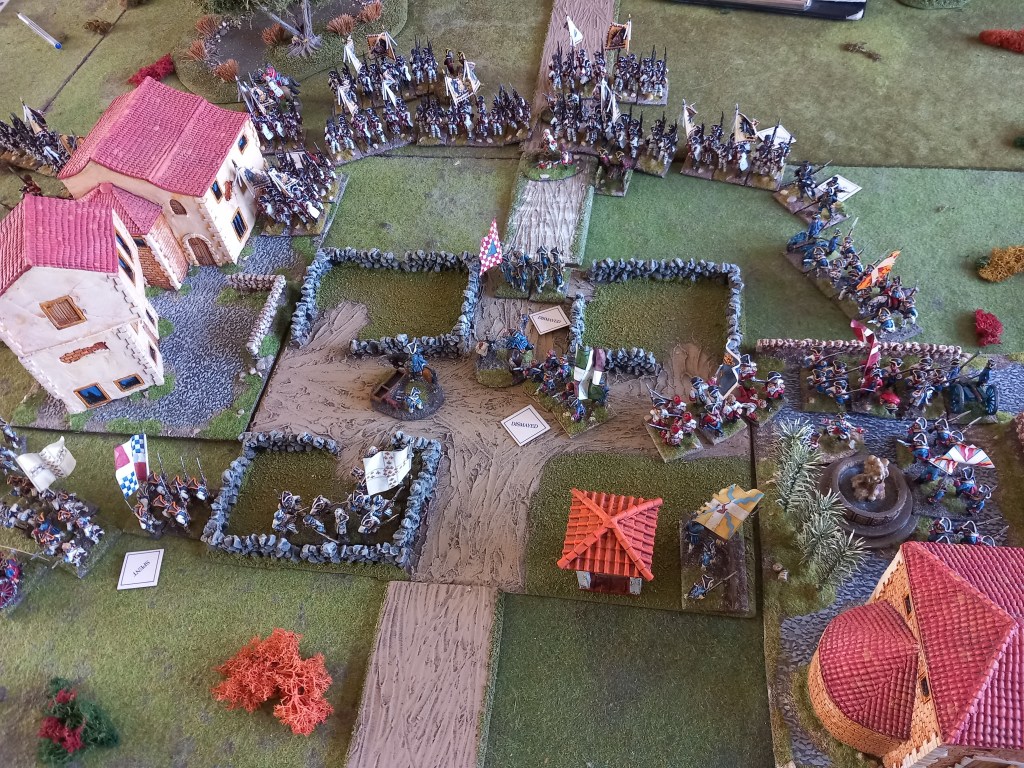
The Austrians just keep on coming! Numbers are beginning to tell at this stage and the French have already recognised they don’t have enough to occupy all the built up areas.

It’s about what would be seen as the mid point of the game. The French hold the central gardens and the whole of the right built up area, the left is contested with the Austrians. The cavalry on both flanks are holding their own. This is the high water mark of the French effort.

Emboldened by their success the French cavalry right spurs its horses forward scenting victory. An infantry brigade is supporting to the rear. What could possibly go wrong?

In a bizarre turn of events the French left cavalry received orders to pull back to their original starting point allowing the Austrians the opportunity to sort themselves out and exit the gardens. The reasoning of the French CinC was that he thought the cavalry would be overwhelmed in due course but what this order did was to allow the Austrians to fight with the advantage of their numbers and it also exposed the left flank of the infantry brigade trying to stop the Austrian juggernaut coming round that side of the town.

The right hand side of the town (as seen from the French side)has fallen to the Piedmontese assault. Frankly they made hard work of this, this part of the town was only held by two skirmish regiments as the French didn’t have the numbers, none the less the French in the central gardens were now under serious threat.

The situation worsens in the town. The left hand side built up area has been given up to the Austrians and the weight of Austrian fire on the centre (look at all those battalions!) has driven the French out allowing the Piedmontese to begin occupying the ground.

Out on the Austrian right, their cavalry prepare to seize their moment, now it is their time!

“Onward to victory!”

Oh dear ๐Ÿคฃ๐Ÿ˜‚ In a stunning turn about the Austrians lost their bottle and retired without even crossing swords!

And it got worse. It just wasn’t the Austrians day. The French breathed a sigh of relief.

However out on the French right the cavalry brigade has all but been destroyed by Piedmontese musket fire and the supporting infantry brigade has also collapsed. Yes the Piedmontese have suffered losses but the French are in no position to do anything about it.

With night falling the French are finished. Despite the unlooked for success on the right the rest of the army is spent and retreat is the only option covered by the very lucky right flank cavalry.

I for one was really glad we carried this on to a second day. There was plenty of fight left in the game, in fact the bulk of the fight was in the second day. We had some knife edge moments, some lucky moments and some disastrous moments, in fact everything you could want in a good game. Well done all!

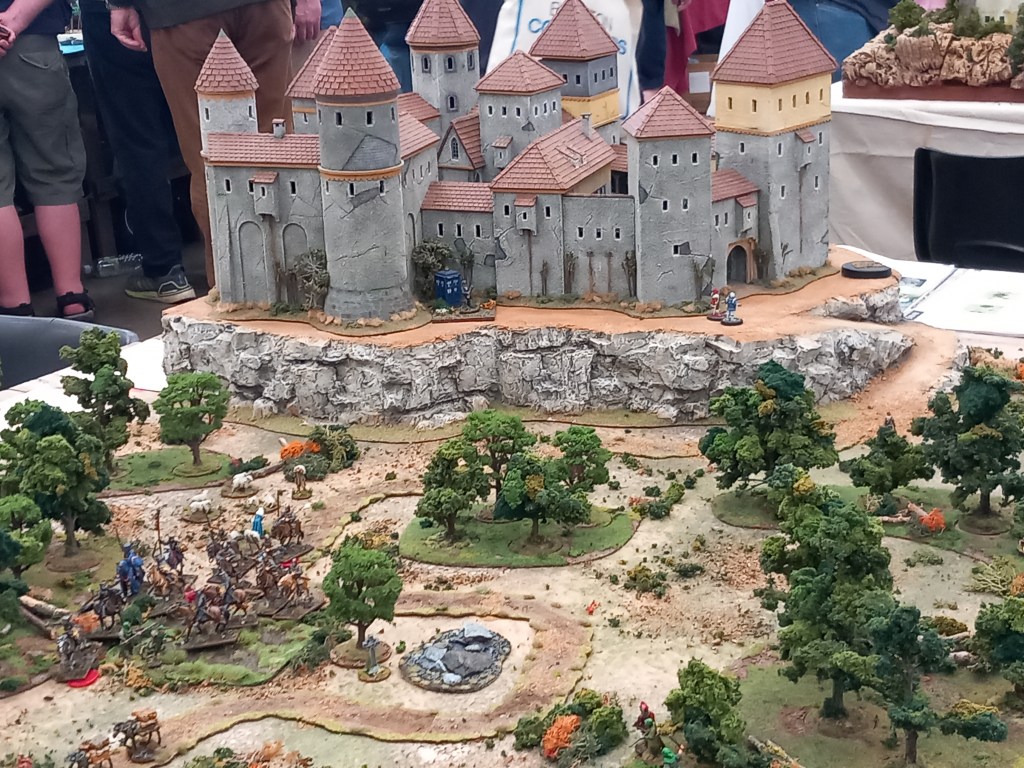
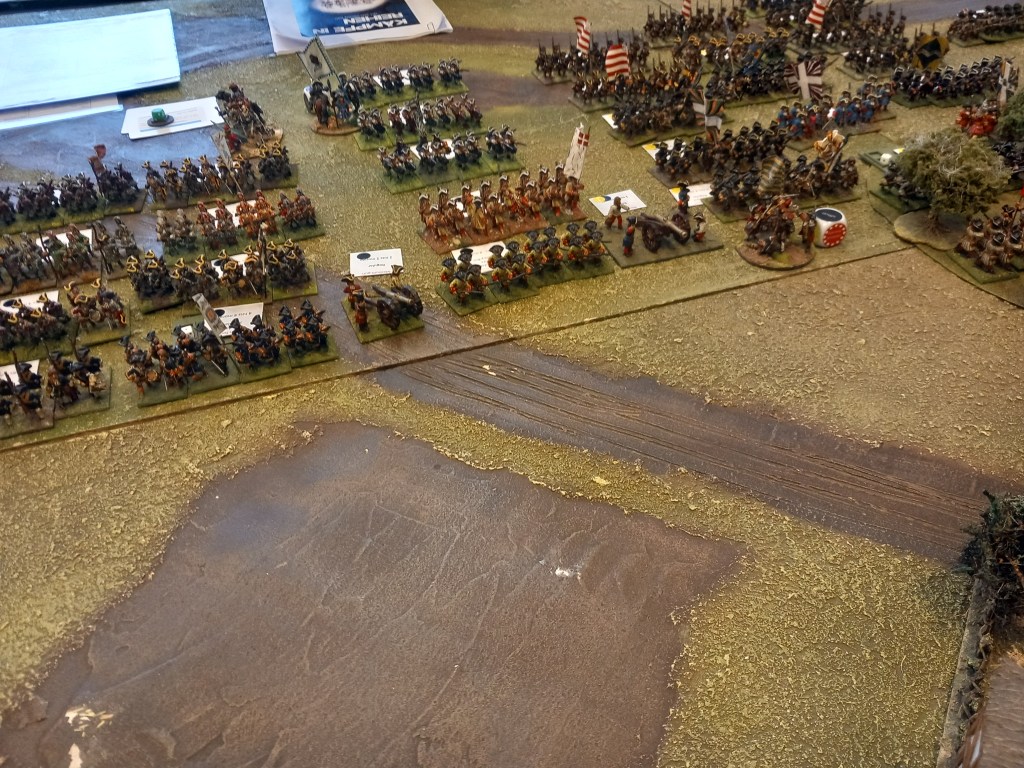
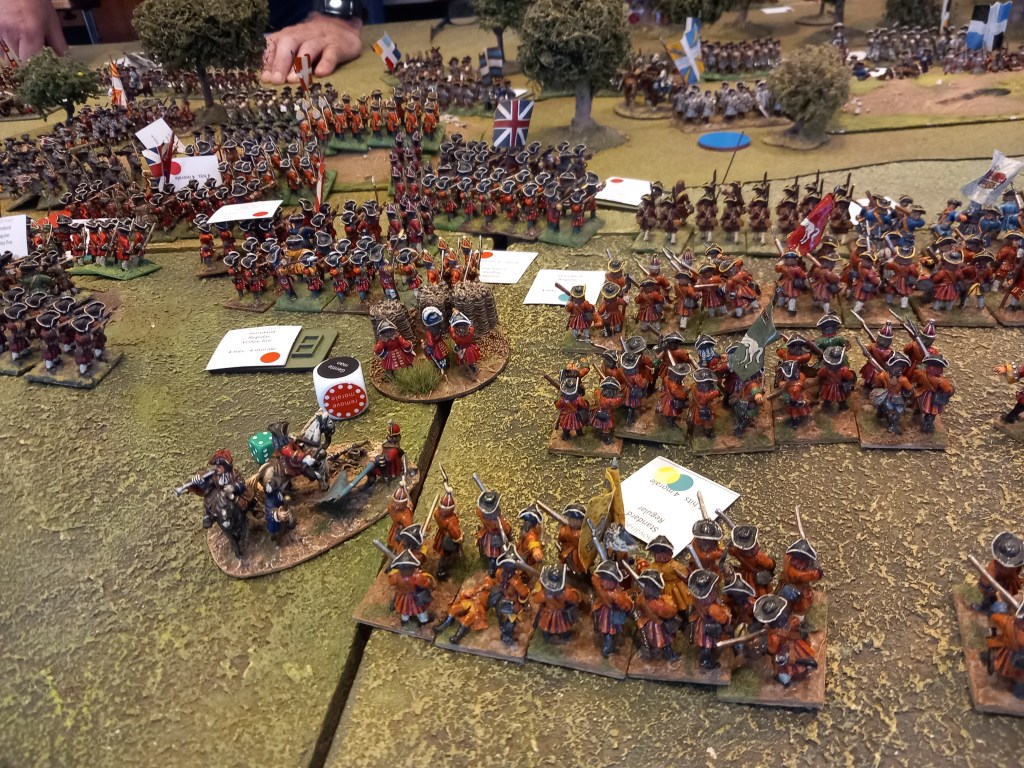
In theory that should have been it for the month but not for me because I went down to Basingstoke for a refight of the battle of Malplaquet hosted by Mark Freeth at the Wargames Holiday Centre. I say ‘at the Wargames Holiday Centre’ when in fact the WHC comes to you, because these days Mark sets up the 27 foot long playing area in an extended conference room at the local Holiday Inn, so you stay, eat and drink in the hotel and game in the conference room all very convenient.

I’d love to give a detailed account of the ebb and flow of the grand battle but I can’t. The one disadvantage (oh the trauma of it all!) of playing on such a large table is that you only really know what’s going on in your six foot square of action.

I can say that on the Friday night and all day Saturday we played a series of games that were a loose simulation of contacts leading up to the battle but were in reality a means to get people used to the rules – Kampfe In Reihen by Steve Thompson. Personally I think this this was a bit too long and it kind of took you out of the moment, maybe Friday night and Saturday morning would have been enough.

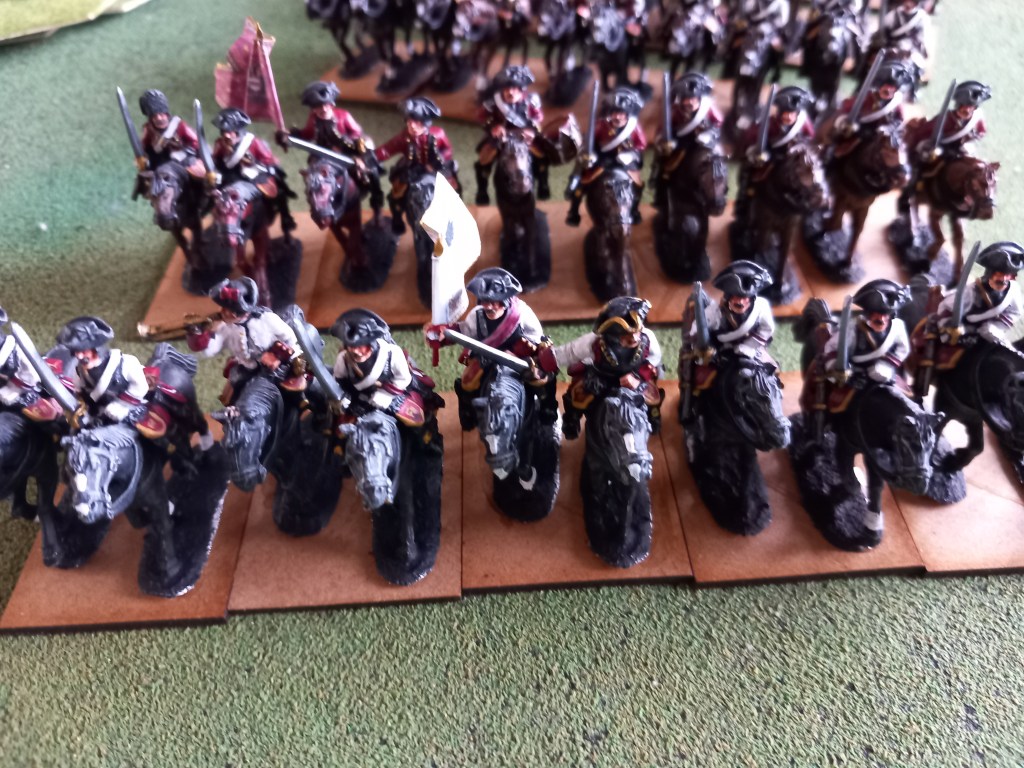
Sunday was the main event and as best as I could tell it went something like this. The French left cavalry (me) fought a long and bloody battle against superior numbers of allied cavalry but finally gave up the struggle. Way down on the French right a mixed force of horse and foot made little headway against inferior opposition. In the centre sheer weight of numbers drove in the French centre.

I’m, glad I went, it was an itch that I had wanted to scratch for years. I had been to the WHC in the very early years under Pete Gilder when I was a callow youth and then continued with it when Mike Ingham took over from Pete and amongst other things instigated the Marlburian period as a staple on the menu but despite meeting Mark at the centre under Mike and forming a friendship I had never been able to attend under his stewardship so that’s done now.

This kind of mass gaming can be seen as a bit of a relic of a different time in wargaming and I get that, certainly it’s not for everyone and it does have a cost attached to it. I’m glad I have finally got to play in it’s third iteration, whether I will again remains to be seen, but it was a nice note to end the month on.

March 2025 Report

Wait! What? A quarter of the year is over! I’ve still got projects to finish ๐Ÿคฃ

Well the month opened nicely with a trip to Hammerhead from which I seem to have lost the photo’s of some of the games ๐Ÿ˜ฅ To be honest I was a bit underwhelmed, it was certainly busy and that is a good thing for the organisers but I felt the range and quality of the games was a bit sub par. There were some stand out games (the photo’s I’ve lost) but for me it was perhaps a case of more means less and given that the idea is participation I wasn’t feeling the “come and play” vibe that has existed at past shows. Obviously a very personal view and one not necessarily shared by others.

All that said I did manage to pick up painting commissions that hade been ongoing for a while so plenty of basing to do when I got home ๐Ÿ˜€

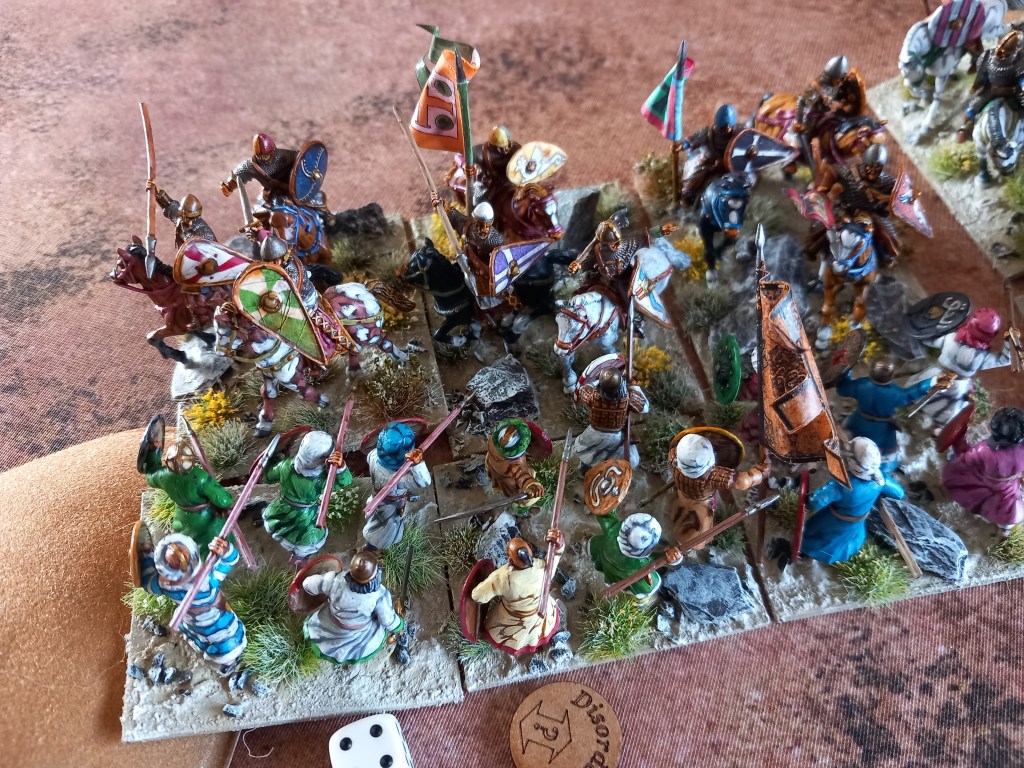
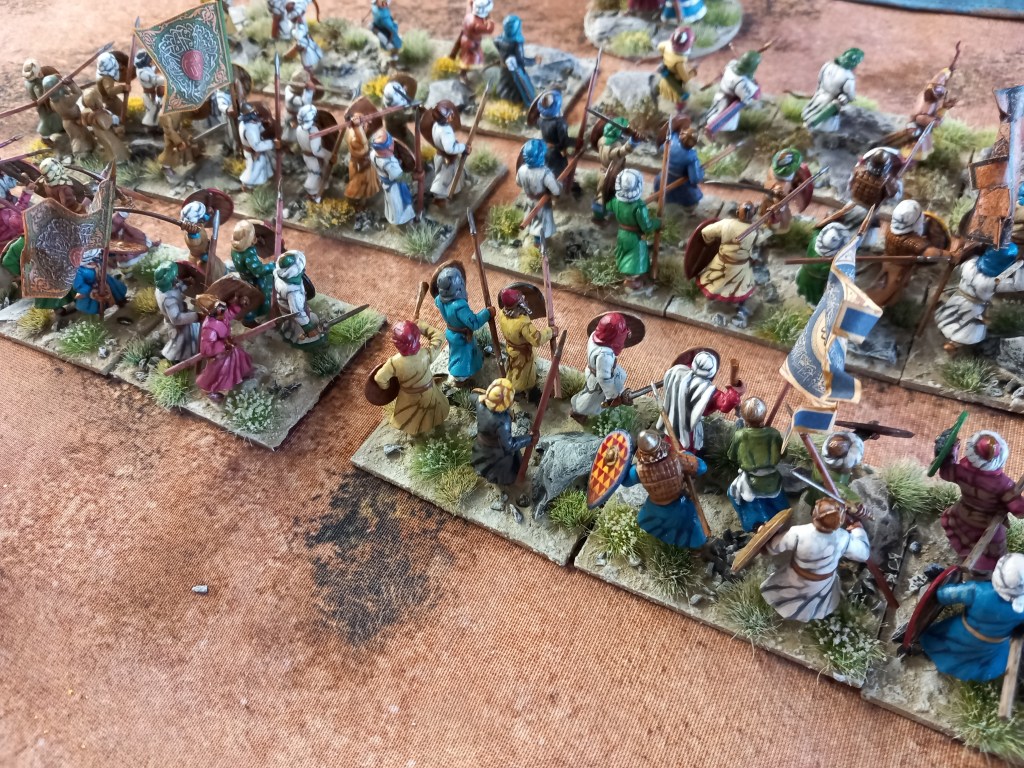
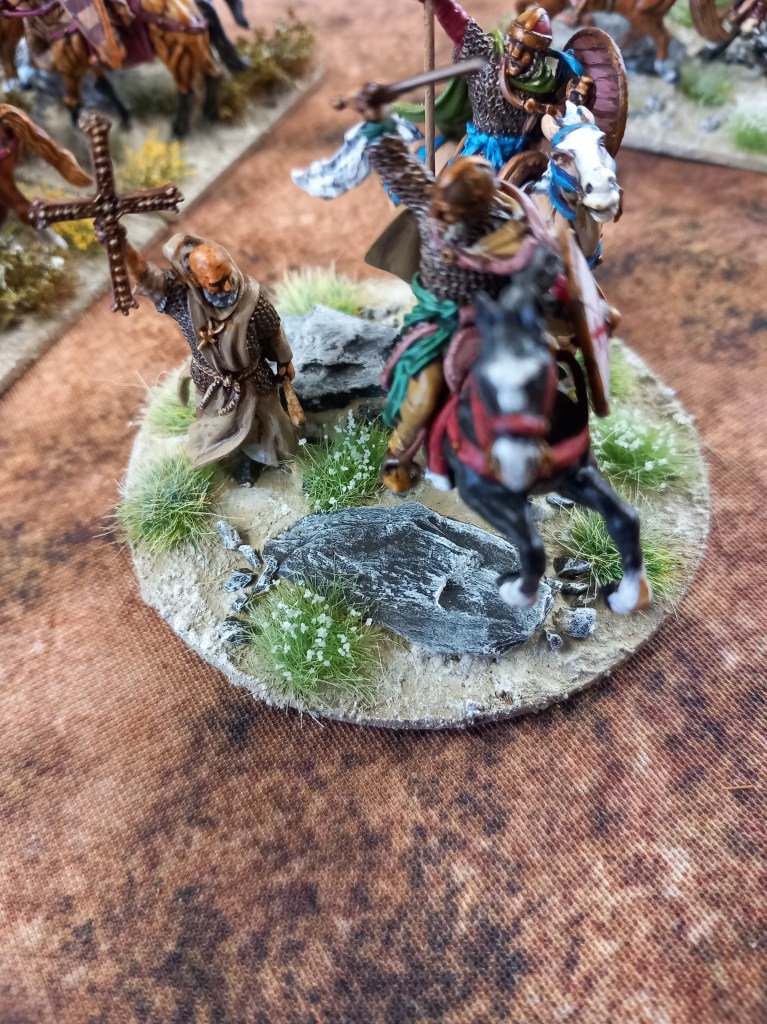
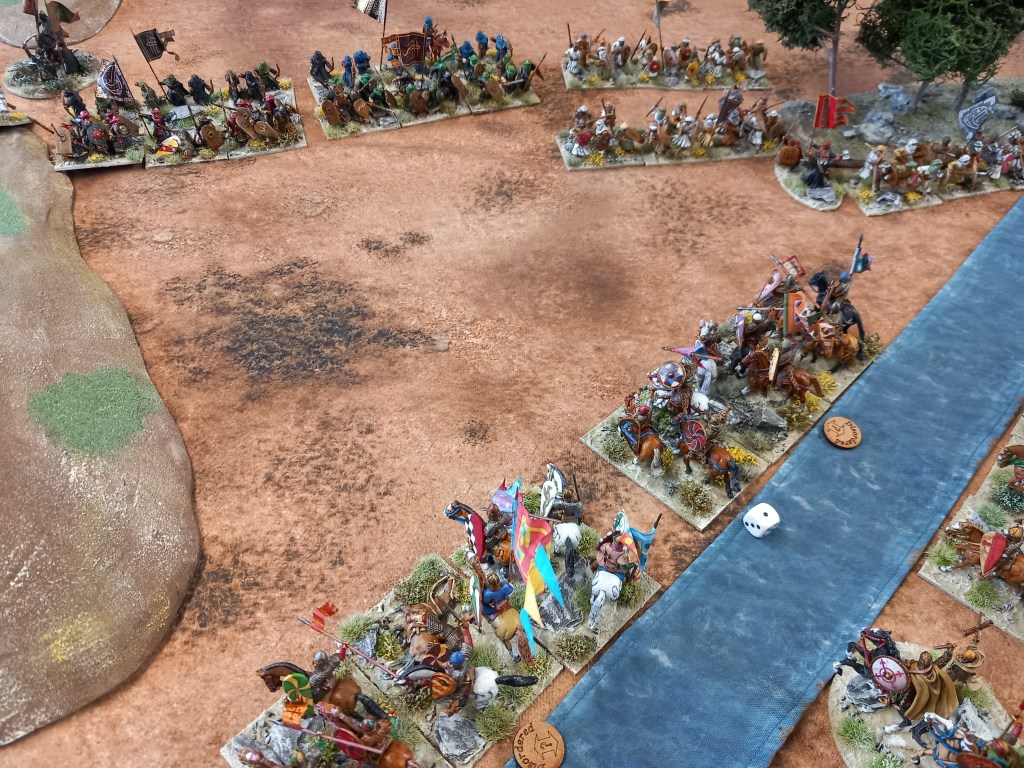
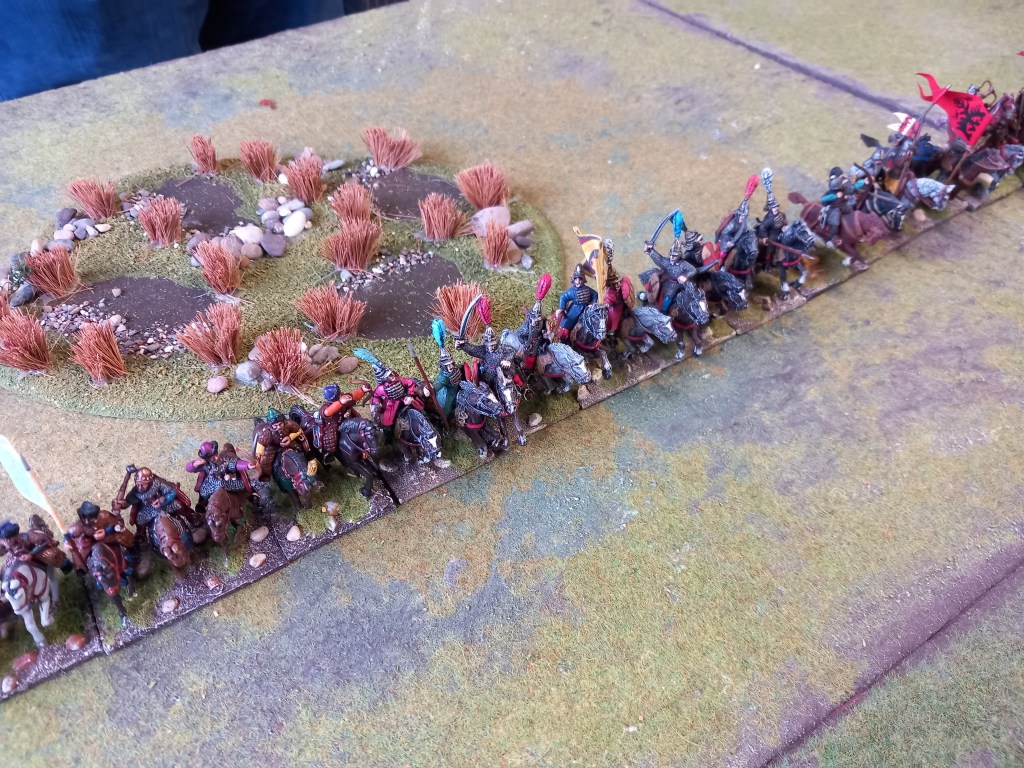
Our first game of the month was another in our “reconquista” project. For this one we had Almoravids led by Yusuf ibn Tashfin facing off to the Christian Spanish under King Alfonso VI who had the redoubtable Rodrigo Diaz commanding his cavalry.

The Christians gambled on a strong cavalry wing overwhelming their opponents and sweeping around the rear of the Moslem centre while their own spearmen and missile supports held the centre. A mixed infantry & cavalry contingent of Andalusians acted semi independently on the other wing.

The numerically stronger Moslems relied on their Black Guard to dominate the centre while the rest of the Berber contingent advanced on the right, spears adjacent to the Guard and cavalry out on the wing. Like the Christians they also had an Andalusian contingent, a mix of spears and skirmish cavalry out on the left.

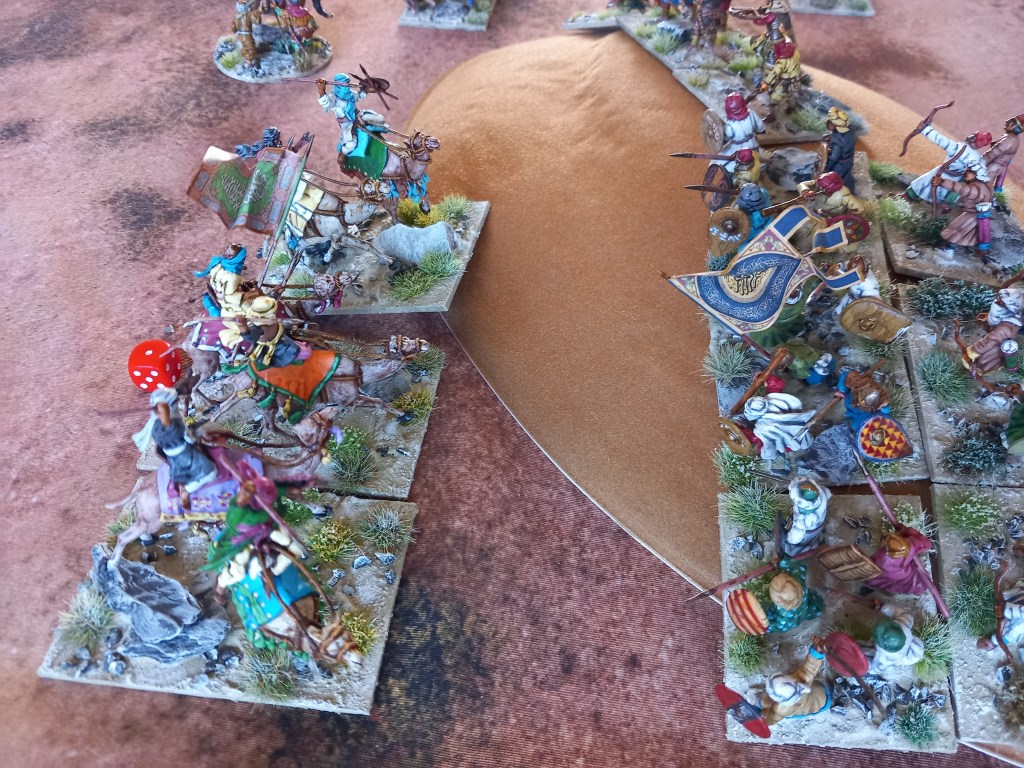
The initial action featured the Berber camelry menacing the Andalusians but some well placed bow shots from the rear archers contained the smelly animals.

The first proper action was the Andalusian cavalry from the Christian side sending the Almoravid jinettes scampering off with a bloody nose and then mixing it up with the following Berber cavalry, managing to rout one unit and kill a leader before finally being routed themselves by a second Berber cavalry unit. This took the majority of the game to evolve and the lone Andalusian unit had a fine old time ๐Ÿ˜€

In the centre the Black Guard and their Berber supports got stuck in with the Christian spearmen and a prolonged slog saw the melees swing one way and then the other. One of the Guard was particularly successful, routing its opponent and cutting them down to the last man in the pursuit, but then found itself stranded and surrounded by skirmishers who potted away and wore it down. Generally though the centre infantry slog was inconclusive.

Out on the Christian right El Cid threw in his Caballeros presuming an easy victory over the Andalusian spearmen and a victory he did get but only after a bitter struggle which delayed the grand sweep originally planned for.

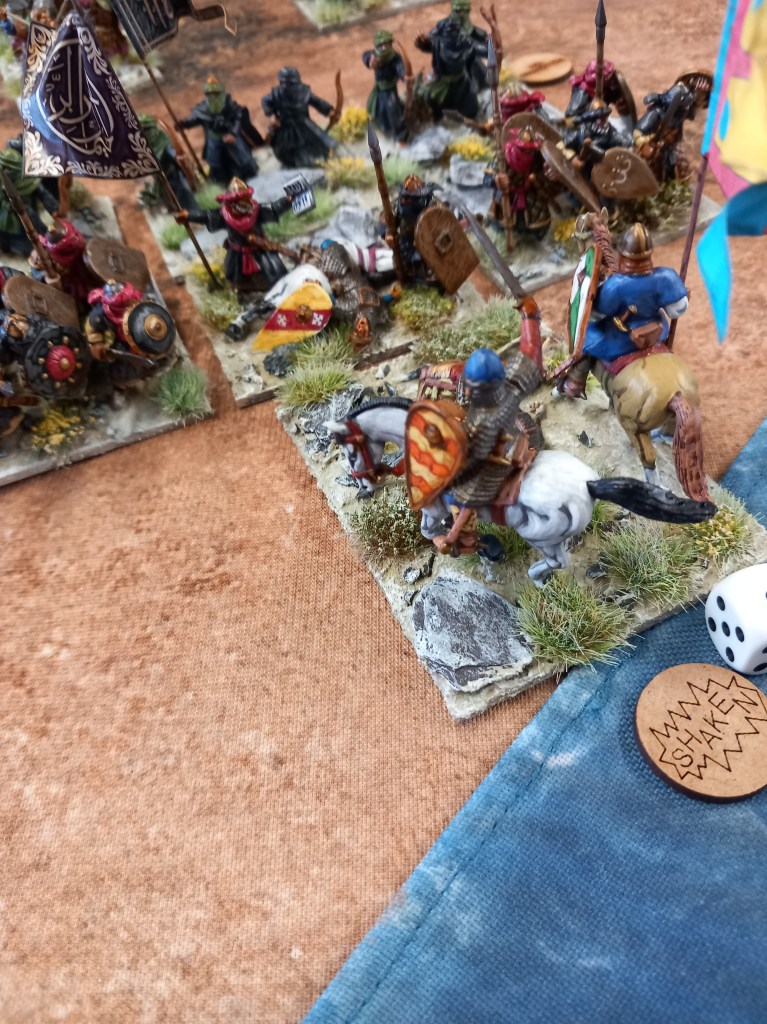
This was the key moment, El Cid led his cavalry into the flank of the remaining Black Guard and victory was assured.

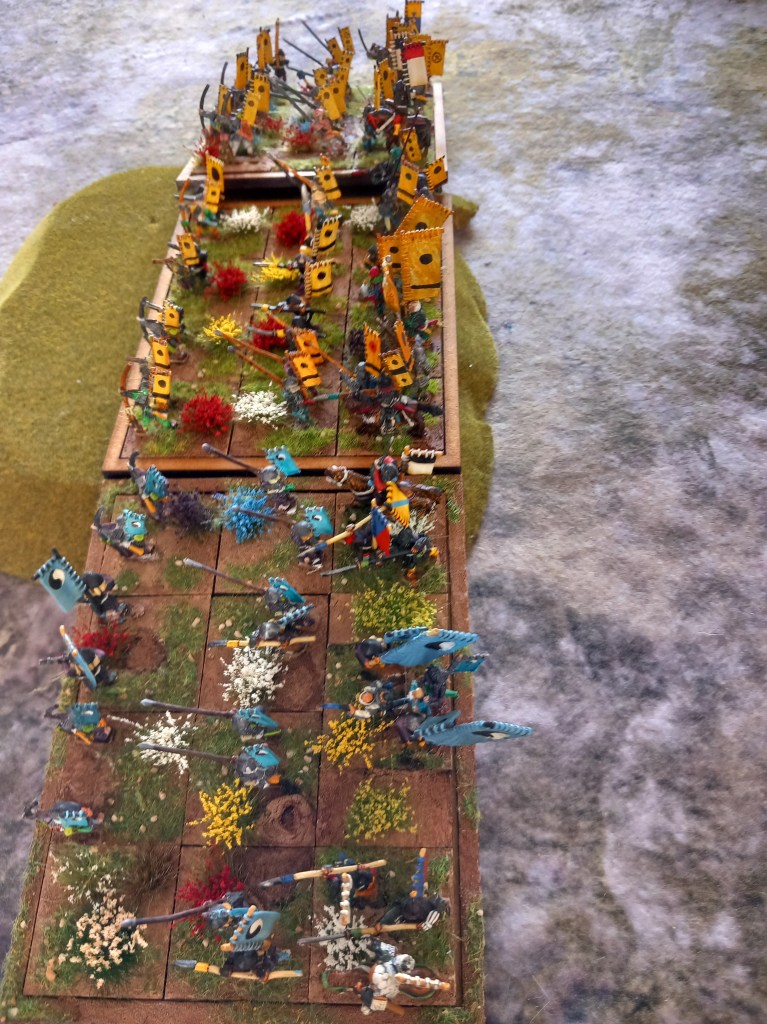
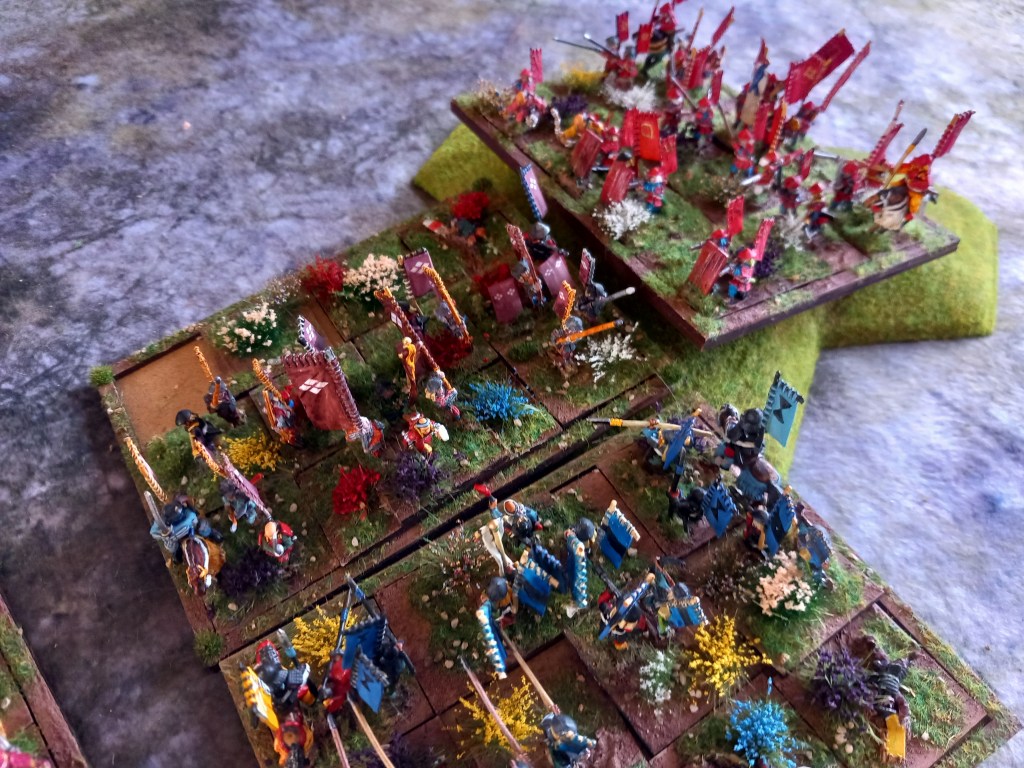
Our next game was a first for the group, Samurai, 1590’s, curtesy of group member Gerard who has spent considerable time putting together this pet project. The rules were ‘Battles in the Age of War’ with some amendments for the style of fighting in this period – small numbers of actual Samurai, plenty of Ashigaru formed into a single unit. The armies were Tokugawa v Ishida.

Essentially it was solid lines moving forward to fire and then melee, the key tactical decision being when to withdraw your shooters and commit your fighters. As a game it had a very Marlburian look to it albeit with different tactical nuances.

As a first outing I thought it played well – probably influenced by the fact that as Tokugawa I crushed the Ishida right wing and was declared the victor ๐Ÿ˜‰

This has definitely got legs and I look forward to our next game.

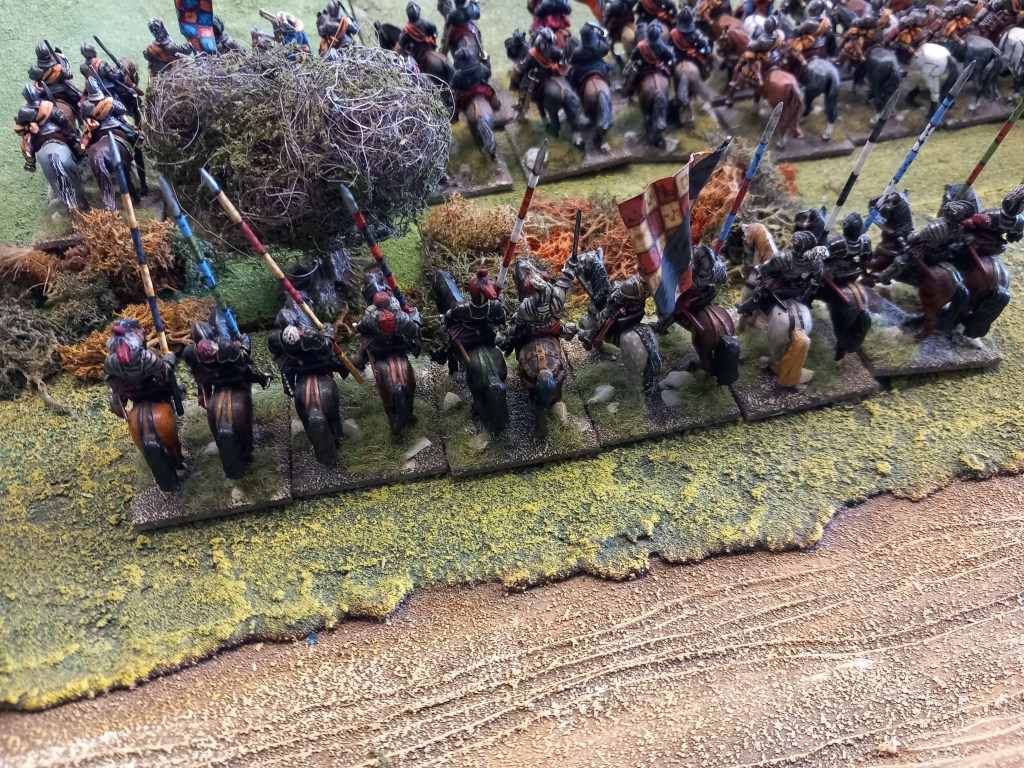
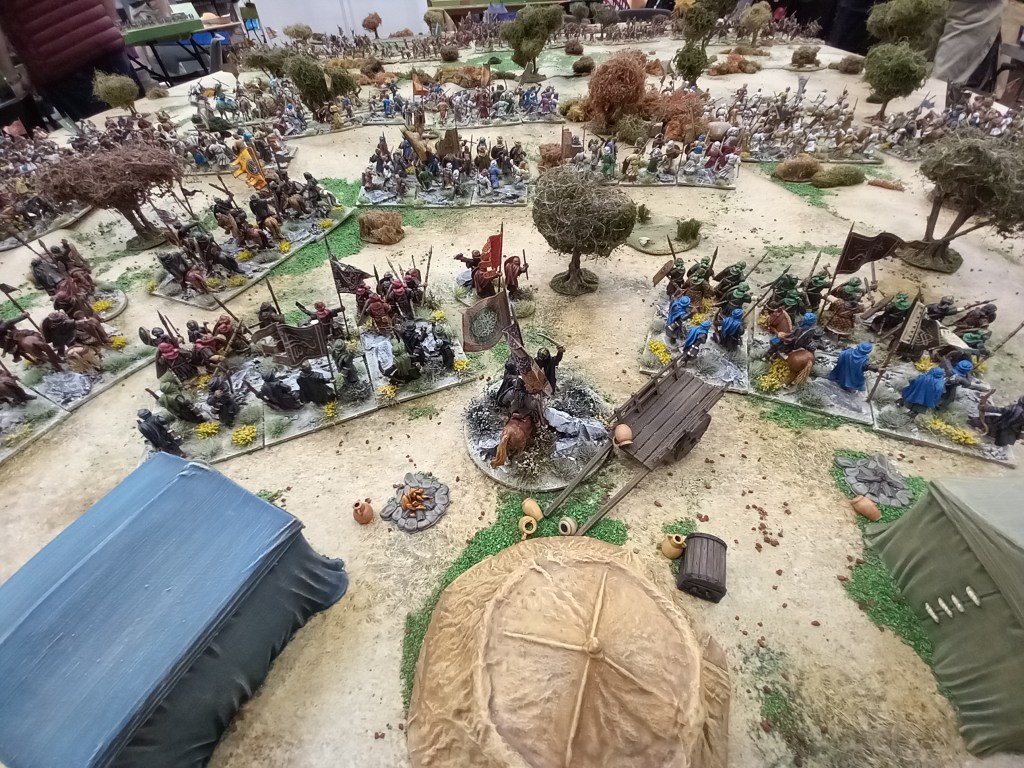
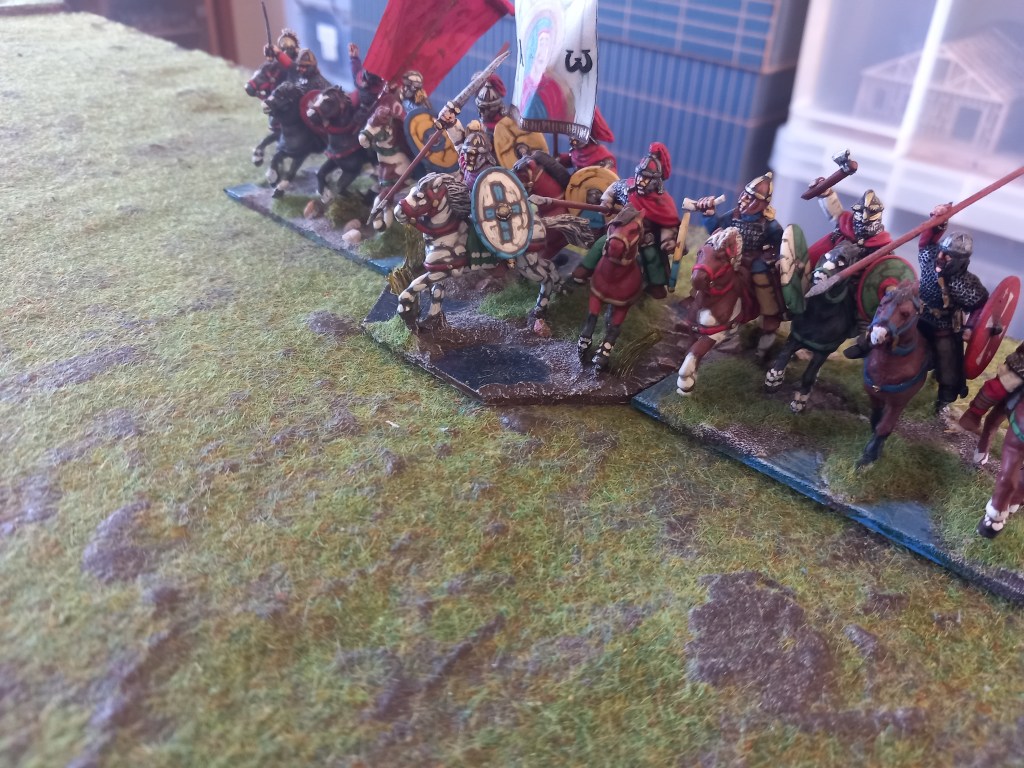
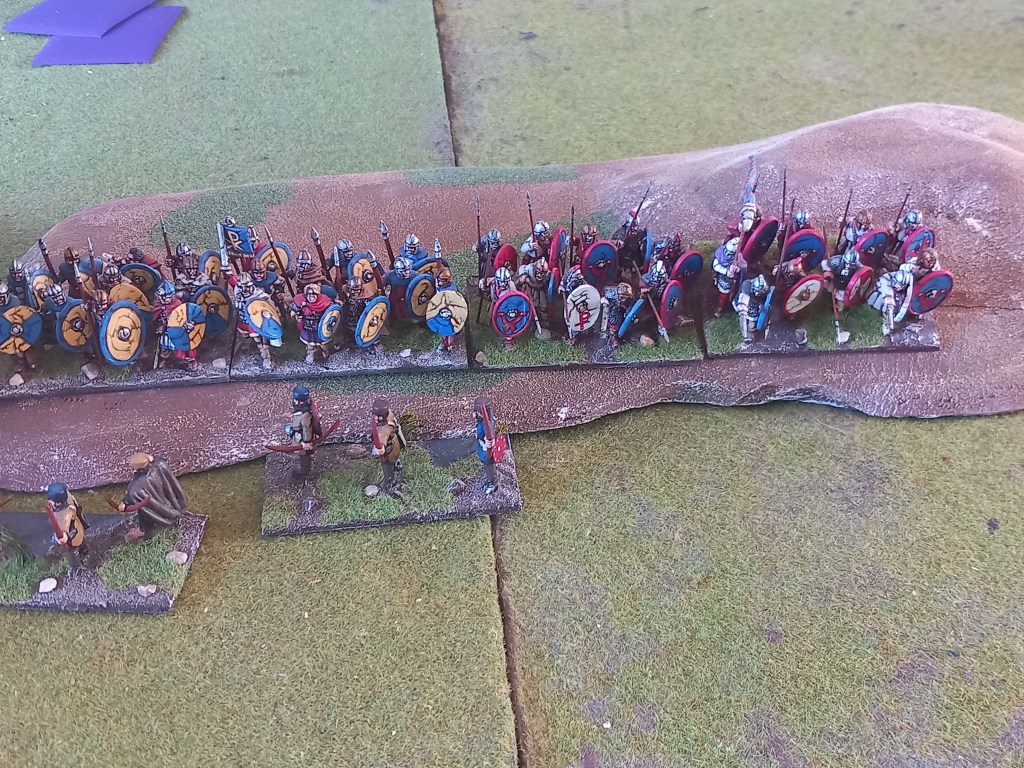
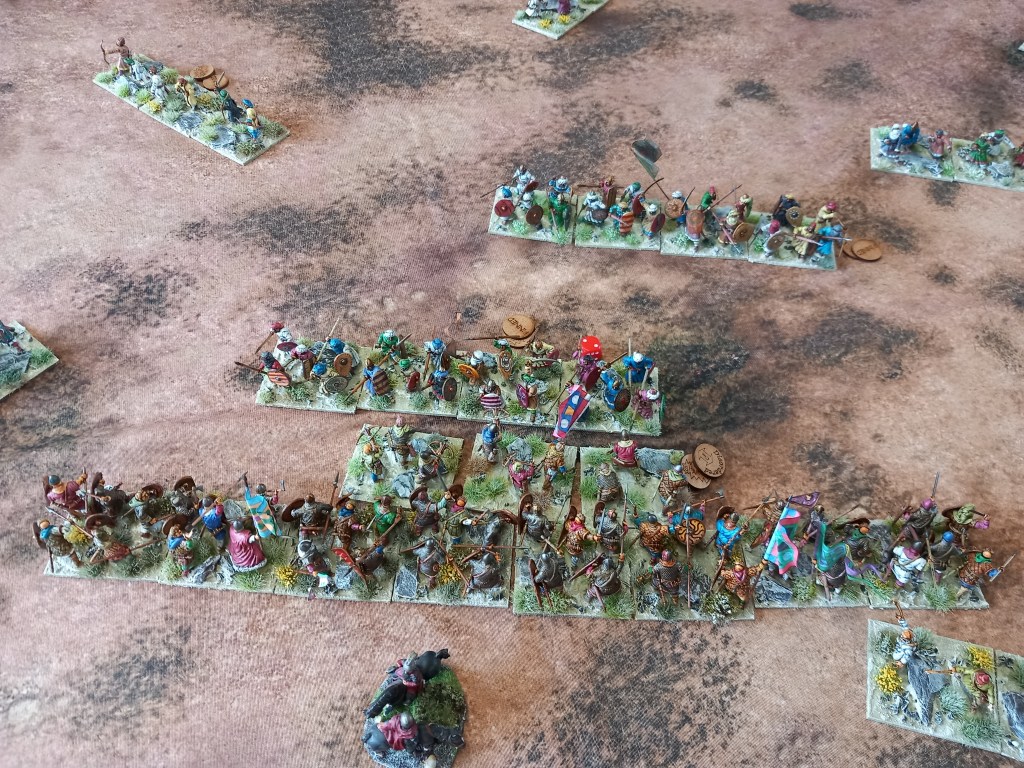
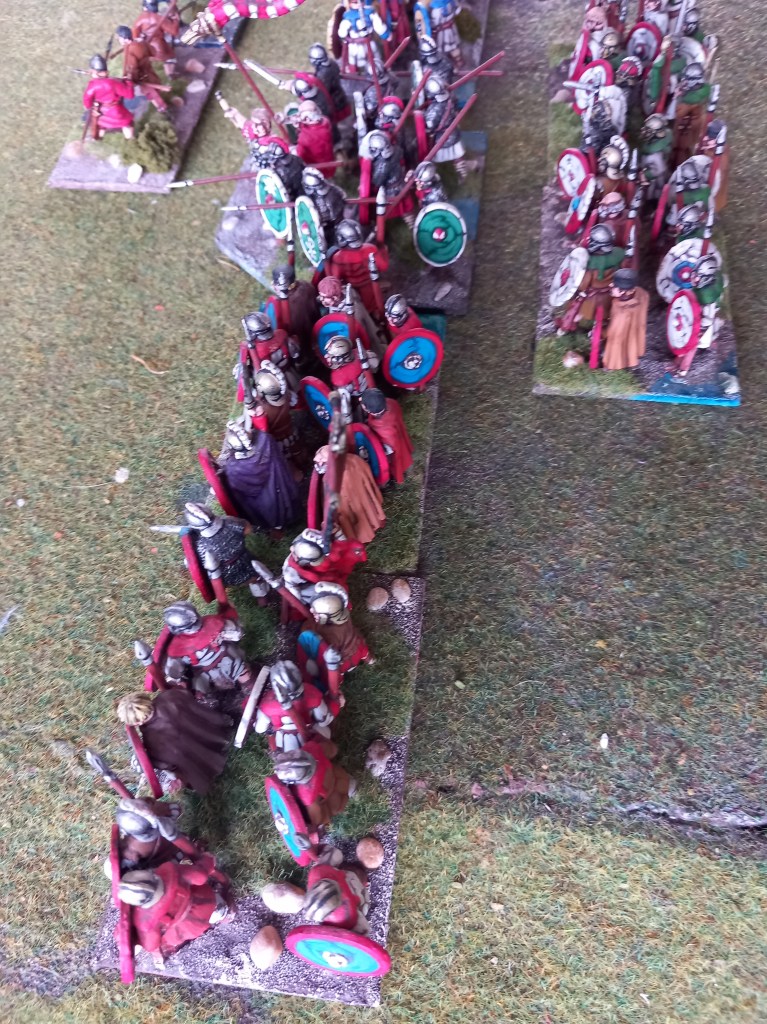
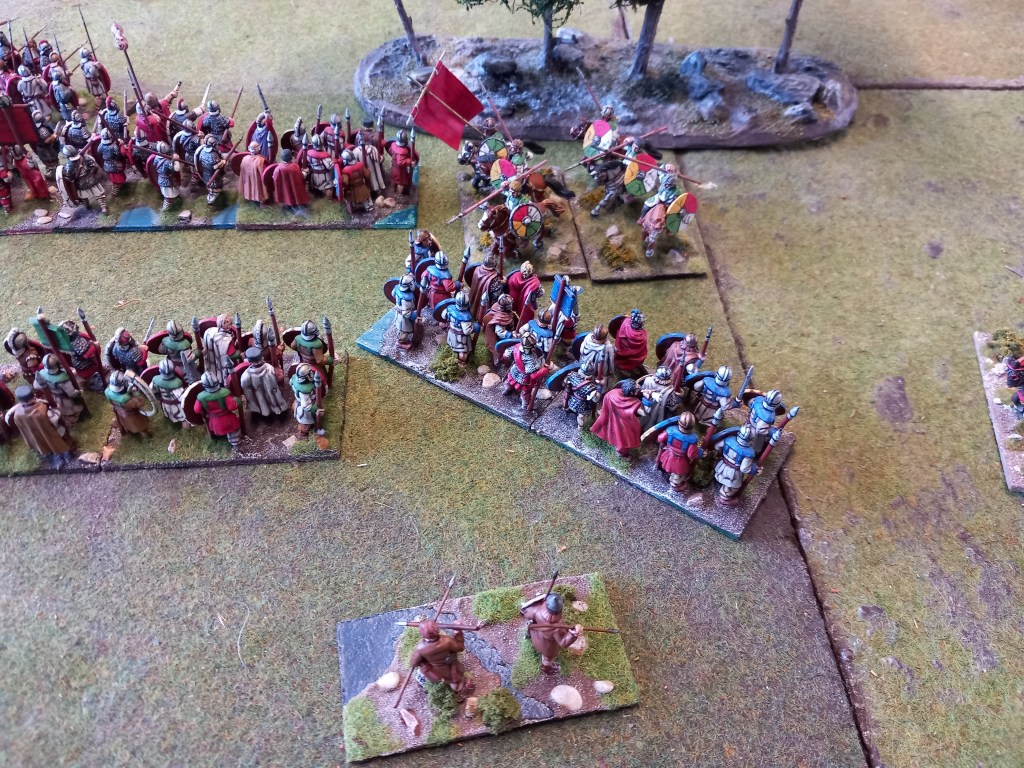
Next up was a return to the Dark Ages (Early Medieval) using our post Roman Britain collection which we reckoned hadn’t seen the light of day in 18 months. The opposing forces were Ambrosius Aurelianus with a small force (mostly hidden in this photo) facing off to invading Jutes under Aesc.

Ambrosius deployed his better quality Limitanei behind a hill on his left screened by skirmishers with orders to hold and his inferior Milites similarly deployed behind the right hill; a collection of other skirmishers waited in ambush in the central wood. His lone cavalry unit strike force he deployed well back under Artorius so he could survey the land before committing.

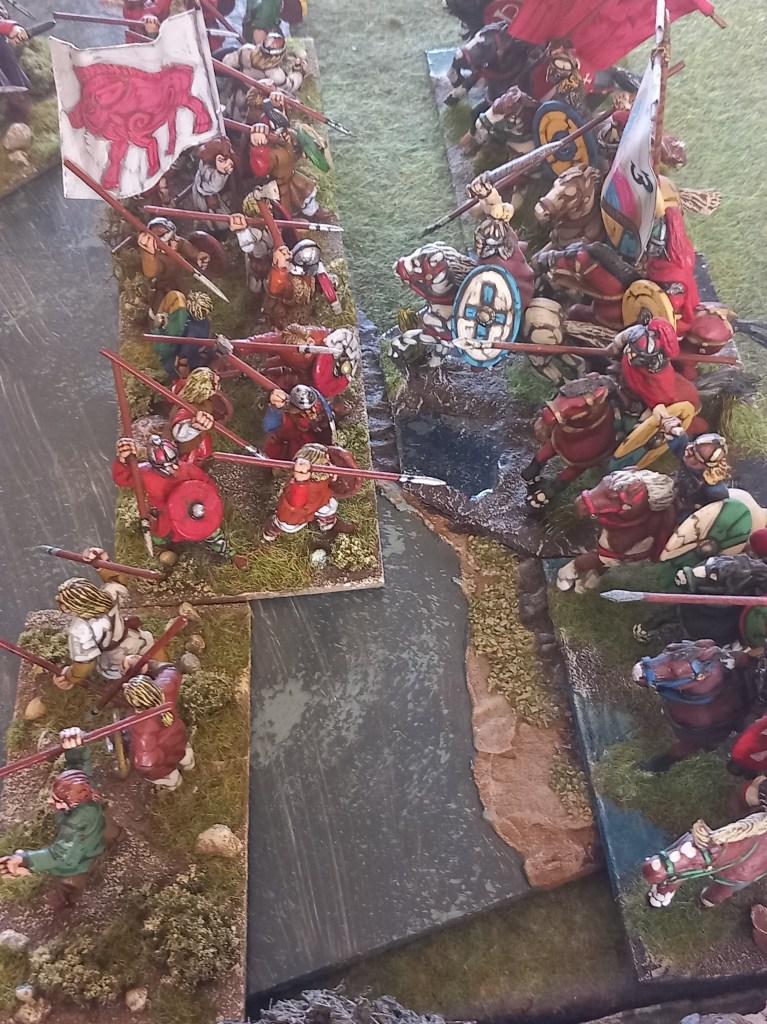
Aesc hampered by a stream he had to cross placed his seasoned Duguth on the left under Ebissa while he took the wild Geoguth on the right, the allied Britons were placed under Oslac but little was expected from them.

While the Jutes got their feet wet crossing the stream the Britons deployed themselves safely on the hills and sent the skirmishers forward.

Gambling that wet Jutes were not quite as effective as nice dry Jutes Artorius led his Equites into the leading Geguth unit. In truth this really was a gamble, the Jutes were pretty effective in the first round of combat and there was more of them, fortunately the Christian god smiled on Artorius and despite a glancing blow to his helmet the Jutes retreated and in the follow up the cavalry slew the heathens in their droves – or so the sagas say ๐Ÿ˜

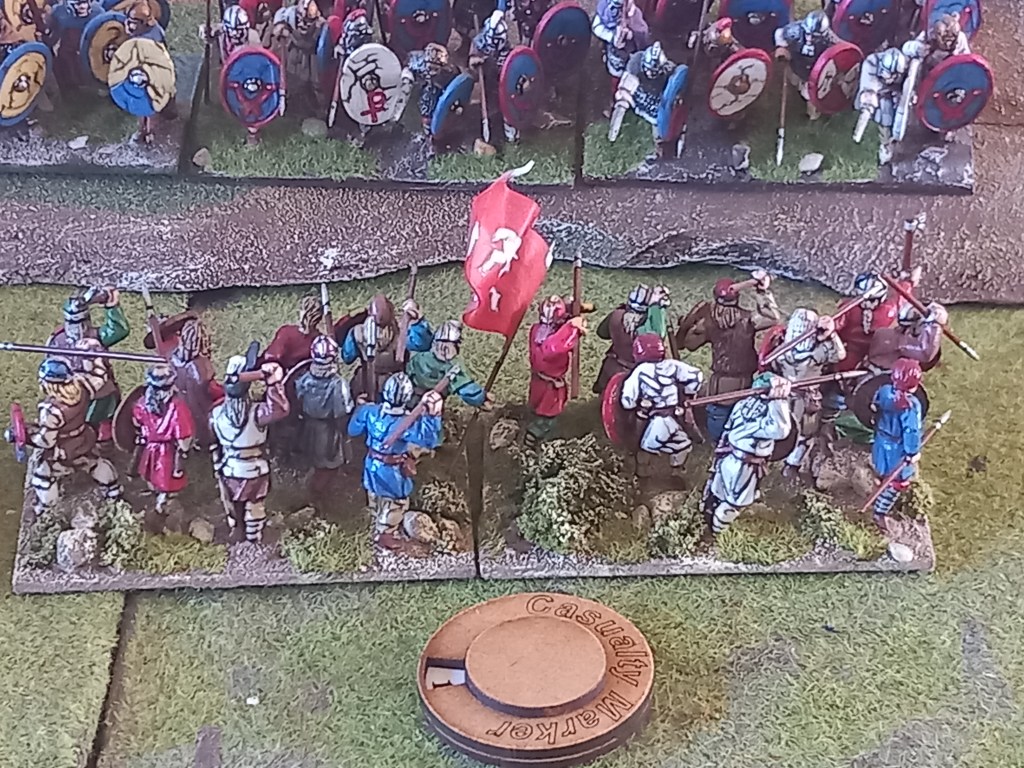
It wasn’t all about Artorius though as the Jutes were approaching the hills ready to do battle – notice how the skirmishers are nowhere to be seen ๐Ÿ˜‚

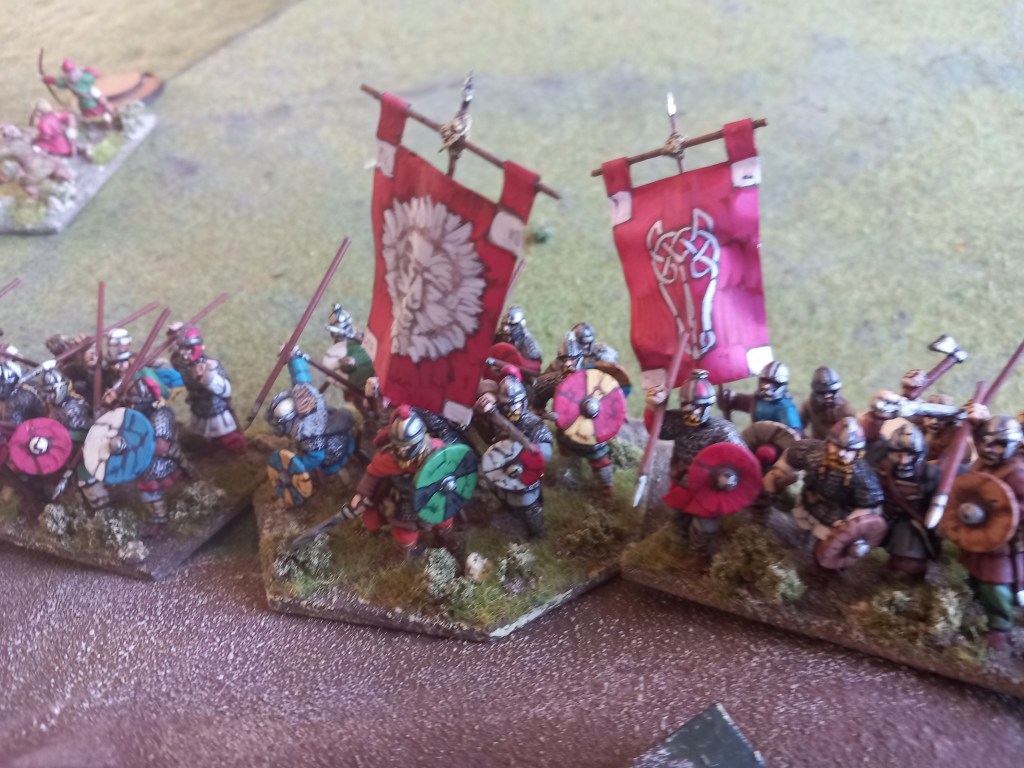
The Jutes charged all along the line, they were fiercer but the Britons had the ground.

On the right-hand hill the Milites just couldn’t cut it and after a short struggle they headed for home.

On the left hill the Limitanei fared better and pushed their opponents off as they prepared to commit both units.

Ultimately the Britons yielded the ground, the Jutes were over the stream and onto the hills, there would always be another day.

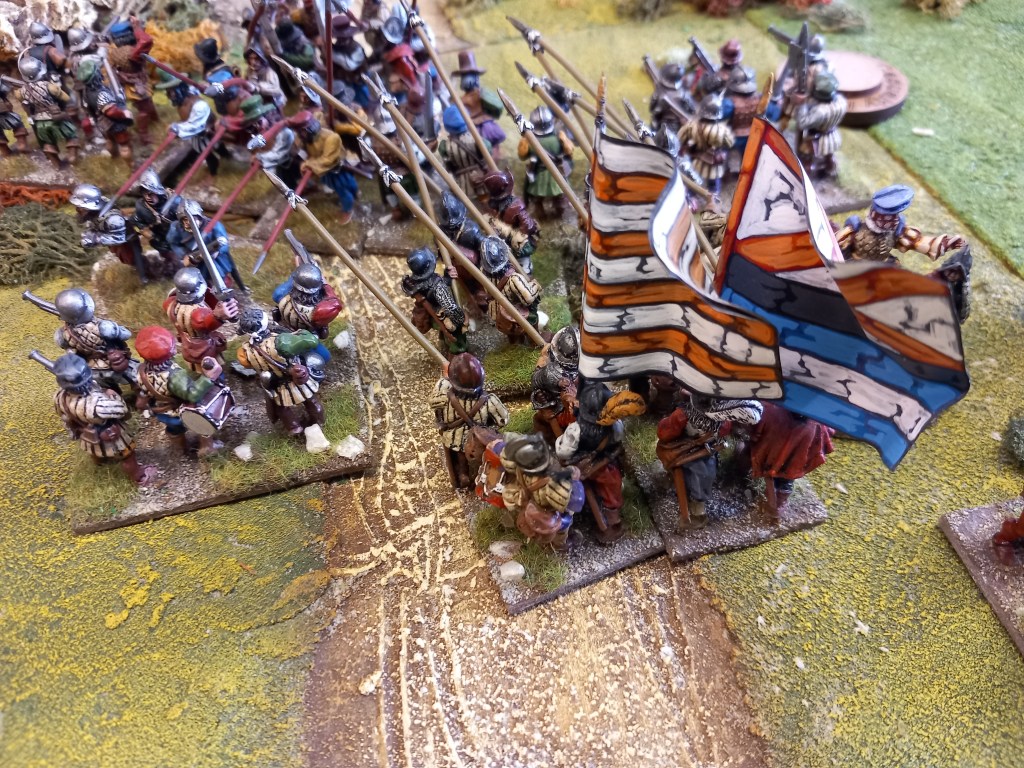
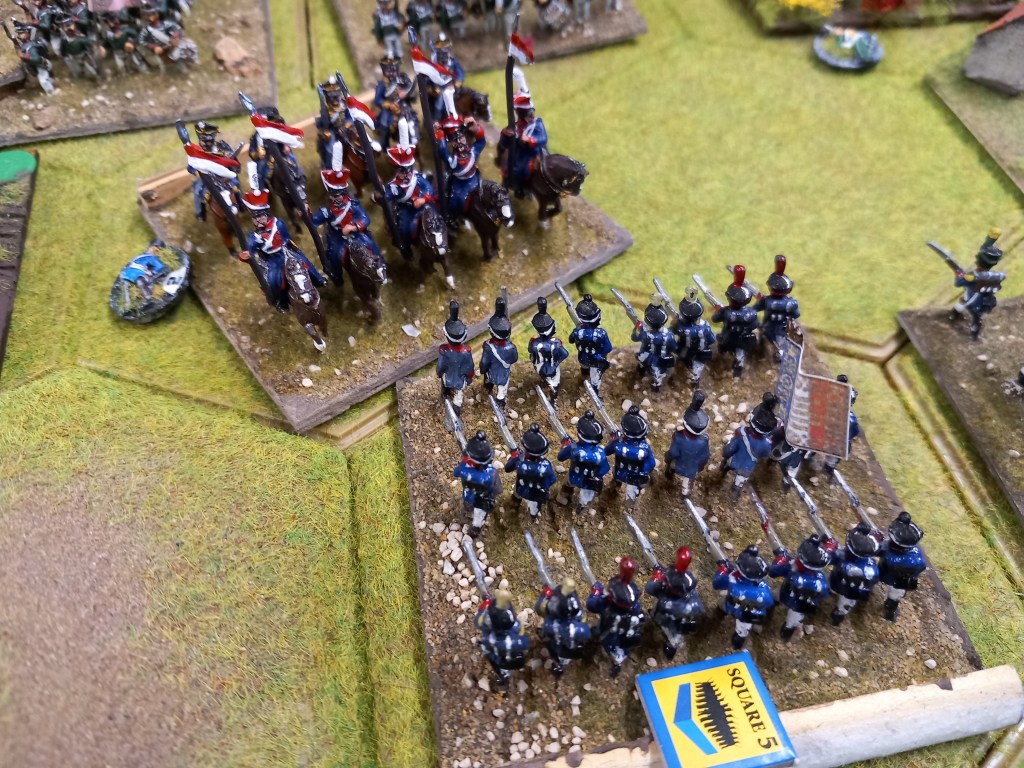
Our next endeavour was another first and an historical refight. The first was using Volley and Bayonet for a 15mm Napoleonic scrap and the historical refight was the battle of Sacile in northern Italy 1809, the first of three fought by Eugene in that campaign.

What a confusing battle, three points of entry for the opposing sides, different times of arrival, difficult terrain; a wealth of tactical decisions to make though.

A brief description of the game would see two French divisions (Severoli & Seras) attack the town of Porcia through very uninviting terrain, ultimately taking the town and destroying Frimont’s division.

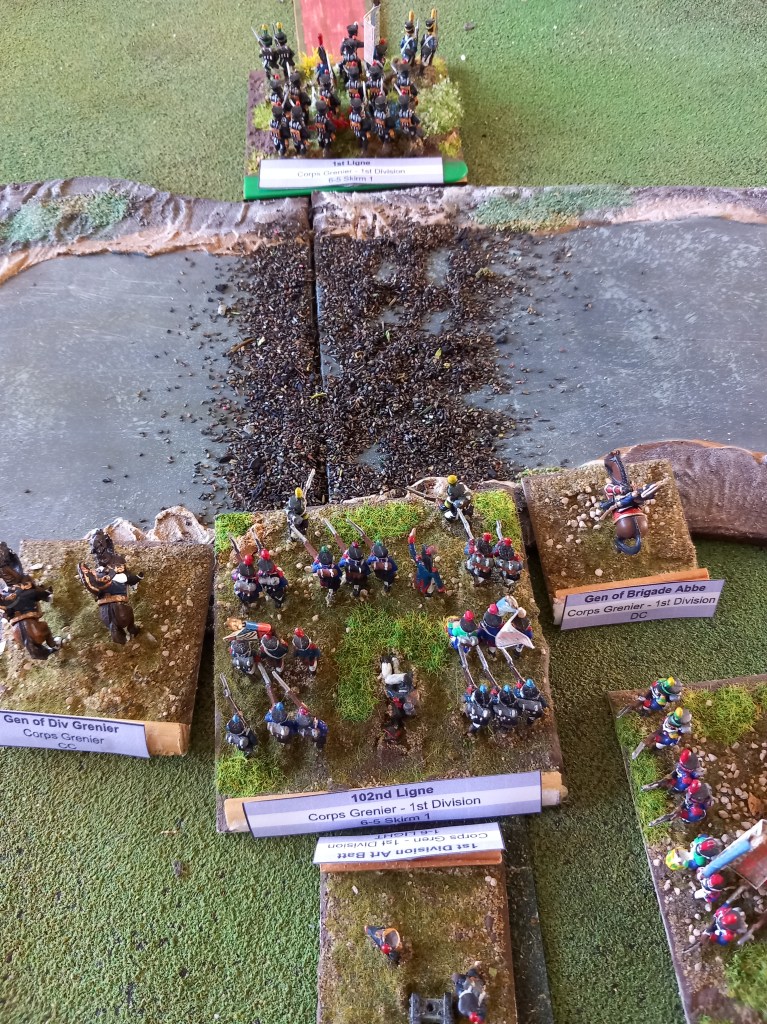
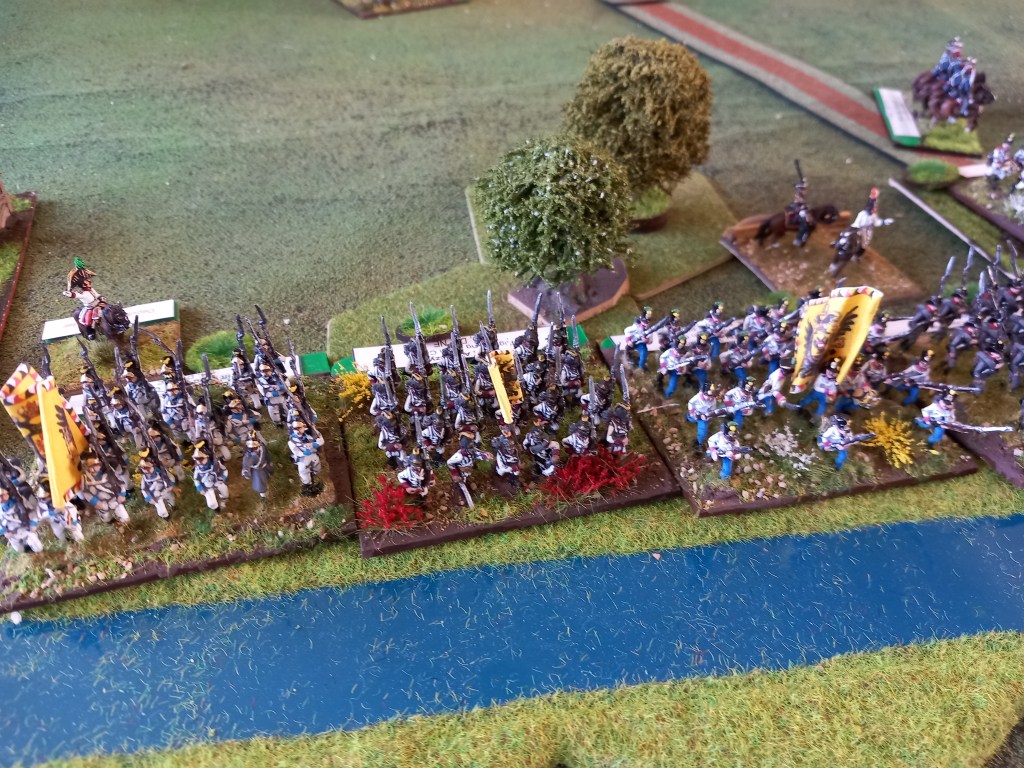
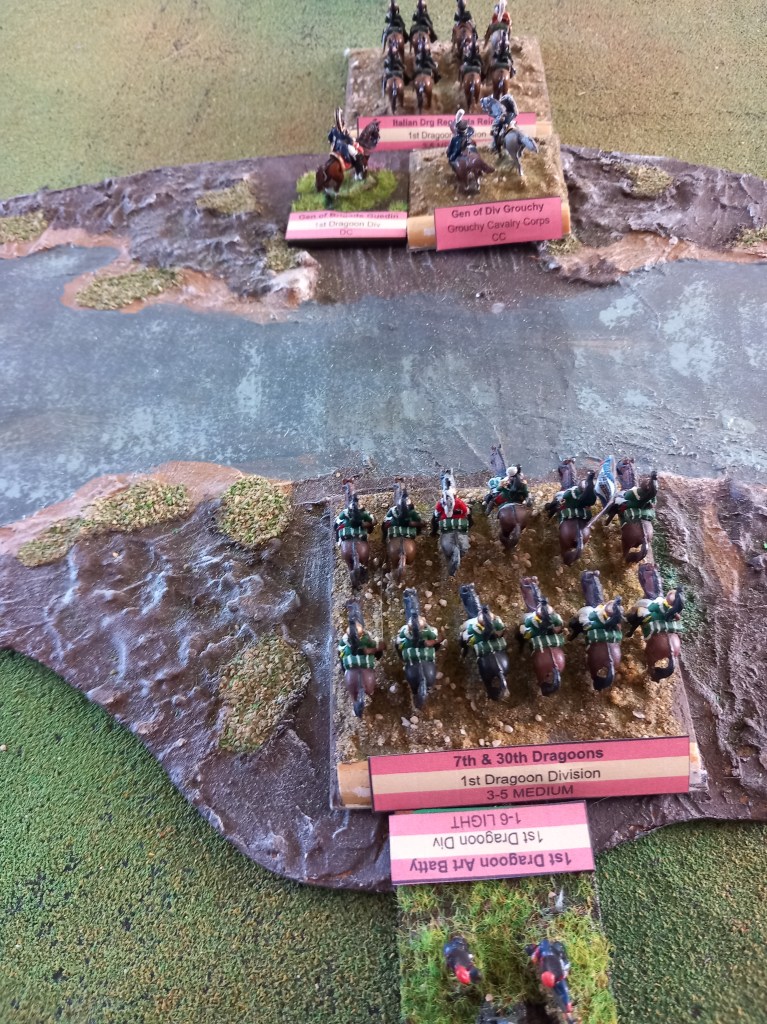
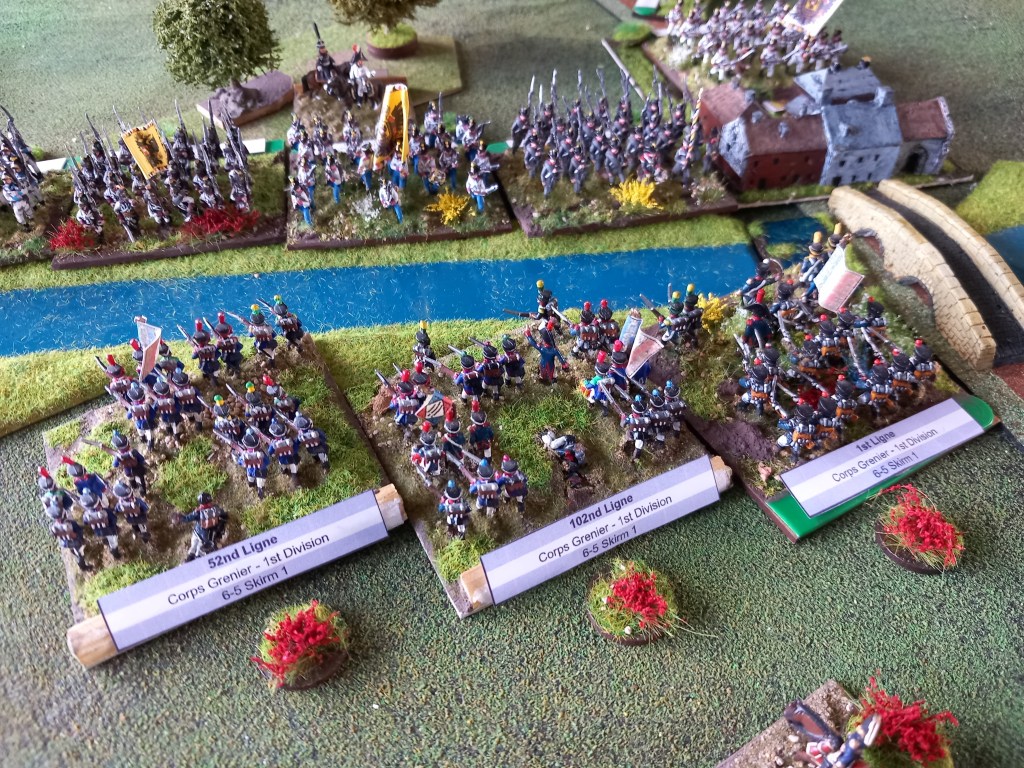
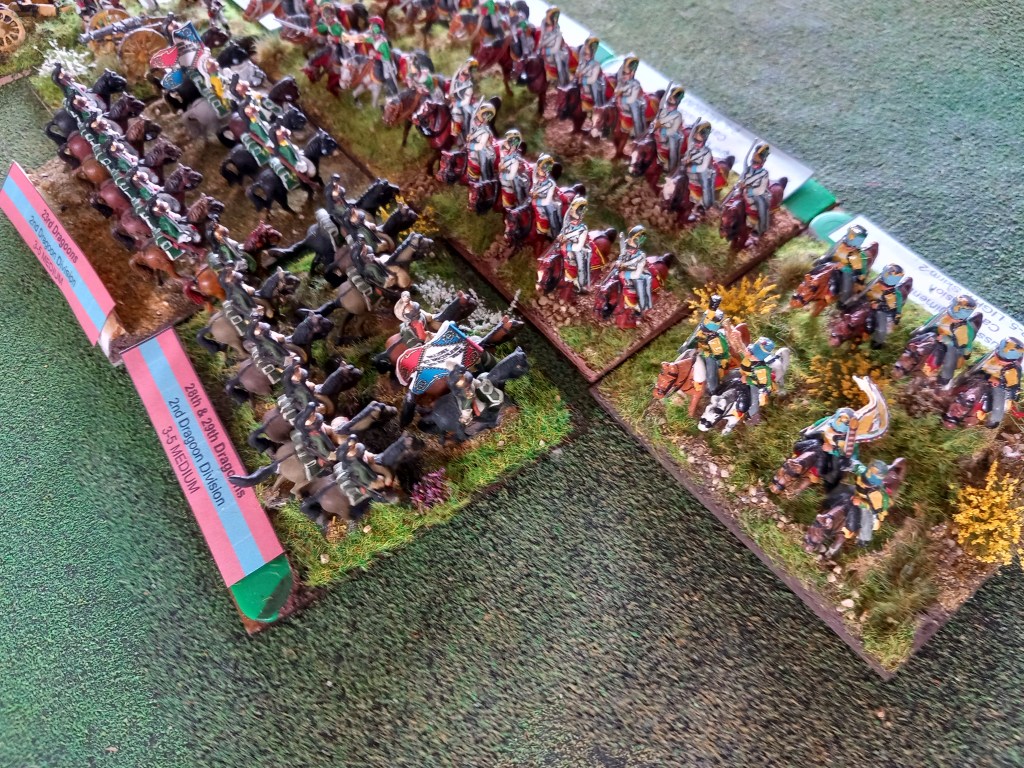
In the valley below the real action took place. Initially the French had the upper hand as the divisions of, Broussier, Grenier, Barbou & Sahuc, arrived bit by bit and force marched forward – I thought the rules recreated this really well. Early success however faded as the Austrian VIII & IX corps pushed more and more divisions into the valley outgunning the French and vastly outnumbering Sahuc’s cavalry who were duly destroyed.

The French initial attack was quite a success and confidence was high.

But the Austrian counter attack was successful

And then they really piled it on and the French had nothing left, Barbou’s division collapsed and both Broussier and Grenier were severely mauled, a definite Austrian victory.

Curiously, when we totalled the scaled losses, they were very close, Austrians 7000, French 6000.

I’ve never made any secret of my ambivalence to Napoleonic’s and the one big base equals a brigade concept is still a challenge reminding me of a board game BUT, unlike Command and Colours which at it’s core is a board game, this did give a real flavour of operating at a macro level and one which I would gladly play again.

We closed out the month as we started with a “reconquista” game, this time Christian Spanish against Muslim Andalusians, or Andalusian civil war ๐Ÿคจ

For this encounter the Muslim force deployed a long thin infantry line of alternately spear and bow units screened by skirmishers with two equal cavalry bodies on the wings. The Christians deployed with a strong central body of spearmen flanked by crossbows screened by skirmishers also with two equal bodies of cavalry on the wings.

Not surprisingly the initial clashes took place on the cavalry wings where the Andalusians had the better of it on both wings. The difference was the presence of skirmish cavalry on the Andalusian side who managed to weaken the Christians before their clash with their opposite numbers.

In the centre the Andalusians inflicted a steady flow of casualties on the advancing Christians.

Eventually the Christians stormed the hill and the tide looked like it was turning.

The Andalusian spearmen clung on desperately.

But the break up of the cavalry wings meant morale checks and that didn’t go so well especially as the camp was being looted. A clear Muslim victory.

And that was March. Best stop typing I’ve got the April game to organise ๐Ÿ˜

February 2025 Report

Well here we are, February been and gone but thankfully the games keep flowing.

Our first game was another from our Iran Iraq collection. In this one we did a version of the opening days of the war when the Iranian 283rd Armoured Cavalry battalion, comprised of Scorpions and M150’s, held off the best part of an Iraqi division for a couple of days.

For our engagement the Iranians started with a company of Scorpion light tanks, a company of M150’s – M113’s with TOW’s, and a company of M113 mounted infantry which were dug in and around the town of Karoun. An attack helicopter was on call via an FAC. Reinforcements in the guise of a mechanised infantry battalion, a Chieftain battalion and some off table artillery, were available once the fighting started subject to contact being made.

The Iraqis were deployed south of the Iranian position and comprised a full mechanised infantry brigade and a full armoured brigade plus an FAO with access to off table artillery. Their objective was the simple historical one, crush all opposition and advance towards Khoramshahr.

The Iraqis advanced on a broad front planning to overwhelm the Iranians by the sheer weight of their armour.

Historically the TOWs were very effective and they certainly were in the game, outranging the older Soviet armour used by the Iraqis and destroying them with ease.

The Iranians were also very fortunate with their communication roles and the off table rocket battery scored a devastating success early in the game.

In an effort to avoid the devastation of the TOW’s the Iraqis went on wide sweeping movements which did have the desired effect but also meant it took them longer to get into range.

Just as the Iraqis thought they might carry the town the Chieftains arrived and hearts sank – we’ve played enough games now to know that these dammed things are pretty much invincible ๐Ÿ˜

Suffice to say the town was held and the Iraqis suffered catastrophic losses.

We always have a wash up at the end of the session especially when one side has had their arse handed to them. Was it the rules, was it the players, was it the scenario? The TOWs are certainly powerful in the rules – Cold War Commander, but when you do the reading they brewed up dozens of tanks with less vehicles, scale wise, than we used – our 3 models represented around 9 of the real thing. From a scenario perspective I think I over egged the Iranian pudding a little because I feared it would be a walk over and we would be packing away in an hour ๐Ÿ˜‚ the game could probably have played just as well and perhaps been a little bit more of a nail biter without the Iranian reinforcements. Lesson learnt.

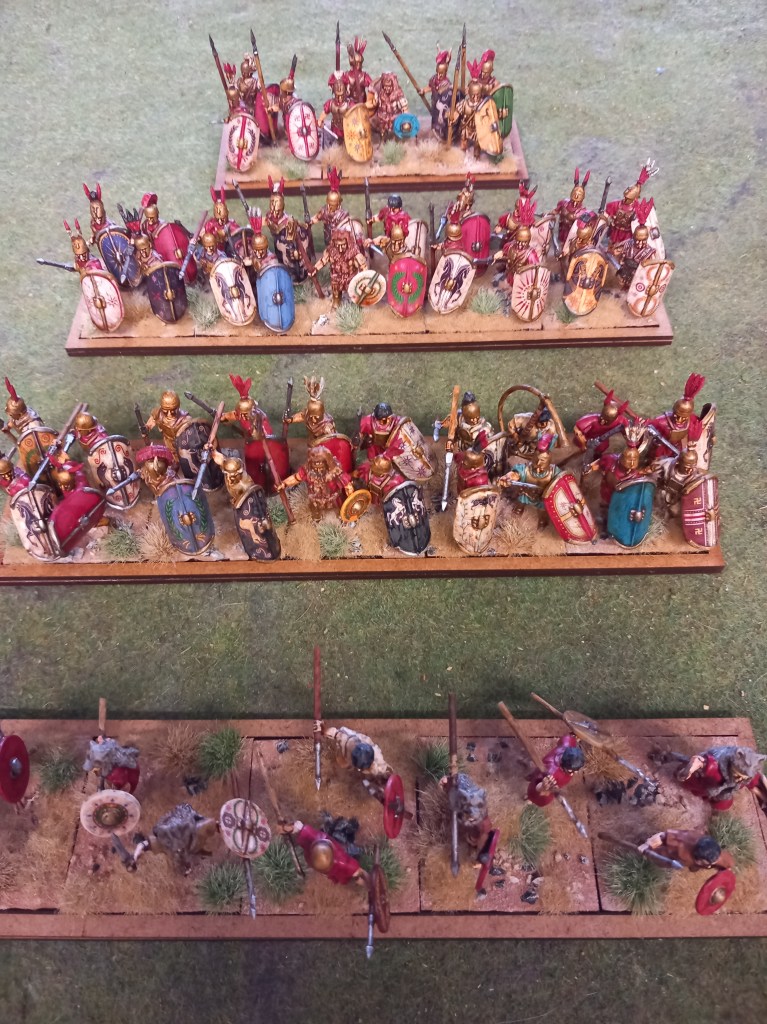
Our next foray was the familiar ground of the Successors but on this occasion we mixed it up a bit by deploying Republican Romans so we had Pyrrhus take on a consular army.

Now there is a bit of a story around this expansion of our period. When I wrote the rules I very specifically avoided taking it to the end of the dynasties at the hands of the Romans because A) it’s another army to do a list for and once you’ve done them do you do Carthaginians, and then…. and B) Republican Romans are notoriously difficult to represent – I’ve never come across a rules set that achieves it satisfactorily unless you go to such a helicopter view that the intricacies just don’t matter. However Dave started painting Romans because “I had some of the plastics knocking around” – what! several hundred plastics just knocking around ๐Ÿ™„

Suffice to say, the figures got done (and they do look lovely) and so I put together a single sheet of amendments to the rules to enable us to play something that maybe is a bit like the real contest as best we can decipher from the sources. As I said above I still haven’t come across a set of rules that represents the difference fully.

Anyway. Pyrrhus deployed in a classic manner, pikes across the centre, mercenary hoplites on the flanks, an elephant squadron to protect one flank and a few cavalry to protect the other. The Romans deployed 3 Legions, 2 Latin, 1 Roman, each Legion with separate (but connected) units of Velites, Hastati, Principes & Triarii, cavalry on the wings.

As always the initial action was on the wings where on one flank the Romans killed the elephant and then ran into the veteran pikes and died horribly and on the other where the cavalry on cavalry fight saw the Roman commander killed and that command halt paralysed.

In the centre we got what we wanted, pikes v pilum and the combat did sway back and forth a bit but the depth of the pike blocks and the fact that they were pikes won the day for Pyrrhus although the death of the consul acting as army general and the consul commanding the Latins probably did help a bit ๐Ÿ™‚

And that was it or should have been and I think this is worth noting as a lesson in sticking to your guns. Unfortunately one our Roman players got a little over excited about the loss, taking the stance that it was a bad game because the Romans lost; a point of view I think that comes from the popularisation of the idea that the Romans were forever invincible and therefore should never lose. The fact that Pyrrhus won all 3 battles he fought and that later Roman victories were against empires in decline and on unsuitable ground were lost in the debate.

For me the rather heated discussion demonstrated the rightness of sticking to what you know you’ve written a set of rules for and not something else. That said the amendments gave us a game, tempers cooled and seeing as we’ve got some very nicely painted Romans in the collection I’m now looking at version 2 of the amendments.

Our next foray was into the Thirty Years War using Gerard’s 15mm collection to re-fight Lutzen using the Tilly’s Very Bad Day rules.

We’ve only played these as a group once before and then not all of us so this was a bit of a steep learning curve.

The armies were laid out as per the historical affair with some caveats for differing the dispositions and then we had at it. Fairly obviously it was the Swedes who were doing all the heavy lifting, all the Imperialists had to do was sit back and wait behind the ditch and hope Piccolomini turned up.

As can be seen, you are playing at a higher level of command than say a typical 28mm game, here a stand represents a cavalry regiment or an infantry brigade, there are no losses to remove just a steady wearing down to record.

In terms of the history the Swedes didn’t do quite so well. At the ditch the infantry just couldn’t make it across and by the end of the game were well and truly stuck.

On the Swedish left, Bernard and his Saxons seemed to have the odds well and truly in their favour, their cavalry were more numerous, there was a gap to be exploited but it just didn’t come together, call it bad dice rolling, call it the random nature of the combat, the fact was the command was destroyed and Bernard killed. Done.

On the Swedish right it was all very historical, the Swedish cavalry pushed on over the ditch and were clearly in the ascendancy but just needed that final push (an extra dice for a commander in the melee). So in went Gustavus and just like that he was dead! The only consolation to the Swedish players was that Holk died in the same melee.

And really that was it. Two commanders dead and an infantry battle going nowhere, the Swedes were definitively defeated.

I’m really not sure what I think of the rules. On the plus side it’s not often you can fight a battle like Lutzen to a close in a few hours and come away thinking “well that seemed something like the history” and it not have been a massive headache inducing exercise. Also when standing back there was an element of looking at those C17th engravings that accompanied so many early publications on the period. On the negative side it did feel a bit artificial, almost like a board game, all the units look and act the same, there is no visible reduction in strength because there is no concept of figure removal and it is somewhat mechanistic. I realise of course that a lot of that is to do with my wargaming journey, I’ve always played 25/28mm (big and small games), figure removal is very much a part of that tradition and in most of those games you are down with the troops and not looking above them. That said I would like to play more of the period using the rules and just try and get over my prejudices.

A quirky interlude was an away game with a few of the guys in the wider Coventry area for an ancient skirmish game using the one hour wargame rules published by Helion (I think). Probably the worst set of rules I have ever played in my wargaming life and that is a long time. A deck of cards a few figures; everything decided by the random draw of a card from the deck, no period atmosphere, no skill, no fun.

Our final effort was a 6mm cold war gone hot game using Cold War Commander.

The scenario was a riff on the scenario in Jim Storr’s ‘Battlegroup’ whereby the the Soviet Third Shock Army breaches the IDB and British & Bundeswehr divisions respond. Perforce our encounter was a little smaller so we had a Panzer Brigade taking on a Soviet Tank Regiment in a race for the bridges over the River Oker.

This was one of those games where as the scenario designer you are a couple of moves in and you are thinking ‘this just isn’t going to work’ which was exactly what one of the other players was thinking (he later confessed), then about half way through it actually came to life. Phew.

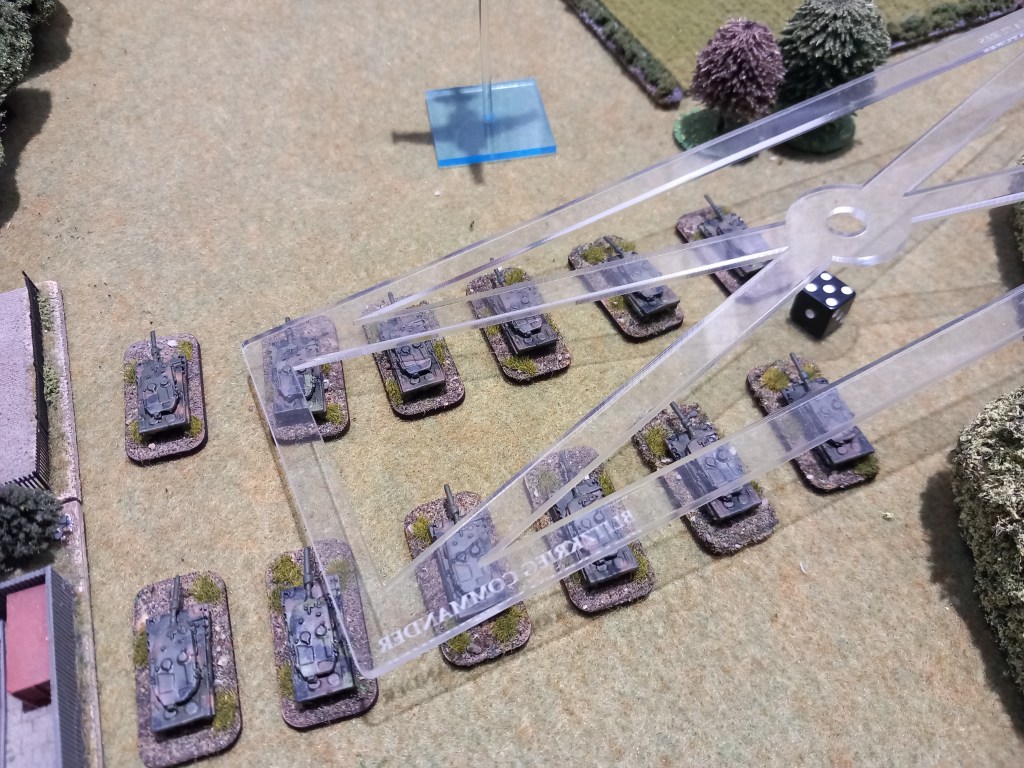
Apologies for the flying Leopard ๐Ÿ˜Because the armour could only cross the river via the suspension bridge this meant that the early phases of the game was both sides shooting across the river particularly as most of their ATGW couldn’t fire over water.

But in a bold move the Bundeswehr player stormed the suspension bridge (see previous photo) and the game changed. The Soviet flank was turned so they were scrambling all their battalions to face off to the Germans and the surprised Germans (I don’t think they thought the attack would really work) were throwing everything towards the bridge.

Annoyingly we didn’t get the game finished – a rare event these days but we agreed the Germans had probably shaded it based on losses sustained by the Soviets so far. Not completely satisfying but we learnt a couple more things in the rules we hadn’t realised were there or we just hadn’t tried so silver linings.

On the painting front I got the Iraqi support elements done so hopefully they’ll see the tabletop soon.

I got some rural built up areas done for the 6mm cold war. I was really pleased with these.

More rural delights ๐Ÿ˜€

Some military bridges got done.

And some railway lines.

And that’s it. Thanks for reading and enjoy your gaming.

January 2025 Report

Bloody hell January has gone! A better month than I thought it would be what with post Christmas & New Year activities to deal with so here are our efforts for the month.

First up was a game from our Reconquista/El Cid project which is progressing rather well.

In this one we had Christian Spanish v Moslem Andalusians, an ‘equal points’ game rather than a scenario driven game – it’s easy to deride ‘points games’ but if you are trying to formulate a set of rule mechanisms that work then this does give a level playing field to work from.

Our terrain was a line of ridges with a stream just behind running east to west, emerging from the hills and ending at one table edge, the ground opposite was fairly open.

As it was the beginning of the month our numbers were low so we actually played the game twice with different players. Strangely both sets of players chose almost exactly the same set up with no knowledge of the previous player choices.

The Moslem forces chose the ground behind the stream & ridge line and in the first game deployed their spearmen covered by skirmishers out of sight behind the hills, in the second they deployed the infantry on the left hoping to move to the stream and deny a crossing to the Christians. With their cavalry; in the first game they deployed their jinettes and two units of retainers on the left and their nobles and two other units on the right, in the second game the jinettes were behind the ridge line and all the cavalry on the right.

In both games the Christians deployed their infantry in the centre – militia spear and militia crossbows screened by skirmishing slingers and bowmen while on the right their caballeros (retainer cavalry) were deployed and on the left the military orders and noble cavalry.

In the first game it was all about the cavalry. On the Christian left the nobles and military orders swept away the opposing nobles and retainers and on their right fought a tougher but ultimately successful series of melees which saw that Moslem flank also collapse. In the centre the Moslem infantry gained the ridgeline and held off the Christian centre but with both flanks swept away it was a clear Christian victory.

In the second game it was a much more even handed contest. The attack of the caballeros at the stream was met by the spearmen who defended the stream with tenacity and despite the the caballeros forcing their way over at one point their losses were too much and they fell back. On the Christian left the veterans and military orders were met by more numerous opposition and a couple of decent class noble units which ultimately proved decisive and the Christians fled with severe losses. In the centre the Christian infantry gained the ridgeline with little hindrance but so what? and in fact the overspill of Moslem cavalry from the Andalusian right started to cause problems for the crossbowmen, one unit of which was ridden down. So with the stream held and the best Christian units seen off an Andalusian victory was declared.

Although two games of the same scenario is not really our thing this did in fact prove very useful in that we were able to prove out the last rules mods and now have something that will see us through some consistent play. The particularly positive outcome was that we now feel confident enough to do the game at the next Partizan so come and have a look if you are there.

Our next effort was a step back in time and a re-fight – the battle of Panium, 201BC.

I knew nothing of this battle until one of the guys pointed out the recent article in Wargames Soldiers & Strategy by Mark Backhouse. As it featured later Successors (Ptolemaics & Seleucids) it talked to one of our loves and as we had just finished up some more cataphracts it seemed very serendipitous!

If you want a detailed read then turn to Mark’s article or if you fancy yourself as a scholar dig out Polybius Book 16 but I warn you it is just as confusing as Mark says! A precis of the battle is as follows; the Seleucids deployed with their cataphracts on the right stationed on Mount Hermon, the centre was the usual array of pikes covered by skirmishing infantry & cavalry plus elephants and the left was a smaller cavalry force; the Ptolemaics were weak in cavalry and so deployed limited numbers on both flanks but had a strong infantry centre of pike & Thracians screened by numerous skirmishers. The Seleucids opened the battle with a furious charge of the cataphracts off the hill which swept away the opposition, seeing this the Ptolemaics pressed the attack in the centre and seemed to have gained the upper hand but the victorious cataphracts returned and enveloped the Ptolemaic left at the same time as the Seleucid left turned in on the Ptolemaic right and the game was up.

Our refight used the order of battle presented by Mark, translated into our rules and lists which came out as follows: On the Seleucid right, 3 x cataphracts under Antiochus the Younger, in the centre, under Antiochus the Great, 4 x pike (including the elite silver shields) screened by a unit of Cretan bow and a unit of Tarentine light horse with 5 x elephants placed at intervals between the pike, on the left a single unit of Agema heavy cavalry and a unit of local formed cavalry under Nicarchus (conjectural). On the Ptolemaic left was 2 x formed cavalry under Ptolemy, in the centre 6 x pike, and a unit of Thracians screened by 4 units of skirmishers of varying quality and out on the right the overall commander, Scopas, with a single unit of Agema cavalry.

Our refight was a classic example of how wargamers can break the historical narrative and the reason why we play.

As is always the case with these kind of games it’s all about the cavalry to start with. On the Seleucid right the cataphracts lumbered off the hill (hardly a furious charge ๐Ÿ˜‚) but the Ptolemaics got the initiative when it came to contact and got in first precipitating a drawn out melee which ultimately saw the one unit of cataphracts fleeing. Fast forwarding, this flank then devolved into the other Ptolemaic unit being routed by it’s opposing cataphracts and the the third cataphract unit advancing to the Ptolemaic camp and begin looting. On the other cavalry flank the clash of the Agema resulted in the destruction of the Seleucid version and their supporting cavalry was shot down by Ptolemaic skirmishers, the Ptolemaic Agema however was in no state do do anything further.

In the centre we got to do the thing we love, shove long pointy sticks at each other ๐Ÿคฃ

Both sides advanced steadily and in the initial missile exchanges the Seleucid Tarentines were quickly eliminated. The Ptolemaic levy skirmishers who made up half the total performed surprisingly well which demonstrated that crap troops can do well enough if not overly threatened. The Seleucid elephants had a good start when being used as a shooting platform and assisted in the destruction of the enemy Aetolian javelin men.

Once troops started to close then it became more hard core. The elephants had to start earning their keep and that was a bit of mixed bag. Two elephants (well squadrons) got stuck in with the veteran Ptolemaic pike and paid the ultimate price although it did slow those units down and broke up the nice neat lines. Unusually only one unit panicked and of course that ran into it’s own pike effectively pinning that unit, the other two essentially hung around never quite getting the courage up to get stuck in – well who would!

The battle of the pike battalions went pleasingly well from a game point of view but the Seleucids were having a far harder time of it than their historical prototypes. The Silver Shields destroyed the Thracians, great for them but probably a poor use of an elite unit. Further Seleucid success saw the rout of one levied pike and one mercenary pike on the Ptolemaic side with the loss of only one mercenary pike on the Seleucid side.

As we reached the prescribed number of turns assigned for the game it was clear a Seleucid victory had been obtained. The Ptolemaic camp was looted and so the focal point for rallying was lost and they had more units in the wind. Not the decisive victory of history but a dammed good game.

A bit of a sidebar note, I did speak to Mark about doing a write up of the game as a follow on from his article to offer a bit of a different perspective from his own rules but he advised that WS&S policy wasn’t to publish battle reports. Their loss your gain ๐Ÿ˜‰

Up next was another Cold War Commander this time with our growing 6mm collection, both in terms of hardware but also the terrain, I think we have made some serious progress ๐Ÿ™‚

We opted for the ‘Battle of Attrition’ scenario from the rules which is exactly that, kill more of the opposition than they kill of you within a fixed number of game turns.

Given that both sides start in fixed positions, somewhat randomised by the roll of the dice, this is a bit of a cat and mouse game and on reflection I’m not convinced of its historical veracity.

Regardless, both sides manoeuvred to try and get the advantage, the Soviets to use their superior numbers and the potentially devastating Hinds with their onboard ATGW arsenal, the Bundeswehr to get the best out of the superior range and superior armour of the Leopard 2’s.

The vulnerability of the Soviet armour was demonstrated several times although in fairness presenting your flank to enemy fire does tend to result in disaster ๐Ÿคฃ๐Ÿ˜‚

Ultimately the game was a NATO (Bundeswehr) victory but probably not one of our more satisfying games. The rules, like any set of rules, have bits where you go “really?” but I think it was the scenario that was a bit self defeating, more of a narrative game next time I think.

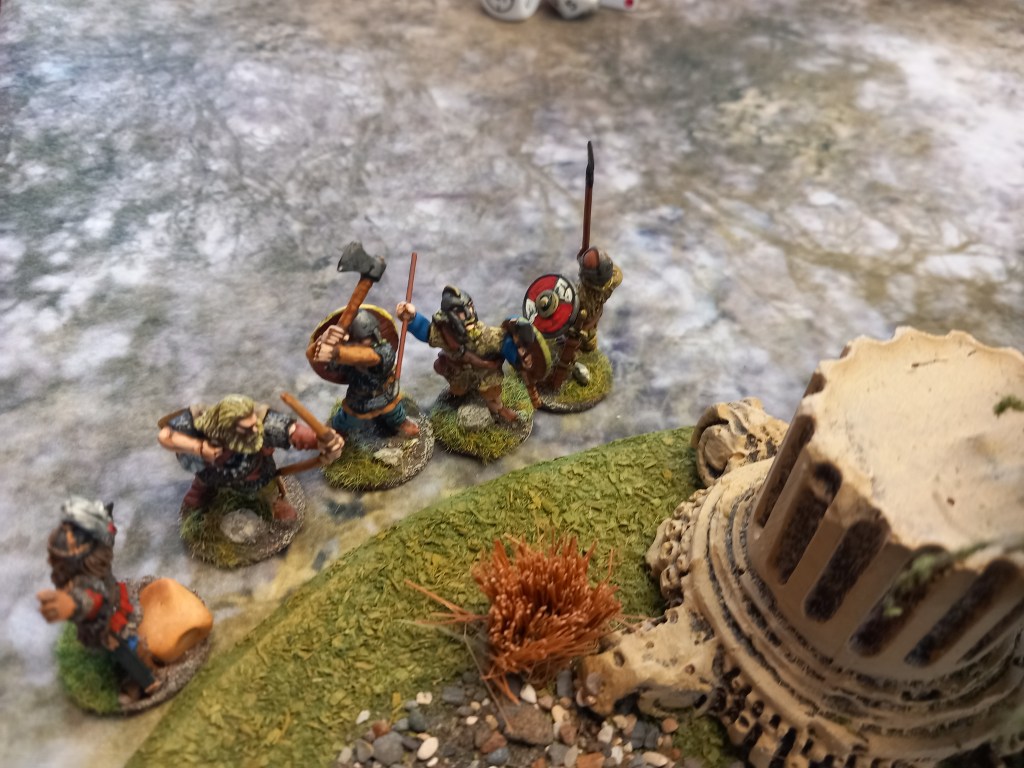
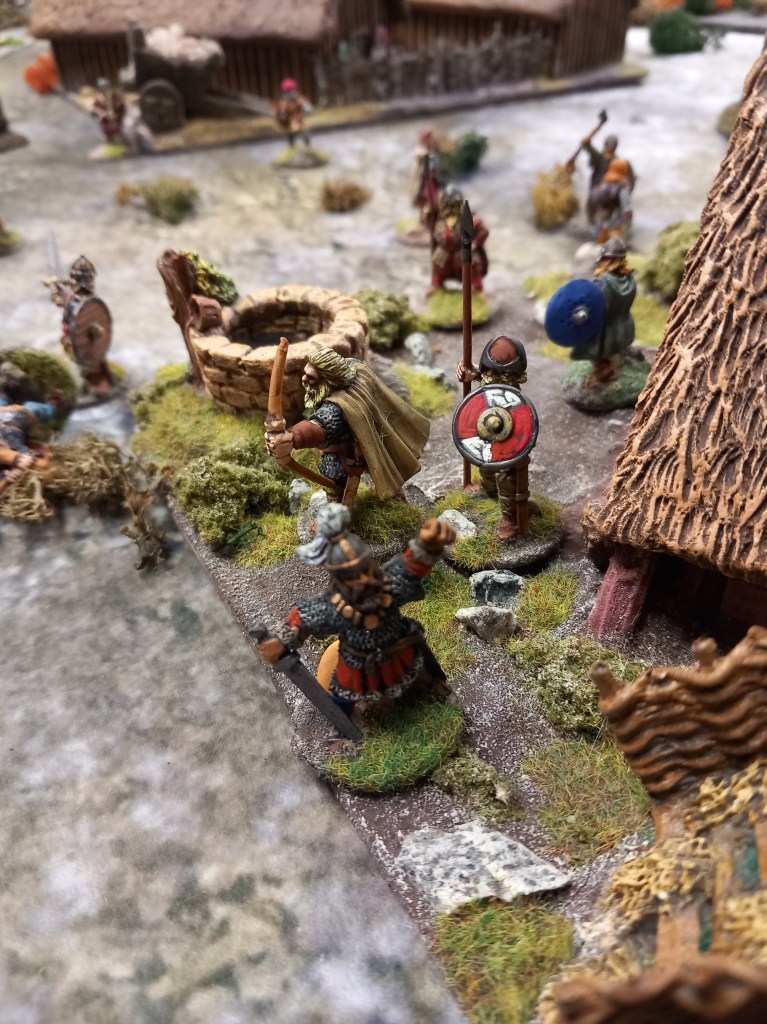
By way of a complete change our next effort was a Viking skirmish, two roving/allied bands out to loot a rival settlement getting ready for winter.

The raiding bands had the rather obvious objective of obtaining loot, ranging from livestock to hidden wealth, the settled Vikings the objective of seeing off the raiders and killing enough for them not to try again. Forces were positioned randomly on the board.

The raiders approached from the north and the east under Eanmund and Halfdane respectively. Eanmund headed for the isolated smithy to start while Halfdane skulked around the vegetable patches.

The village guard dogs were completely useless and it was complete luck that one of Hygellac’s crew saw Eanmund’s band at the smithy. Horns were sounded, to battle!

The game quickly became the battle for the smithy – not quite Beowulf level but hey ho ๐Ÿ˜†

The ‘battle’ eventually sucked in Hrothgar’s band from within the village and a lopsided fight saw Eanmund fleeing the scene bleeding from his wounds, his armour rent and his sword notched.

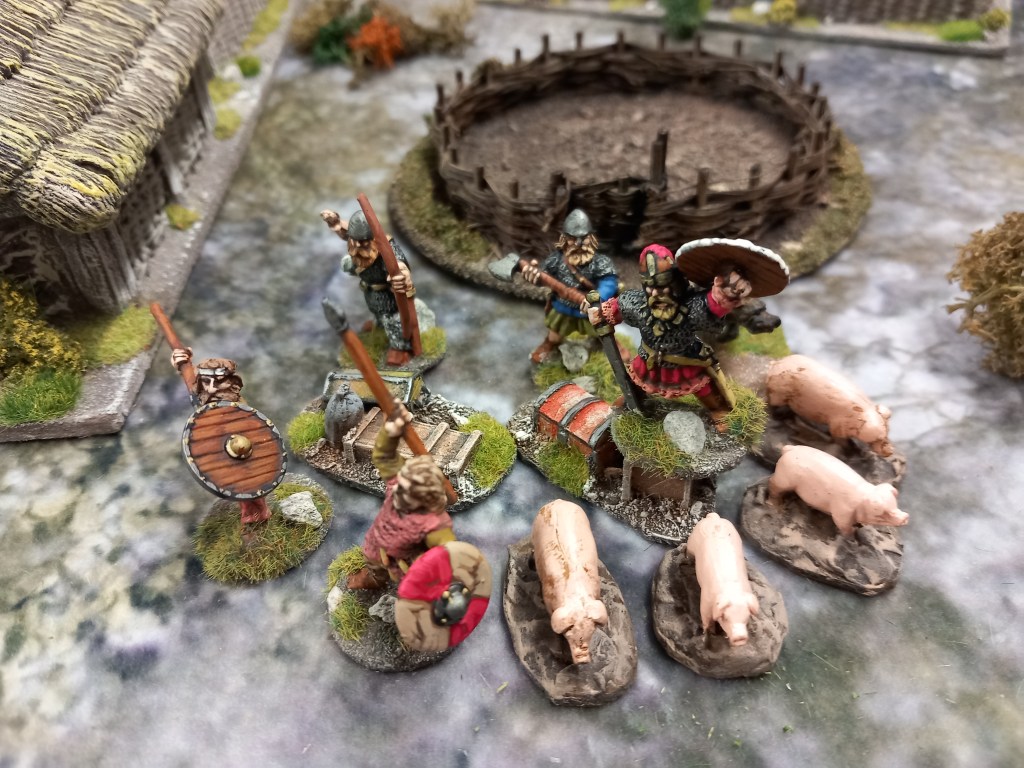
But what of Halfdane and his band I hear you ask? Well, with the guard dogs having wandered off and Hrothgar having heeded the call of the horn it was time for some easy looting.

In fact Halfdane was the clear winner, livestock taken and some of the lesser valuables looted, a fine day out ๐Ÿ˜„

Next up, Italian Wars, Florentine and Venetians squabbling about real estate in Mantua.

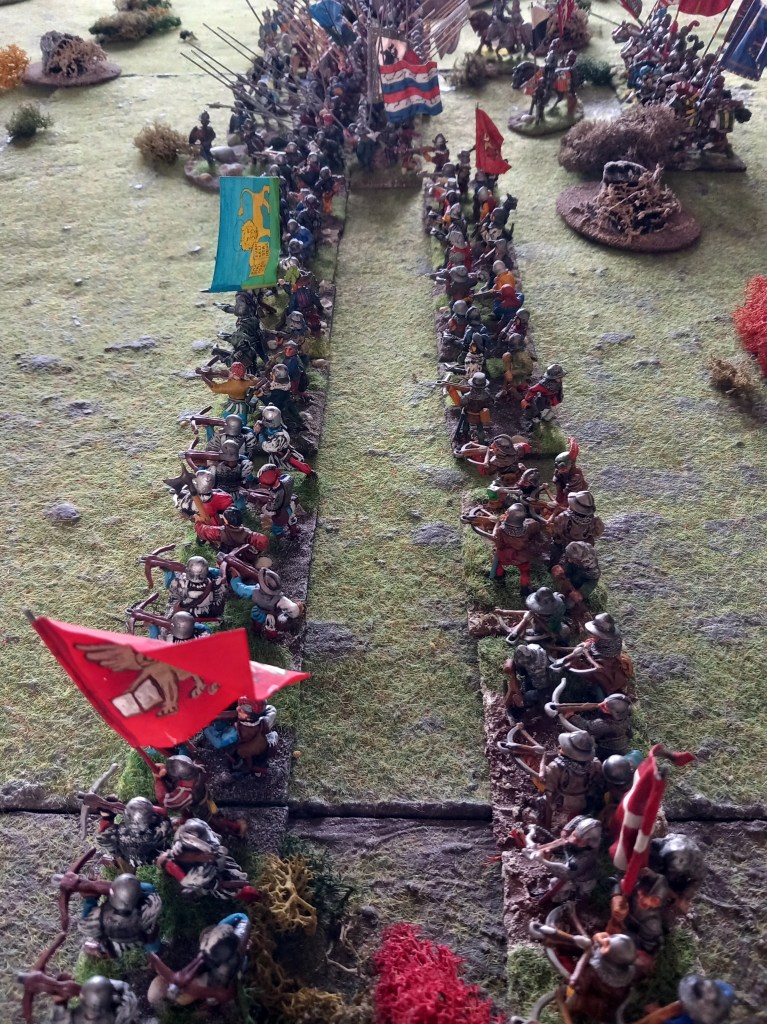
Both sides fielded pretty large forces. The Florentines were strong in militia crossbows & pike supported by mercenary condottierre and mounted crossbows. The Venetians slightly outmatched the Florentines in cavalry and did have the better quality Lanze Spezzate while their infantry was a more eclectic mix of professional crossbowmen and mercenary pike & crossbows. Both sides had a smattering of skirmish horse.

Both sides deployed their battle cavalry on the right flank, the Venetians screened by a wood and the Florentines planning to use the town to anchor their flank. Given the number of crossbows in their army the Florentines strung them out in one long line hoping to get the best out of their firepower, the pikes they deployed on the right centre. The Venetians had deployed their Provisionati (professional crossbow) opposite the Florentine condottiere so their plan automatically became shoot the heavy guys before they ride you down, the mercenary pike and crossbows were deployed in the centre. Both sides had formed units of crossbow cavalry, so not skirmishers, which they deployed on the flanks – history tells us there were thousands of these guys and generally ineffective they were too.

The initial aggression was shown by the Florentines who got their condottierre moving (after a bit of persuasion) in the direction of the Provisionati.

To fast forward a bit the Florentine condottiere weathered the storm of crossbow bolts that met them and ultimately swept away the Provisionati which ended the participation of both combatants for the game.

In the centre we had general disappointment, despite some fairly effective skirmishing neither side could get their pikemen to get stuck in. A mix of poor dice rolling and low rated captains meant that all they did was stand and stare – we did have a discussion about this and although not completely satisfying from a gaming perspective we had to acknowledge that historically these units weren’t that effective in the field.

The game was lost on the Venetian right. The cavalry block advanced late from behind the wood and ran into crossbow fire from the Florentine crossbows on this flank but it wasn’t the casualties that stopped them it was the death of two captains that stymied the advance and led to more casualties and ultimately morale failure.

With the centre deadlocked but the Venetian right stuck and the left lost we gave the victory to the Florentines.

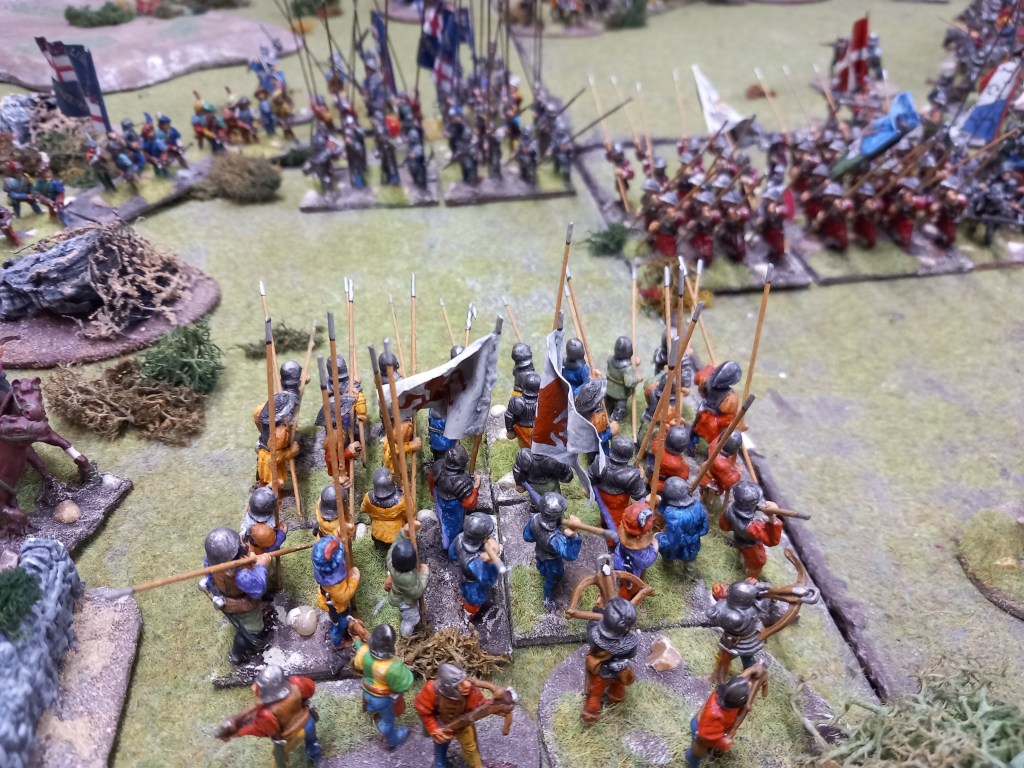
Our final effort of the month was a refight of the battle of Vimeiro 1808 using Command and Colours in 15mm.

My understanding of Vimeiro is that Wellesley, with slightly superior numbers, defended his position at Vimeiro and the adjacent ridge against several uncoordinated attacks by the French under Junot and drove them off with significant losses and ended the French intervention in Portugal.

For our refight the troops were set out as per the historical prototype using the map supplied with the rules.

Being coordinated or otherwise is rather at the discretion of the cards drawn and the playing of them.

In the centre and right the British attempted to get as many units in and around the village of Vimeiro as the cards would allow as well as trying to wear down the French attackers.

On the British/Portuguese left there were a series of moves and counter moves with the French as each tried to seize a village I’ve forgotten the name of and was in fact completely unimportant.

The game was won in the centre where the British just couldn’t get enough troops around Vimeiro to defend it and the French didn’t obligingly launch piecemeal attacks. Conclusive French victory.

I’ll freely admit the rules don’t really do it for me, the card thing is just too abstract and the use of a unique dice mechanism too random. That said though the rest of the group are all Napoleonic fans and there are plenty of battles to fight so we will continue to feature these in our play.

Well that’s it I reckon, not much done on the painting scene although this Iranian armoured recon battalion did get finished along with some road sections, most of the month has been spent on terrain items for the 6mm. So, signing off, please feel free to comment and look forward to posting in a months time.

Dreams For 2025

January is usually a bit of a slow month to get going so with time on my hands I thought I’d reflect on what the group could tackle going forward.

Historical re-fights. Once the life blood of the hobby but not so much so these days. This year we have made a bit of an effort to stage some of these but it has to be admitted they take more organisation than a pick up game or even a narrative game and the reward v effort has to be weighed carefully.

Some of the periods of history in the collections lend themselves fairly well to a re-fight. Our Successors have achieved some good results as have the GNW, Sikh Wars, Wars of Religion and Carlist Wars and there is still more we can probably do with these – fight them through chronologically for example? Other periods suffer from the shear size compared to the scale we happen to have chosen to collect in, others from the dearth of information available, but maybe we just aren’t trying hard enough?

Going forward it would be nice to fight some Thirty Years War battles using Gerard’s 15mm collection under Tilly’s Very Bad Day. The re-vamped War of Austrian Succession in Italy might also be a possible choice, although this may need some additions. On a tricorne theme my French have been waiting patiently for Dave to complete his British for about 5 years now ๐Ÿ˜‚and there are plenty of battles in Savory’s seminal work, maybe 2025 will be their year?

The Victory at Sea collection is most definitely big but the real thing is massive! No way can we fight any of these. Maybe this would lend itself to a mini campaign? Worth think about ๐Ÿค”

Having conveniently mentioned campaigns above this is one of those things we haven’t tried at all. Certainly they can be a curse for any group/club no matter how big the group or how tight the players – certainly the experience of two of us in a medieval campaign away from home in 2023 was not positive despite the tremendous efforts of the umpire.

Despite the risks I’d like the group to to consider it but choosing the period/campaign will be tricky and the density of the campaign rules would need to be considered carefully. A limited theatre game using our modern collections might work – 10mm Iran/Iraq or 6mm 80’s Cold War or a more formal C18th game.

Weekend game. Or just a longer game. Currently we meet at 10.30am, chat a bit, play until lunch time, break for about 40 minutes for lunch and then crack on until tea time – anywhere between 4.30pm and 6.30pm. Usually perfectly adequate and luxury compared to those who have 3 hours max at a local school/community centre etc and we are well aware of how lucky we are. But occasionally we are left thinking, ‘if only’, a common wargamers complaint and usually when you have bitten off more than you can chew in the choice of the game or you have chatted on too much prior to the game starting – definitely guilty on both counts ๐Ÿ˜.

The weekend game is definitely a wargamers holy grail and hiring a hall for a weekend wouldn’t be beyond us financially but would require some organisation by someone. What might be a consideration would be to play in the knowledge that the game is staying up until the next time – next day, next week, whatever. This might allow us to do a narrative where the first day (or part of it) was the initial probe – reinforced recce elements in a modern game, advance guards from C18th & C19th forces, etc.

As I’m typing away I’m thinking maybe this would be a way to ease us into a mini campaign, limited theatre, say the Shenandoah Valley campaign, some map movement, forces collide, games ensue, lasts two or three meet ups. Maybe it would work for the Victory at Sea idea of re-creating an historical engagement?

Skirmish games. In a previous incarnation skirmish games were a staple of the group mainly because we were constrained by the 3 hours and you’re done format. Over the last couple of years however the vibe has changed, we are no longer constrained by the 3 hour set up and around half of the group nowadays is pretty anti the whole skirmish thing.

This does present a bit of a problem. As the original creators of the group Dave and I have a ton of skirmish stuff which represents an obvious investment issue and because skirmish gaming is terrain heavy also gives a storage conundrum. The other week we had the hard conversation about what we could get rid of (along with the stuff we just aren’t using anyway) but each period has a level of emotional attachment which is difficult to break.

The alternative is of course to effectively recreate the 3 hour game by playing separately one afternoon or morning with those who fancy a bit of a gunfight or Viking raiding. Discussion to be had.

Joint projects. We have never discussed this in the group as it now stands but I think it could be worth the trip. There is always the risk that someone can’t/won’t commit but a couple of units in a wider project shouldn’t be too much of a stretch especially if we go for the mini campaign idea or if someone says “I’m thinking of doing……” and everyone else says, “I’ll do a couple of units”. The lead would have the task of basing other peoples troops to ensure a level of conformity but no big deal I reckon.

Sharing the burden. The simple fact of life is that 75% of games are played in my games room and therefor I organise the bulk of the games which can lead to creative staleness on my part. Some steps were made last year to remedy this and maybe if we do some of the things discussed above the staleness might go. Alternatively I just need to say, “guys, somebody else needs to organise”

I think I’ve waffled on long enough now and I’ve got NFL highlights to watch. Certainly given myself things to think about and ideas to float with the group, but not all at once ๐Ÿ˜€. So until the January round up, farewell and have a good new year.

December 2024 Report

Well the year is drawing to a close and the last game has been played; we managed 56 games as a group this year so we’re feeling pretty dammed pleased with ourselves, hopefully more of the same next year.

First game in December was another of our Successors encounters, this time Royal Ptolemaic v Late Imperial Seleucid, basically around the time of the 5th Syrian War. The Seleucids had a bit of everything, elephants, chariots, cataphracts, Bedouin camelry and of course a core of phalangites & psiloi. The Ptolemaics were also varied but in a different way, yes they had a core of phalangites but lacked significant numbers of psiloi so instead had Galatians & Thracians to supplement their numbers, on the horse front they outnumbered the Seleucids but lacked armour.

The Seleucids deployed their elephants in the centre astride the road that ran between the two armies. On the left was the cavalry wing comprising the line cataphracts, the Agema, the chariots, the Bedouin and the Tarentine skirmishers. On the right was the 4 pike blocks angled diagonally away from the centre with a unit of Thureophoroi anchoring the end of the line against some hills, levy psiloi screened the front. The Ptolemaics deployed their phalangites in the centre astride the road screened by their psiloi flanked to the left by the Thracians and to the right by the Galatians. In a curious move a single phalangite block was deployed to the right of the Galatians and to the right of that the allied and mercenary cavalry, Greeks, Thessalians, Galatians & Tarentines. The Kleruchoi (settler) cavalry were deployed to the left of the Thracians.

As is nearly always the case the game began with the cavalry. The mighty cataphracts trotted forward on the Seleucid left making sure to give the chariots plenty of room ๐Ÿ˜. The Ptolemaic cavalry advanced on both wings, the Kleruchoi engaging in a wide sweep to come round the hills and roll up the Seleucid flank, the allies & mercenaries gulped and rode toward the men in tin cans and the idiots in chariots.

For once the chariots did what they were meant to do and blew up the enemy cavalry line. One routed the veteran Thessalians and the other was just a nuisance as the other cavalry tried to avoid it until the single phalangite block trampled over it – oh that’s what it was there for ๐Ÿค”

The action on the Ptolemaic right continued to be disadvantageous as the cataphracts duffed up the Greek & Galatian heavy cavalry and pursued them towards the camp.

The elephants were fun as always. I completely get the attraction of these lumbering beasts for ancient generals despite their general lack of success, you just weren’t one of the cool kids if you didn’t have some ๐Ÿ˜‚

Our elephants did manage to do everything we wanted in this game, they were a bloody nuisance, they panicked, they fought and they died. Perfect!

In actual game terms 2 of the elephant squadrons died in combat, both against the Galatians, the other panicked across the battlefield.

Still with cavalry stories, the Kleruchoi horse really didn’t fare very well. One got mixed up with the Thureophoroi and that didn’t go well and the other two got distracted chasing psiloi defending the low hills. The grand sweep around the flank was a bust.

As the cavalry side shows wound down the main attraction took place and the clash of the titans began.

The decision to place a pike block out on the wing was now felt by the Ptolemaics, their 3 faced 4, so a plucky Thracian unit took on the extra pike……and died. In the ‘push of pike’ the sides were equally matched so it was all down to the dice.

Ultimately the Seleucids prevailed and two out of the three Ptolemaic blocks broke.

Although it could be argued (by Ptolemy!) that all was not lost it kind of was. The left wing cavalry was dispersed and doing nothing of any tactical value, the Thracians were finished, the centre was broken and the right wing cavalry were either dead or on the run and their commander was dead. A decisive Seleucid victory was declared.

Next up was another from our Iran Iraq collection. This was a narrative driven scenario with an Iraqi commando battalion supported by an armoured artillery battalion holding an Iranian town and it’s highway & rail links; help is on the way in the form of an armoured brigade. The Iranians are approaching from several possible routes and comprised an armoured brigade of two tank battalions and a mechanised infantry brigade plus a motorised pasdaran battalion.

The Iran tank battalions, both of Chieftains, deployed with one aiming direct for the town and the other swinging off to where Iraqi reinforcements were thought to be coming – good guess.

In the early exchanges the Iraqi armoured artillery fared badly, poor armour made them easy pickings for the Chieftains once they got in range.

The Iraqi’s did however have a ace up their sleeve with a flight of SU-22’s on standby.

The aircraft didn’t arrive every turn and weren’t always that effective but they did look so cool on the table ๐Ÿ˜ƒ

With the arrival of the Iraqi reinforcements the Iranian blocking force got into action and the superior range and shooting power of the Chieftains took a toll on the Iraqi Soviet kit.

The one sided nature of the tank duel compelled the Iraqis to re-evaluate and so they diverted 2 battalions toward the town and left one to soak up the pressure – this worked way better than they thought as the Iranian commander was having such a great time blowing up Soviet armour he forgot about the objective ๐Ÿคฃ

Tanks weren’t going to take a town so the Pasdaran dismounted.

And began assaulting the outskirts of the town.

Napalm strike from an SU22 run.

The Iraqi armour now started to reinforce the town.

Mechanised infantry moved up to support the decimated Pasdaran as the fight for the town intensified.

The Iraqi’s held firm whittling away the Iranian attack.

Ultimately the Iranians reached their break point (we use Cold War Commander) before the Iraqis (just) and failed their test. The Iraqis held onto the town and gave thanks to the brave SU-22 pilots.

Our next effort was a French Indian War skirmish – we haven’t done a skirmish game for ages!

In this scenario two bands of trappers decide to wipe out the opposition ie the peaceful village by the banks of the river.

The Indians also had two groups, one in the village and one randomly placed in the woods hunting. The trappers could deploy at the ford (as seen above) and follow the stream down to the village or dice for random deployment, they went for random.

The deployment for one group of trappers saw them just outside the village in the cover of the woods. Without a moments hesitation they stormed forward with muskets held high as clubs and got stuck in – the rational here being that shots would alert the other Indians.

This attack went reasonably well except for the pesky Indian leader who thought meleeing with a perfectly good musket was a silly idea and so extricated himself from the melee and shot one of the trappers dead. Everyone was alert now.

The other group of trappers had wound up some distance away from the village and by the time they got close everyone was alert and the hunting party had returned. None the less they opened fire before anybody could spot them and downed a couple of Indians but then were marked and the the shots started coming back.

The fight continued and both the trappers and the hunting party lost their leader; both failed their morale test and ran; the Indians rallied, the trappers didn’t.

With one enemy gone it was time to settle with the others. Oblivious until an arrow dropped one of their number the other trappers cut and run. The village was defended but not without loss.

Next was a return to Victory at Sea, US v Japan as always, a points game chosen from the rules, so same points but different objectives.

I’ll admit some of the optics don’t fully work for me but if you want to do WWII naval and have ships you can actually see then this is a pretty good rendition.

The Japanese were outnumbered and definitely deficient in aircraft but for a while managed to fight just one half of the US battle fleet with some success.

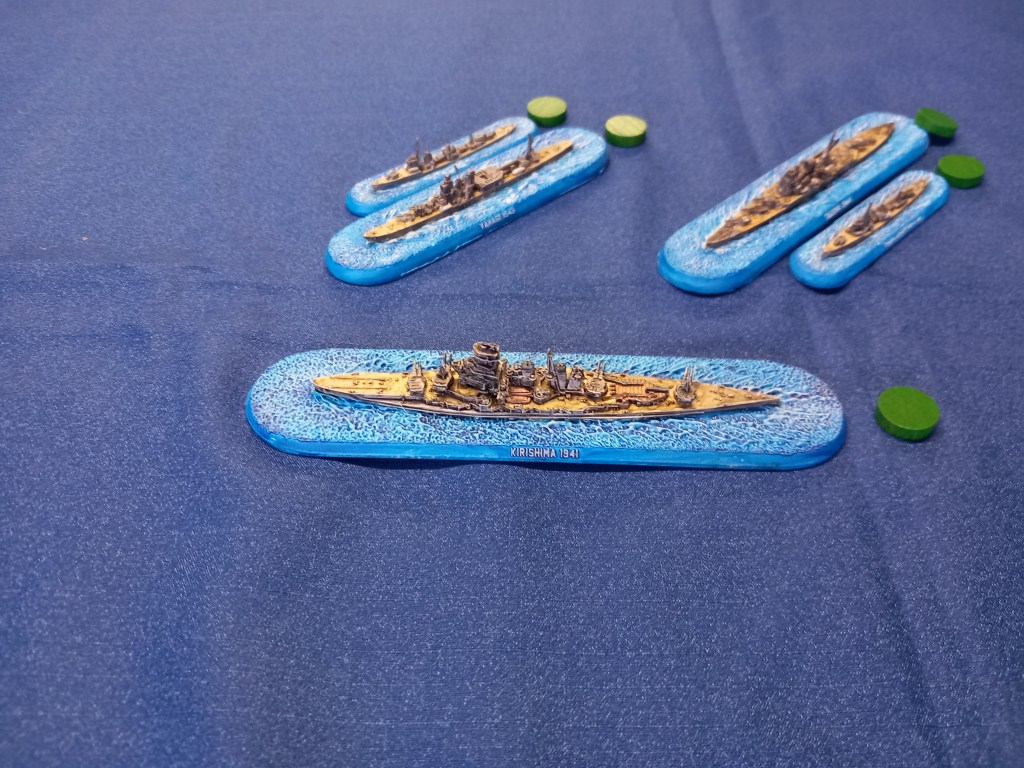
However once the US air superiority kicked in then large ships like the Kirishima were vulnerable and went to the bottom of the sea.

Once part of the Japanese air cover arrived – it never all arrived, we did manage to have the fun of a dogfight.

Quite a few ships were sunk on both sides but at the end point the Japanese had completely failed in their objective and the US achieved a major victory.

Our final game was another in our ongoing development of an El Cid era set up using Dave’s superbly painted figures.

For this one we had an Almoravid host under Bin Yusuf against a Christian force under El Cid.

Once deployment was done it was obvious that the main game would be EL Cid and all the Christian cavalry attempting a flank march over a stream only to find that this was where Bin Yusuf had deployed his Black Guard and allies!

After two refusals to charge which meant they were sitting ducks for missile fire the Christians cavalry finally got stuck in. Unfortunately the Cid died and some minor successes elsewhere weren’t good enough to offset this disaster. A victory for Islam.

I reckon we’re nearly there with the rules now. A couple more games and we should be able to put on a demonstration game at a show in 2025.

Well that’s it for the year I reckon and a pretty good one it’s been. The Iran Iraq and Successors is done, anything else is just gravy. Our quick dip into 6mm Cold War has seen us table two decent sized battle groups and 2025 should see East Germans, British and maybe Belgians on the table. Dave’s El Cid is going well and Gerard’s Samurai is coming along nicely, hopefully both will see some action in 2025. Plans? There are always plans but let’s just see how the year rolls out. In the meantime a very happy new year to one and all.

November 2024 Report

November has been and gone and the year draws to a close – where the hell did 2024 go?

The first game of the month was the firm favourite, Successors, on this occasion Alexandrian Imperial under Perdiccas facing off to the Antipatrids under the old soldier himself.

Antipater’s army was strong in Phalangites (of varying quality) and mercenary Hoplites well screened by skirmishers deployed with their right against the stream while all the cavalry were deployed out on the left.

Perdiccas had the larger army and a varied one in terms of troop types and quality. The centre comprised the pike screened by skirmishers and the elephants, the right featured the Thracian mercenaries screened by Persian skirmishers and the left was the strike cavalry screened by skirmishers and supported by the Hypaspists.

Predictably it was the cavalry who got the ball rolling with both wings advancing. Antipater’s strike cavalry headed for the Thracians with the intention of turning the Perdiccan right. The cavalry of Perdiccas were on the wrong side of the stream so had a more difficult journey to make.

The initial clash between Thracians and Antipatrid cavalry saw the cavalry pause due to javelin volley casualties.

However, after a bruising melee the Antipatrid cavalry broke the Thracians and the wing was shattered – Alcetas bravely threw himself into the combat to try and stabilise the line but to no avail and he fled along with the hill tribesmen.

Due to the manner of deployment the centre infantry blocks weren’t directly facing each other which meant that, A) they were going to be slow to contact and B) the Perdiccan cavalry were going to have to attack the pikes – oh dear ๐Ÿ˜ฅ

The initial action in the centre featured the skirmishers and the elephants which generally favoured the Antipatrids.

We did have the fun bits with the elephants though…

This going to end well ๐Ÿค”

Yep ๐Ÿ˜‚๐Ÿคฃ

The Hypaspists did get into action and were doing well until a second pike unit joined the fray and then it didn’t matter how good they were…..

The Perdiccan cavalry just couldn’t make any headway and either broke or retreated, either from missile casualties in the case of the skirmishers or forlorn charges on pike blocks.

As we rolled into the final turns the Thessalian cavalry from Antipater’s left were busy looting the Perdiccan camp thus preventing the last chance of rallying broken troops.

Unfortunately we had to call time before the centres were fully committed which was a shame although we had a great game. Quite why this was I couldn’t work out, part of it might be to do with players having a C19th mindset where everything has to be spread out, the other is perhaps the slowness that comes with age ๐Ÿ˜‚, or maybe the rate of movement is too slow? My take is that players don’t relate to the actions of the historical prototypes, concentrate in the centre and the peripherals will take care of themselves.

As sure as day follows night our next game was Iran v Iraq – mainly because the cloth is the same for Successors and modern desert ๐Ÿ˜‰

The Iranians were on the defensive with the objective of retaining control of the tactically important high ground.

The Iraqis are the more challenging side to play having inferior armour on an historically open terrain so line of site favours the better Iranian armour. However in this scenario they did have the option for a flank march and took it with a mechanised infantry battalion.

Early success for the BMP1’s against the vulnerable M109’s.

Despite having deployed with the better tanks of the 10th Armoured (T72’s) the Iraqi’s still suffered from long range shots from Iranian Chieftains.

There was some relief for the Iraqis though when an Iranian air strike hit the wrong target ๐Ÿคฃ

As the battle progressed the Iranian tank line held firm although by this point most of the M109’s were toast.

The T72’s continued their advance so as to get into range but losses mounted.

The Iraqi flank attack ground to a halt with significant losses – rule number one, always get out of the vehicles before somebody shoots it up ๐Ÿ˜ฎ

Ultimately however the Iranians reached their morale break point (we were using Cold War Commander) and failed the test thus giving the Iraqis a minor victory. It was really close and thoroughly enjoyable.

Next up was an away game with the Cold War Commanders Facebook group in a very cold Stone in Staffordshire.

The premise of the game was a Warsaw Pact breakthrough being opposed by NATO at the second line of defence. The table was 16 foot by 6 foot with some lovely terrain which we duly took note off for our own burgeoning efforts. The scale was 6mm and this time I was able to take my own troops – Bundeswehr Panzer battalion and Gerard was able to bring his Soviet tank regiment with all the added extras.

It was always going to be an uphill struggle for the NATO players faced with the (historically) larger number of Warsaw Pact units but initially it went well – I was particularly proud of my Leopard II’s destroying a Soviet tank battalion which strayed into the open ground – line of site is really important.

The great thing about these larger (and longer) games is the opportunity to get more toys on the table – we had attack helicopters on both sides firing away with ATGM’s, multiple air strikes from various aircraft models and off table artillery barrages. Fantastic.

There was quite a lot of debate about how effective (or not) air strikes are in the rules – usually when somebody had completely crapped out ๐Ÿ˜‚๐Ÿคฃ which was a bit of a distraction. For me I’m not overly bothered, the game is about units on the ground, not in the air, and if a group is not completely satisfied then come up with a local amendment, the rules police wont arrest you ๐Ÿ˜

There was some hard fighting in and around an industrial centre – doesn’t it look lovely? And it was good to see infantry actually doing something – we haven’t quite mastered the infantry thing yet.

Come the second day the NATO left (me) had been turned which in turn exposed the Austrian centre who were holding on desperately against superior numbers.

NATO Starfighters roll in to stem the tide.

Ultimately time was called and a narrow Warsaw Pact victory declared (I think). Two days well spent, we learnt a bit more about the rules and managed to pass on some things we’d learned, got some hints about terrain and came away fired up for more. Success!

Back to the home front and it was a 15mm Napoleonic game for the first time re-fighting Austerlitz using Command & Colours.

Not being a Napoleonic’s guy I’ve no idea if this was representative or not. It certainly looked impressive with one base representing a brigade, so very much at a macro level, which takes some getting used to if you are used to playing at a battalion/regiment level.

The rules are fairly straight forward – they would have to be given the level you are fighting at, and the results from firing and fighting didn’t throw up anything glaringly ‘off’. That said I did find it somewhat abstract and lacking in flow.

In terms of the narrative, the French right made a mess of the Russian left but didn’t advance beyond the river, the Russians obligingly came to them, on the French left a slow advance chewed up the Austrians but it was in the centre that the French did the best to the extent that when we called time the French had won convincingly on points.

For a so called ‘simple game’ it took an inordinately long time to play, part of that was obviously unfamiliarity with the rules and another part was the inability to make a decision by some players which was frustrating when all you had to do was play a couple of cards. It was the longest game we have played so far and by the end I was done in but not with the high that can come from a long intense game. Most of the group are current or ex Napoleonic players so we will obviously play again we just need to think carefully about how much dilly dallying we allow.

The next effort was another round of the El Cid project and I think we might be getting there now.

In this fight we had Spanish Christians and allied Andalusians against other Andalusians with an Almoravid contingent.

This is a cavalry heavy period so we had several swirling cavalry melee’s which resolved themselves pleasingly both in terms of game play and as a perception of warfare in the historical period.

Despite some sterling work by the Knights of Navarre the Christian cause was ultimately lost and a general retreat sounded, the Almoravids did nothing other than look fierce ๐Ÿคจ

Our next game game was an eastern renaissance game using our Husaria rules, Muscovite v Cossack.

The main feature of the Cossack army was their tabor which they deployed in completely the wrong place but still managed to win ๐Ÿคฃ๐Ÿ˜‚

This was a missile cavalry game; both sides had infantry, all harquebus armed, but no real shock troops, the real action was going to be with the cavalry, all bow armed and some lance armed, the Muscovite advantage was that they were better armoured but the Cossacks had more lance armed. It was going to be a challenge for sides of players.

The Muscovites advanced all along their line (well apart from two units that just simply refused to move for most of the game!) in the hope of out shooting their opponents.

The Cossacks sent their boyars forward to try and bust the Muscovite centre but they were sent packing under a barrage of bow fire.

The Muscovites pressed their initial advantage to try and overwhelm the Cossack centre.

Out on the Cossack left the veteran retainers were having a more positive experience. There is no need to talk about the Cossack right because that was where the tabor was sitting doing nothing other than taking a few long range pot shots at the Muscovite centre.

The centre was where the action was and that was where being solely bow armed (the Mongol conquest influence) was starting to become a disadvantage for the Muscovites.

Now it really was starting to hot up in the centre as the Kazak lights tried to turn the Cossack right – out of shot is the tabor doing its one useful thing of shooting into the rear of the Kazaks who didn’t like that very much ๐Ÿ˜ฅ

The make or break moment for the Muscovites was the Dvoriane charging home on the Zaporizhians – the Zaporizhians held firm.

The Kazaks gave up the fight and the tide was starting to turn.

A series of unfortunate morale checks and the Muscovites started to unravel. Time was called on a Cossack victory – despite the Cossack player being convinced he was going to lose ๐Ÿ˜

The final effort was an away game of sci fi skirmish, Three teams of sundry adventurers arrive planet side looking for illegal fuel cells, can they barter their way through the market before the authorities realise what they’re up to?

In short, two teams went through the whole game without firing a shot, got what they came for and left the planet.

The third team got frustrated with being asked too many questions and so opened fire in a crowded market place. The cops came. The end.

Although I appreciate the amount of work that goes into creating the backdrops for these scenarios I think I’ve come to the conclusion that they’re not for me and I need to find a way of politely avoiding such in the new year.

In other news a battalion of 2S1 Gvozdika for the Iraqis.

Iraqi HQ element

That’s it for this month. Thank you for reading, see you in December.

October 2024 Report

Another month of gaming draws to an end plus a visit to The Other Partizan.

First up was another trial run of Dave’s El Cid collection. We’re still not there yet and further work is definitely required.

Our first full battle of the month was a refight of Dreux, 19th December 1562, the first full battle of the French Wars of Religion. A set piece battle where both sides drew up and then waited around for hours for the other side to make a move ๐Ÿ˜ Eventually the Catholics advanced and battle commenced.

In short the battle was a series of uncoordinated attacks by the Huguenots. On the right the Admiral Coligny smashed through the Catholic left and pursued them to their camp although Coligny himself was unhorsed and briefly held prisoner. On the left the Prince de Conde had a far more difficult time as his attack centred on the Royal Swiss who stood their ground long enough for the Catholic reserves under de Guise to sort themselves out and attack the now exhausted Huguenots, capturing Conde. At this late juncture the now freed Coligny managed to rally an assortment of cavalry and re-enter the fray causing enough of an impact for both sides to draw off in the darkness and both claim victory ๐Ÿ˜€

The battle is noteworthy for both sides using lance armed gendarmerie, the move to pistoleers by the Huguenots doesn’t take place until later much to the dismay of us die hard Huguenot players who want to field pistoleers from day one ๐Ÿ˜‚ taking that into consideration both sides fielded lancers and I reduced the normal unit sizes to best match that of the actual contingents. The rules were our long standing set ‘For King Or Faith’

Our refight was interesting. The catholic gendarmes under Montmorency & St Andre hurtled forward in an attempts to overwhelm the protestants and St Andre certainly saw off some reiters who got in the way pretty quickly.

Then it was time for the protestants to counter with Conde taking on Damville and Coligny taking on Montmorency in a clash of the leaders.

The cavalry action continued with St Andre beating up some more reiters and then smashed through some protestant foot and onto the flank of the landsknechts who lost their captain in the melee. St Andre was having a top day!

The catholic roll continued with the Royal Swiss shrugging off pistol losses from another unit of protestant reiters and charging home – you can imagine the mess ๐Ÿ˜ฎ

The protestants tried hard but when you are desperately throwing gendarmes in against veteran Spanish you know that it’s not going to be your day.

With their forces scattered and achieving very little the protestants decided to call it a day. A good game with plenty of action and anguish.

Our next effort was our newly developing 6mm Cold War Gone Hot effort using ‘Cold War Commander’ In this game we had a Soviet tank regiment breakthrough aiming for a town on dominating high ground. The Bundeswehr defenders deployed an under strength Panzer battalion.

This was a tremendous game with a lot of kit on the table and the Soviets flinging in off table artillery, air attacks and helicopter assaults to support a pincer attack.

In the early turns the Germans lost their Marder battalion as they tried to manoeuvre to utilise their Milan’s and left the infantry defending the flank from cover. This end of the pincer was closing.

On the other end of the Soviet pincer one tank battalion secured some high ground to duke it out with some Leopard 2’s.

This proved to be a mistake ๐Ÿคฃ๐Ÿ˜ฅ

However the Soviet advance ground on with losses being shrugged aside and artillery pounding away – very on historical prototype.

There was some light relief for the Germans however when a pre registered artillery strike pounded a Soviet tank battalion ๐Ÿคฃ

However, the Bundeswehr inevitably reached their break point and duly tested and failed. A major Soviet victory and a great game.

By way of a pleasant change our next effort was a western gunfight. Our skirmish collections don’t get much of an outing these days as the direction of the group has changed a bit so it was nice just to do a couple of hours shooting it out on main street of an evening.

A well worn scenario. Son of a local rancher is about to be hung and the rancher aint having none of it. Classic stuff.

“Draw!” And everyone did…..

It was fun. Aggrieved rancher bit the dust, deputised local show off shot himself in the foot as he cleared leather – oh how we laughed! another deputy had a dud shell as he fired, the town marshal went down, heroic deputy used his shotgun with skill and blasted a hired gun, the other fled. Just like a movie ๐Ÿ˜…๐Ÿ˜ƒ

Up next was a journey back to C5th Gaul where Magister Militum Listorius put together a significant force of auxilia and equites to prevent the Visigoths under Theodoric I from seizing Narbonne. It was kind of historical in the sense that the two did engage outside Narbonne in 446AD but that is the sum total of our knowledge.

Brave Romans.

Visigothic Gardingi on the move hoping to overwhelm the Romans.

Litorius gambled all on leading his cavalry into the first mounted clash of the day. It paid off and the Visgothic first line broke.

Riding his luck Litorius charged the Visgothic Dux, Hermengild, in an attempts to dismay his command.

There was plenty of dismay all right, Roman dismay as Litorius was cut down fighting Hermengild and his bodyguard. The Roman army now ground to a halt, things were looking grim for the province of Gaul.

Auxilia start to rally.

Then, almost as if to say ‘anything you can do I can do better’ Theororic got himself killed!!

This was highly hilarious and with both armies paralysed from adverse morale throws (not surprisingly) and facing difficulties in rallying we called it a day. Fun game though.

Our final game was a refight (two in a month!) of the battle of Camposanto, 8th February 1743 which took place as part of the War of the Austrian Succession in Italy between Austria & Piedmont and France & Spain.

The battle came about because of two commanders, de Gages for Spain and von Traun for Austria being under pressure to force a military victory or face replacement, so after much manoeuvring de Gages crossed the river Panaro and found himself facing Traun who was marching toward the river. Both sides duly deployed and then stood around waiting for the other to make a move – sound familiar? During this lull Traun re-arranged his deployment so that his right was in the air but the troops from that wing reinforced his centre, for reason that are lost in time de Gages kept with his original deployment.

Battle finally commenced at 4.00pm with de Gages launching his cavalry on both wings and driving off the Austro Sardinians thus leaving the infantry centre exposed but not really because the Spanish cavalry disappeared in hot pursuit. The Austrians then led their infantry against their opposite numbers and steadily drove them back until the arrival of darkness curtailed any decisive action and both sides drew off.

Our effort started very similarly with the cavalry but reversed history. On both flanks the Austro Piedmontese were completely victorious ultimately driving the Spanish horse into the river.

The infantry fight was far more brutal.

On the Spanish left the Walloon Guard & the Irish Brigade advanced steadily and ultimately destroyed the two brigades facing them – in fairness the Walloons did all the heavy lifting the Irish just looked pretty.

On the Spanish right the Spanish Guard punched through the first line of their opponents but the second line held and the Guard took heavy losses (two battalions were utterly destroyed), finally routing back into Camposanto disrupting their own second line.

A more even fight took place on the Austrian right centre where the Austrians slugged out with the Spanish line resulting in both sides becoming shattered.

Just like the real thing, darkness started to fall and the fighting drew to a close. The Austrian right flank was completely destroyed and vulnerable to the advance of the Walloon Guards and Irish, the centre had seen the destruction of the Spanish Guard and the weakening of their opponents but both second lines were in good shape. Given the superiority of the allied horse we deemed a retreat under the cover of darkness protected by the cavalry would be the most logical Austrian next move while the Spanish consolidated their position.

That was it for our gaming. We did get a visit in to The Other Partizan in the middle of the month just as punters this time and came away with a mixed view. Yes it was undoubtedly busy and by that criteria a success, but with numbers comes crowding and the inability to give the games a good look over as well as the forever queue at the food outlet. There were certainly plenty of games but I did come away with the view that quantity didn’t mean quality, some of the games were quite average and more than one suffered from detritus leaching onto the gaming area – I do recognise however that this is a bit glass half empty.

In other news Dave is cracking on with his Republican Romans to fight our Successors, a project we said we’d never do because of the inherent difficulties of making pilum v pike work – oh well so much for that ๐Ÿคฃ๐Ÿ˜‚

That’s all for this month, hopefully see you November.

September 2024 Report

Slightly late going to press due to holiday away in Spain being cultural – I now know the complete ins and outs of Romanesque and Gothic architecture ๐Ÿค”

First game of the month was from the Iran Iraq collection, another scripted scenario. This one was set in June 1982 in the Central Front and involved a brigade level clash around the town of Chananeh with both sides tasked with securing the town and its rail link. As with previous games both sides were given an orbat of the basic level force and then a series of options to upgrade/reinforce the battlegroup.

The Iraqi’s chose to insert a commando battalion via helicopter as their option and the Iranians went for additional manpower in the guise of a motorised Pasdaran battalion.

The perennial problem of getting troops to deploy first time (or second time, or third time ๐Ÿ˜‚) was no different in this game than in any other but the Pasdaran were game on and roared into town alone.

The bulk of the Iraqi mechanised infantry brigade soon deployed to contest the town and in the absence of the dreaded Iranian Chieftains pushed their T554/55s forward. The commando coup de main however was being slow to arrive and a vital opportunity was being lost.

Unfortunately for the Iraqis the Iranian Chieftains did arrive and stared taking long range pot shots at the Iraqi BMPs prior to the infantry debussing ๐Ÿ˜ฎ

Despite losses from the Chieftains and off table 120mm mortar fire the Iraqis pressed the attack from the west and secured the immediate outskirts.

Finally the commandos arrived and started fighting their way into the town from the railway yards, but was it too late?

The battle for the town intensified with the commitment of the Iranian mechanised infantry supported by close up fire from the Chieftains; it was now two infantry battalions versus three but the Iraqis had already been whittled down.

Rightly scared of the Chieftains the Iraqi armour hung back and offered support fire but it was largely ineffective.

At the pre-programmed final turn neither side had achieved its primary objective but the Iraqis had reached their breakpoint and the subsequent test saw them fail their moral and cede the ground. Another excellent CWC game.

Next was another run at the El Cid project which is in danger of faltering due to a lack of a rule set ๐Ÿ˜”

Against my natural inclination I agreed to do a rough stripped out version of our Successors rules (mainly because they work and we know them well) and adapted them to suit the unit sizes and base sizes Dave had already gone with ๐Ÿ˜Ÿ

Not surprisingly there were some issues, mainly around unit sizes and numbers of figures to a base, but the overall effect was pleasing and we got ourselves a game. The down side, of course, is that I’ve now got another rule writing job ๐Ÿ™„๐Ÿ˜‚

What a coincidence our next game was Successors! Well the mat was out so why not.

For this one we deployed Demetrian Antigonid against Imperial Seleucid – very historical. The army of Demetrius was the more numerous but very diverse in terms of troop types and troop quality, low on pikes but high in terms of Greek allied and mercenary foot an his cavalry were a bit of a mixed bag. Seleucus had the advantage of better shock cavalry and pikes but his lack of numbers might be a problem although he did have the scythed chariots! Both sides fielded elephants.

Demetrius opted to split his army either side of the river that ran diagonally through his deployment area. On the right he placed all of his hoplites screened by levied Persian skirmishers with the intent of advancing on the ford where the road from the enemy side cut the river – the plan seemed to be two fold, 1) prevent a possible Seleucid use of the road to gallop their cavalry up the road and onto the Demetrian flank and 2) to cross the river onto the Seleucid left flank if no such attack manifested itself. The forces on the other side of the river were the pikes flanked by peltasts and screened by elephants & psiloi in the centre and all the cavalry, light & heavy out on the flank to sweep around the Seleucid right.

The Seleucids chose to concentrate their elephants & chariots on the right flank supported by a single unit of Median cavalry mainly because this seemed to be the best cavalry ground – they were right ๐Ÿ˜€. Next to them and in the centre were the pikes, screened by psiloi and flanked by peltasts and out on the left were the Xystophoroi cavalry and on the extreme left an independent command of Tarentines and Hetairoi. Apologies for the non based elephants, a rare oversight.

Once the game got going it became pretty obvious that Demetrius’ allied Greeks were going to have very little to do and were largely reduced to the role of spectators.

The early blows of the battle were struck on the Demetrian left where first the skirmish cavalry and then the formed cavalry fought it out with the elephants and chariots. This contest occupied the bulk of the battle and was hard fought with elephants dying and chariots crashing, in fact quite a mess ๐Ÿ˜

While the elephant/cavalry duel rumbled on the infantry centres closed with the elephants being the dammed nuisance they’re meant to be.

Elephants died and men died but no-one could make the breakthrough that was needed and unfortunately for the Seleucids they couldn’t make their strike cavalry count either.

Back on the Seleucid right it was all going a bit wrong and Demetrius was about to get the breakthrough he needed.

But what of the Demetrian right flank I hear you ask? Well, this was all a bit embarrassing. One of the hoplite battalions got itself a bit isolated and after being softened up by some skirmishing Tarentines it fell to a mighty charge by the Hetairoi. It didn’t make any difference to the battle but it did make the Seleucid commander feel good ๐Ÿ˜
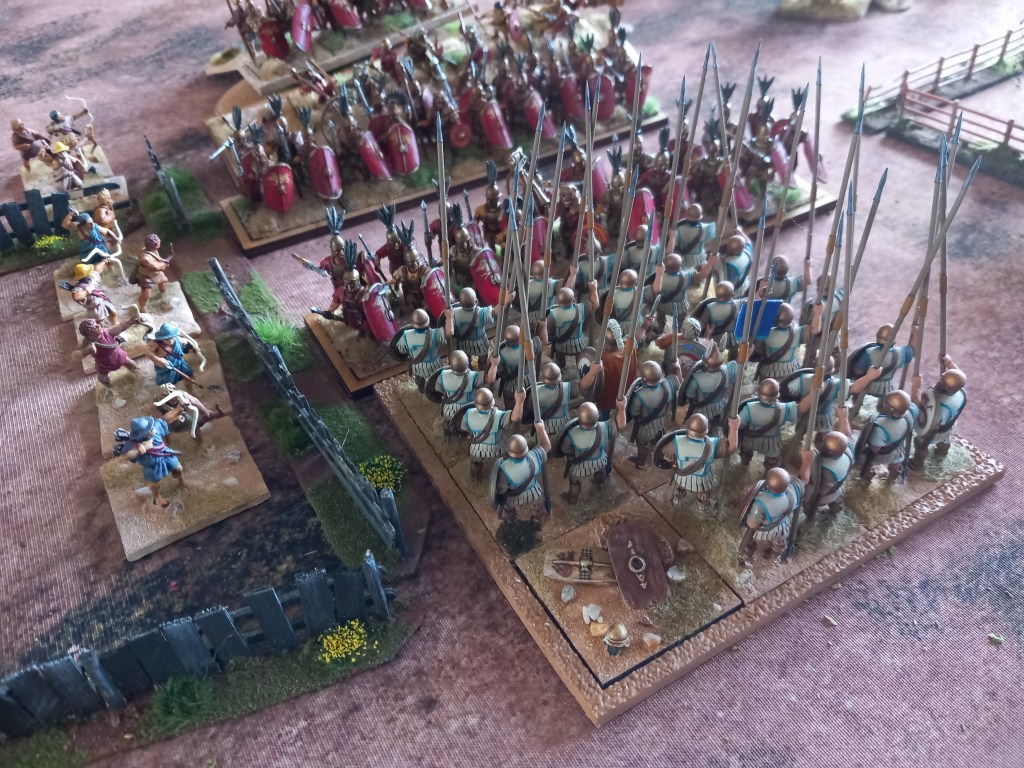
Ultimately the battle kind of petered out and once the Demetrian cavalry were amongst the Seleucid baggage it was over.

Our next foray was into the ice cold waters of the Pacific and another Victory at Sea with both sides picking their fleet from an umpire generated list.

Once initial dispositions were made this looked like it was going to be a Japanese walkover, the US forces were spread thin and seemed to have no chance of achieving their objectives – I’ll admit to some low level whinging here as a US commander ๐Ÿ˜ณ

As we are beginning to learn with these rules, aircraft can be crucial – here waves of Japanese aircraft roar into action.

Unless your anti aircraft fire is effective you are going down to the bottom of the ocean.

No further comment required ๐Ÿ˜

The Missouri goes up in smoke, this was a seriously depressing moment for the American commanders.

But, in a late comeback, the Americans took out the big ass Kongo – what a glorious site!

And then the Mogami got torpedoed. It’s getting better and better!

It was a hard fought engagement and when time was called at the prescribed point the Americans had rallied and won a major victory which they sure as hell didn’t look anywhere near to doing for a good half of the game.

We returned to skirmish gaming for our next effort, Blue and Red teams from the SAS infiltrating a Taliban compound to capture a senior leader – the emphasis being on capture.

All proceeded well for the first few turns, entry into the town was made undetected and overwatch positions were set up. The clever bit would be finding which building the target was in.

Sooner or later someone is going to spot something not quite right and this guy did. Que gunfire.

Taliban start charging out of buildings – might be a good indicator of which buildings might house our man.

Grenades are your friend ๐Ÿ˜Š

In these games (Spectre Operations V2) the advantage definitely sit with the elite tier troops – more accurate rates of fire, better resilience, but they can still die.

With bullets flying and his men dying the target made a break for it with his bodyguards.

Sometimes there are just too many of them – ultimately the SAS teams suffered 50% losses.

The target looks like he’s getting away. Can they cripple the vehicle and not the man?

Nope. The hail of bullets that bought the vehicle to a halt caught the target and he died as the SAS reached the crash site. Technically a failed mission particularly given the SAS casualties but there was a lot of dead Taliban and we did have a great game.

Our final game was our first game with our newly done 6mm Cold War Gone Hot collection again using Cold War Commander. The forces were an understrength Bundeswehr panzer brigade v a Soviet tank regiment.

We got so involved in this that the time just whizzed by and not enough photos were take, better luck next time.

Essentially the Bundeswehr were defending a main road route over a river and the bridge was the critical objective but in accordance with their historical tactical the Germans decided to attack and blunt the Soviet advance.

Soviet mechanised infantry on the move.

Soviet air cover was largely ineffective much to the relief of the dangerously exposed Leopards.

The Leopards were very effective against their Soviet counterparts and importantly could shrug off most damage.

Soviet T80’s taking some pressure – we ran out of suppression markers ๐Ÿ˜‚

For reasons I cannot explain a whole load of photos of a Hind getting serious with ATGM’s have gone missing ๐Ÿ˜ฅ but suffice to say they were very effective.

This played as a very different game to the Iran Iraq affairs despite being the same rule set. First off the smaller scale means more stuff can deploy on the same square footage but move and shoot at the same ranges which has both it’s positives and it’s negatives. Secondly the kit is a lot better (and I mean a LOT better) despite the same time frame and that offers a real challenge to both sides. Thirdly terrain is key, we already knew this from Iran Iraq but here it is really important and we need to do some work both in terms of quantity and quality.

Anyway that’s it for the month, I leave you with a random battle painting from my holiday in Spain. See you next month.

August 2024 report

The year is closing fast and summer is nearly over – did it actually begin? None the less we soldier on ๐Ÿ˜€

First up was a dark age (sorry early medieval) skirmish put on for a potential new recruit, an ex D&D player. A vaguely Byzantine looking wagon train waylaid by Swedish ruffians.

The rules were our own home grown set and the scenario quick and dirty enough for figures to get stuck in quickly, which they did and despite superior numbers the Byzantines were cut down to a man.

Such was the pace of the game that we had a second one, this time Viking v Viking, a longer but equally bloody affair. Whether the potential recruit will join us on a regular basis is yet to be seen (working patterns and all that) but he certainly seemed to have fun.

Next was another in the quest for a decent rule set to get the best out of the growing El Cid collection.

We tried Swordpoint again and although they work well enough there isn’t that spark yet which ignites the passion that went into painting the figures.

There’s a danger of Dave (who’s project this is) getting fed up and jacking it in so we have to find a way through. Maybe an adaptation of one of our existing sets? The jury is still out.

Next up was fan favourite, the Successors. This time Royal Ptolemaic v Antigonid Macedonian. The Ptolemaics were quite compact, a solid base of decent pike armed infantry fronted by enough skirmishers and a reasonable amount of formed and skirmish cavalry. The Antigonids were far more exotic, less cavalry and less pike but units of Galatians and Thracians which could be pretty deadly if used cleverly.

We played an ‘equal points’ game using our home grown rules and used the terrain and scouting rules which saw us start with an interesting layout that was promptly reduced by one side out scouting the other ๐Ÿ˜‚๐Ÿ˜‚

Undeterred our two Generals had at it but from very early on it became clear that errors had been made. The Ptolemaics deployed in two blocks, the pikes and their psiloi out on the left wing and the cavalry plus the elephant squadron in the centre, this meant that the cavalry were doing all the work while the pikes slowly wheeled across the field. The Antigonids deployed their pikes in the centre with their left against a stream and allied Hoplites & Thureophoroi on their right, all covered by psiloi; the actual right wing was all the cavalry and the left was the Thracians & Galatians beyond the stream, fairly classical but the Thracians & Galatians were going to have to get a move on and they had a stream to cross.

The early turns revealed the problems of deployment to both players early on; the Ptolemaic cavalry and it’s elephant support got shot down by the numerous psiloi elements fronting the Antigonid pikes and the force was by and large rendered useless – the Ptolemaic player looked on the verge of jacking it in ๐Ÿ˜ฆ however the Antigonid player also had problems, he realised he had thrown 3 units away by sticking them beyond the stream and was frantically changing the orders of his cavalry so they wouldn’t go hurtling into the Ptolemaic pikes.

At the midway point chickens were coming home to roost. The Antigonid cavalry got themselves into a complete mess, the lead unit of nobles did manage to successfully charge a disordered pike battalion and against all the odds sent it packing – wow! the others however ended up sandwiched between their own infantry, who’s advance was now slowed, and the Ptolemaic pike, and not surprisingly they died badly. The lack of a Ptolemaic cavalry wing however meant that the Galatians & Thracians were heading for the exposed camp.

Things looked up for the Ptolemaics as the battle unfolded, their success against the cavalry meant that they surged onto the Hoplites and Thureophoroi and after a tough slog defeated them and unhinged the Antigonid right. However the Antigonid centre was untouched and it’s psiloi were still being quite effective as the barbarian types headed for some looting.

With both sides having a flank uncovered and their battle winning troops to far away from each other to connect in the time remaining we called it and reviewed the mess. In one way it was one of our least successful games in that the push of pike just didn’t happen but it also illustrated that the real life prototypes deployed in a certain way for a reason and that sticking slow moving troops out on the wings or behind terrain you are not actively going to use is not a recipe for success.

Our next outing was an away game of French Indian War using rebels and Patriots. A French column marching through the wilderness to the relief of homesteaders while those pesky redskins lurked in the woods.

I can’t say I’m a huge fan of the rules but we did get a fast moving fun game completed despite some quite bizarre shooting and melee results.

The best fun was had ambushing the French column who obligingly split up to go scampering about in the woods – many scalps were taken ๐Ÿ˜

Upshot was that the hamlet was burned to the ground and the citizens massacred; the column never got through.

Our next escapade was a massive WWII skirmish organised and presented by Dave. Somewhere in Germany post D Day British, Polish and Americans are advancing on the next town in the way of the relentless Allied advance.

We used our home grown platoon level WWII skirmish rules which have served us well over many years, but in this game we nearly broke them and ourselves ๐Ÿ˜ฎ

The game looked bloody brilliant but we were playing on a ten foot by six foot layout with probably a company worth of troops all told on each side. The airborne element fighting across the table towards the town was a US platoon supported by a weak Polish platoon while coming up the table was a platoon of British infantry (later reinforced by a Royal Marines platoon) supported by armour, carriers and field artillery. The Germans, dug in and around the town, were a platoon of panzer grenadiers and a platoon of paras plus dug in assault guns, artillery and mortars; a tough nut to crack.

The game took us two days to play and by the end we were knackered ๐Ÿ˜‚ With that many single based figures to move and shoot it took some time to complete a full turn but given the random choice of which squad will activate next (a bit like Bolt Action) no one was really sitting around for long.

In terms of the game it was a hard slog for the allies (much like the real thing I guess). After several hours of fighting (two days) the US airborne reached the outskirts of the town having suffered significant casualties and only got that far when a troop of Sherman’s arrived (day two) to blast a way in; the Polish on the GI’s left did better, driving off their opponents in the woods outside the town and then entering.

The British, who were hampered by the fact of approaching across a river on two hedge lined roads and heading up table into the unknown. Visibility was restricted on the roads but off road were large patches of open ground which were killing grounds for the infantry and their carriers.

It wasn’t until the arrival of the Royal Marines (on day two) who drove the German paras out of the orchard and pushed their way into the town that German resistance started to crumble.

In fact for the Allied players it wasn’t until the Marines and the supporting armour broke in that the size of the resistance and the number of them who had been killed became apparent.

We certainly had an intense two days and the game looked cracking so a big well done to Dave but I wouldn’t like to do it again in a hurry ๐Ÿคฃ

Next was the away game with Gareth Lane already reported.

The next home game was a refight of the battle of Lesnaya, 29th September 1708, being part of the Great Northern War.

This came about from me reflecting on what we are all about. Many (many!) years back when we first set up our raisin d’etre was historical gaming and refighting historical encounters. For a variety of reasons that has slipped a bit over the years and although our Partizan appearances are always a refight it hasn’t been so much the case at home. We kicked off with Sedgemoor last month so maybe a game a month as an historical refight might be possible.

With all that said I couldn’t have chosen a more challenging example ๐Ÿ˜„ The Swedes have their back to a river and are encumbered by a supply train as the pursuing Russians close in. To make matters worse they have sent the bulk of their cavalry off on a scouting mission upriver – why does it need 3,000 cavalry to scout for a river crossing when you are sitting on one? The Russians arrive to find the only open ground occupied by a Swedish cavalry brigade and the only way forward is through dense woods and most of their force are dragoons!

We deployed as close to the historical prototypes as we could using the Angus Konstam Osprey book and fought our way through the day.

In most ways our refight mirrored the actual event. The Swedish cavalry brigade saw off the initial two brigade Russian dragoon attack in the open space in front of the village of Lesnaya but by the end were significantly weakened. Fighting through a wood is really difficult and our Swedes held on longer than the historical prototype despite facing Guards.

What also came up was the Why? of a battle. The map shows large areas of open ground to the right of the woods (from the Russian perspective) where the fighting took place so why didn’t Tsar Peter send off the cavalry that were with him on a flanking move? That’s exactly what our Peter player did and once he made his way round he proceeded to burn the supply train and then position himself in the rear of the Swedes.

The arrival of both sides reinforcements – the Swedes earlier than historically, signalled the end of the game and we judged the Swedes would be able to cross the river minus their artillery and obviously without the supply train. Worth the effort and glad we did it.

Our final game was a Back of Beyond away game, itself a follow on on from a previous game back in February. The rules were the Fistful of Lead Bigger Battles set.

In this adventure a British column was advancing to “convince” a local warlord of the folly of accepting Russian and Chinese advisors into his stronghold, the Russians and Chinese of course were keen to impress him with their cunning ways!

In a game punctuated by the breakdown of virtually every vehicle on the table and some really quite wild shooting and melee roles the British were soundly thrashed and sent packing. The East is still ablaze ๐Ÿ˜‚
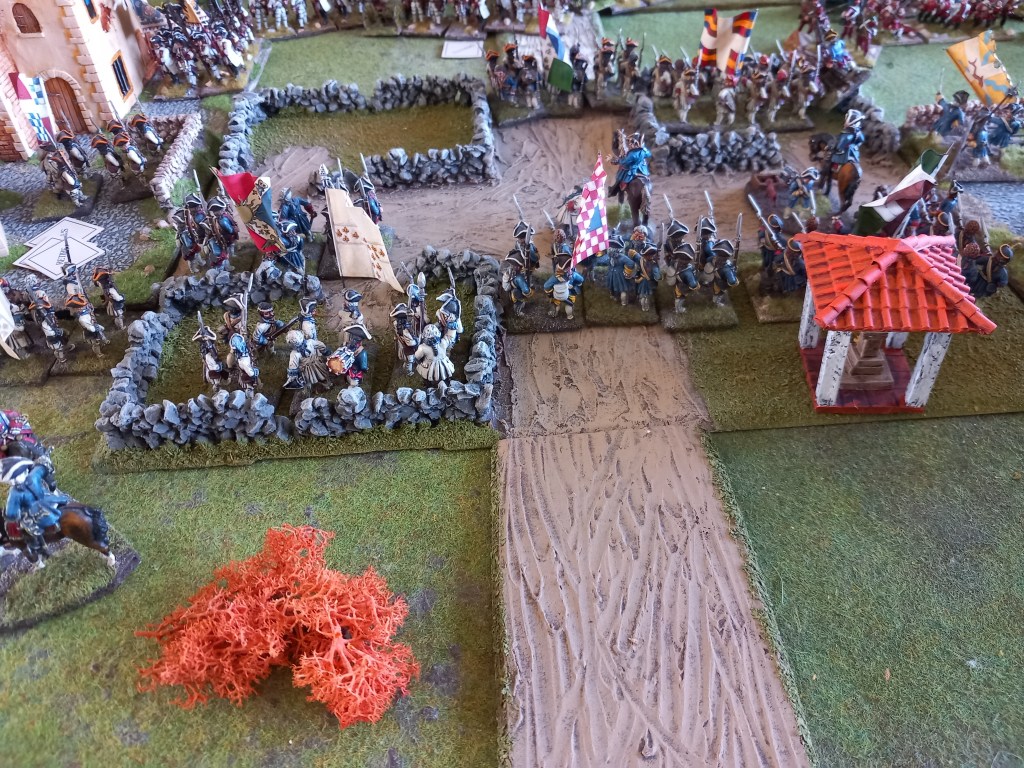
In other news, I went to BritCon – see earlier post.
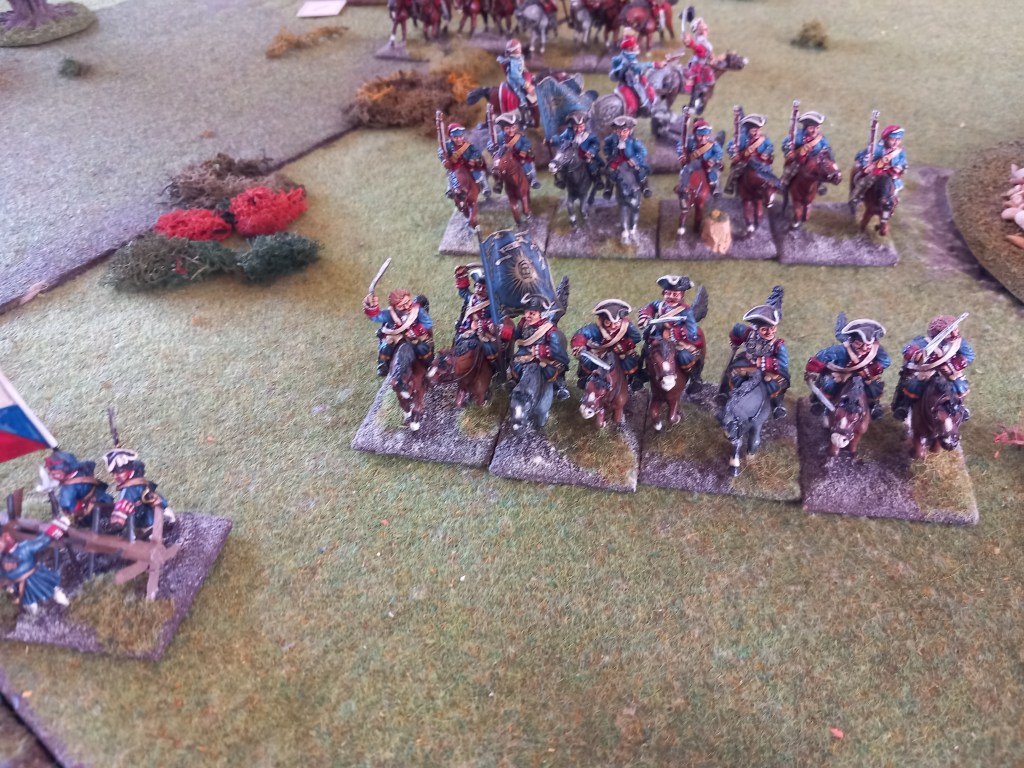
My 6mm Bundeswehr Cold War gone hot army is underway.

Further additions to the 10mm Iran Iraq project have been made after a bit of a hiatus.

Well that’s it, another month draws to a close, bring on September!