Conventions are back! Much awaited and much anticipated we were back at The Other Partizan on Sunday October 10th and it was like we hadn’t been away 😊 Everyone was super excited and there were some excellent games on display although our chance to to view them was restricted by it being just the two of us this year and so our time was taken up with our own game.
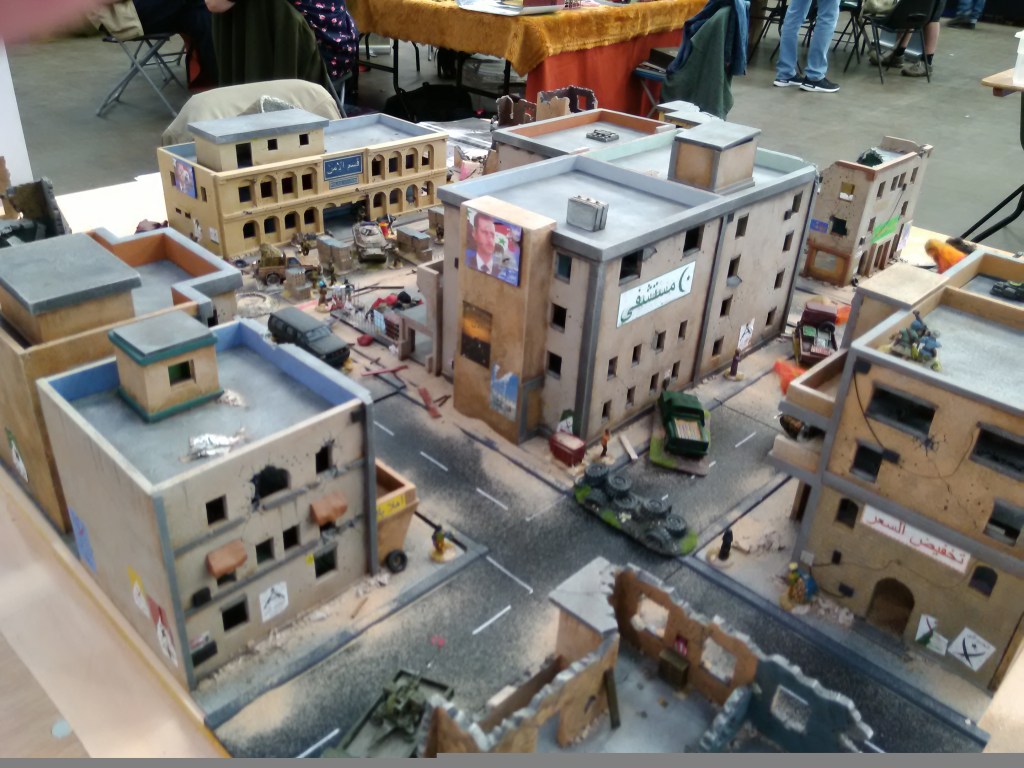
Quiet before the storm
We took along our Syrian Civil War city streets game with the superb terrain from Task Force Terrain and had our streets populated by the crew of a downed Hind, Syrian Special Forces on a search & rescue mission, various representations of the numerous insurgent factions and Hezbollah units bolstering the government forces. The rules were Spectre Operations V2 which we are fairly confident with these days hence the numerous factions (9 different units in the end plus armour support) but as we were at a show and we knew we’d get distracted we didn’t deploy all in one go but rather fed them on as we went.
Syrian NDF deploy outside the police station
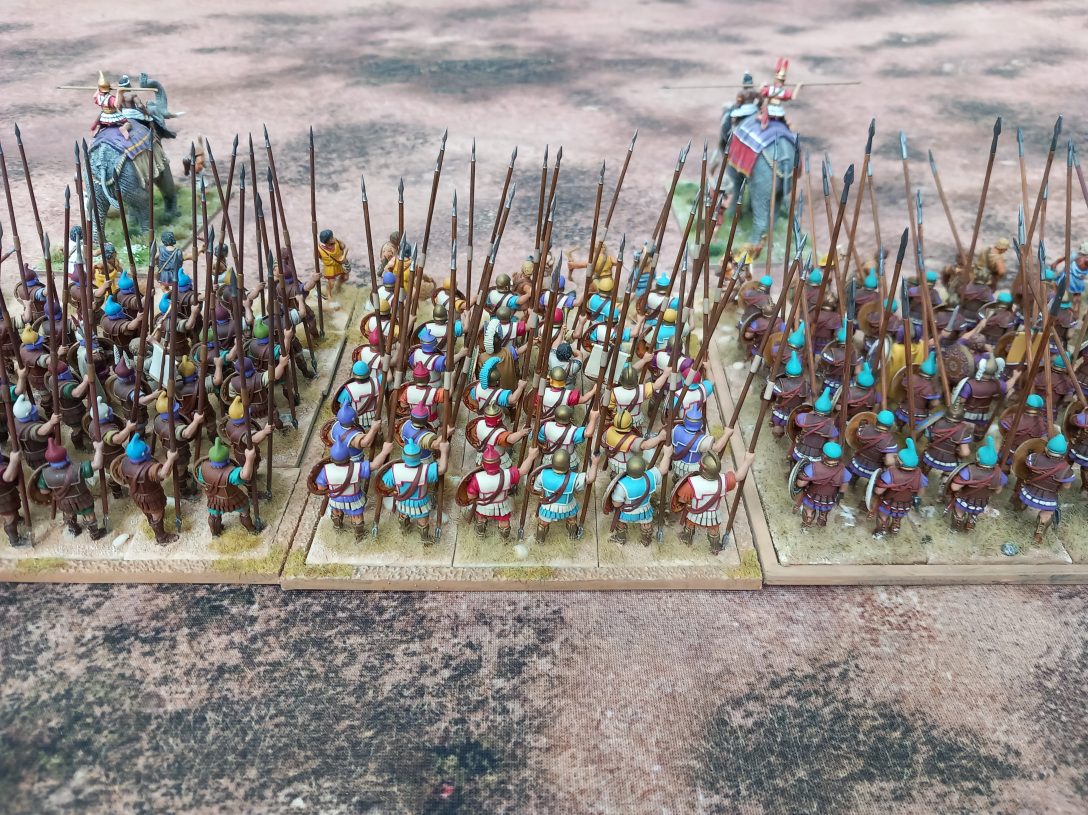
Elsewhere in the hall were some excellent games, none of which we managed to take a picture of, but from memory the outstanding ones for us were; a 28mm Plains Indians War game, excellent Indian village and what looked to be quite an innovative basing system – wish I could have stopped and chatted about this, a superb looking C18th game complete with star fort and two enormous galleons out to sea (I mean the size of the things you see in antique shops!), very visually arresting, an excellent looking El Cid game, although I couldn’t see Charlton Heston 😁 and a quite extraordinary 60/70mm ancients Macedonian v Persian game – wow!
Insurgents take the high ground
On the trade front it did seem a bit thin; the stalwarts were there, Foundry, Warlord, Empress, Dave Thomas, and Warlord and Foundry occupied a significant amount of hall space but I did have a feeling of something missing. This could of course be just not enough time to look around properly or the fact that October is now brimming over with conventions, SELWG on the 17th and FIASCO on the 31st plus Battleground and Warfare in November so maybe traders are taking it steady in the post pandemic times.
Insurgents clash with Special Forces over the downed Hind
In terms of attendees the morning seemed very busy and we spent a lot of time chatting with interested gamers and meeting familiar faces who we literally hadn’t seen for 18 months! Certainly by the time I got home my voice was gone 😂. The numbers were a bit worrying in these post mask times and some people were wearing and some were not, we wore ours to start but eventually abandoned them due to the difficulty in conversing and with so many people not wearing it all seemed a bit redundant. The fact that the weather was kind to us meant that the double doors could be open so there was plenty of air circulation. What was very noticeable was that by 2.00pm the show was largely depopulated, why I have no idea but it was far more acute than ‘normal’.
Insurgents occupying a building
What did strike me this year, from a display gamer point of view, was that the little extras (the coffee vouchers, the free figure, the raffle tickets, etc) were not on hand which was mildly disappointing; hey there’s no rule that says they have to be available it’s just one of those nice Partizan traditions. Maybe with no revenue from 3 cancelled shows some of the costs had to be throttled back and I get that, we also didn’t see anything of the organisers either which was unusual 🤔.
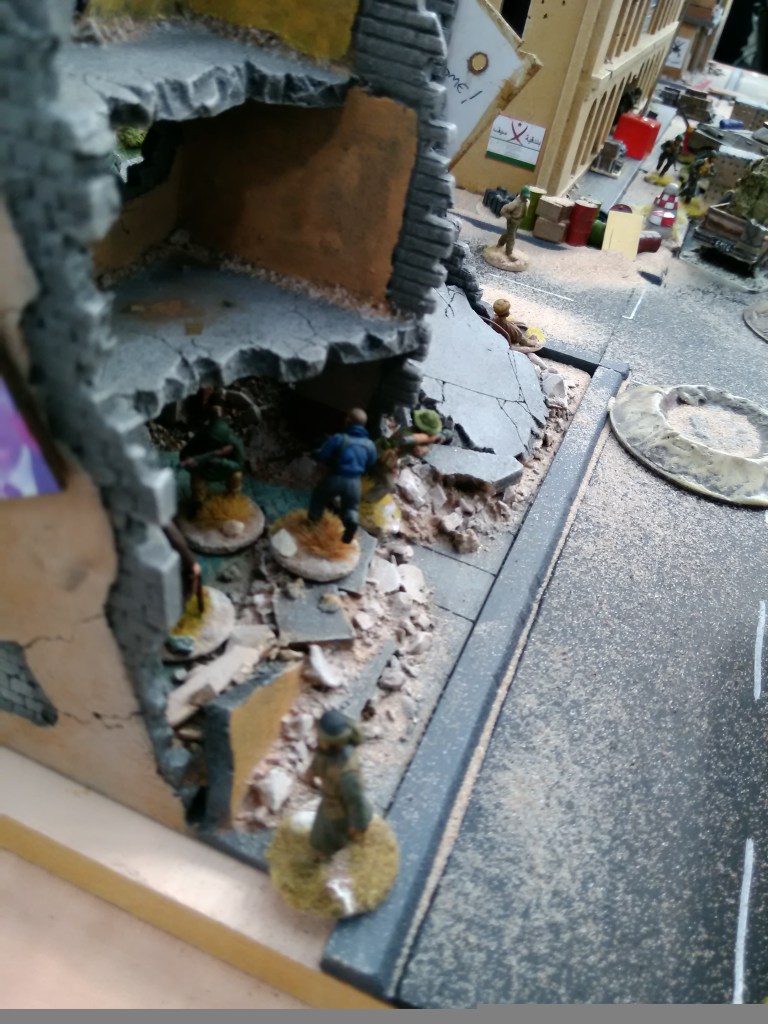
Into the ruins
So, was it good to be back? Of course it was! Will we back next year? Obviously 😁. So many thanks to Laurence, Richard and the the Irregulars, well done.
Many, many, years ago we fought Holowczyn as part of a convention tour, simulating the ‘tour’ of Russia by Charles XII, culminating in the battle of Poltava, so 3 battles, 3 conventions, but we’ve never played it since so we thought we’d roll out the collection and give it a go.
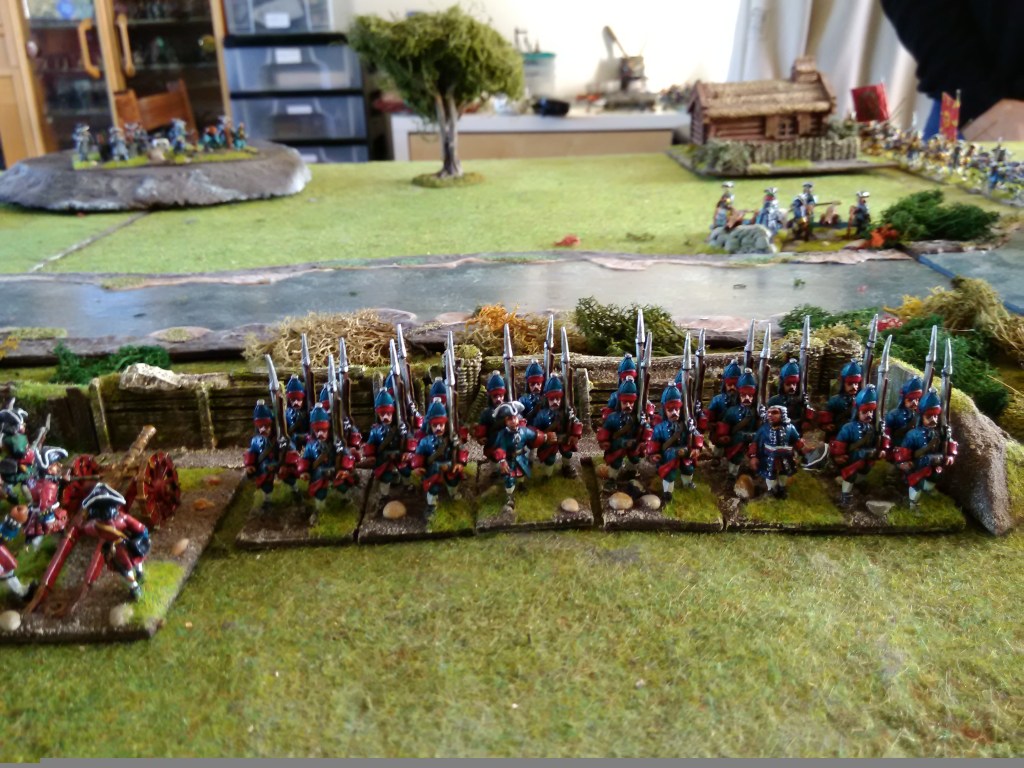
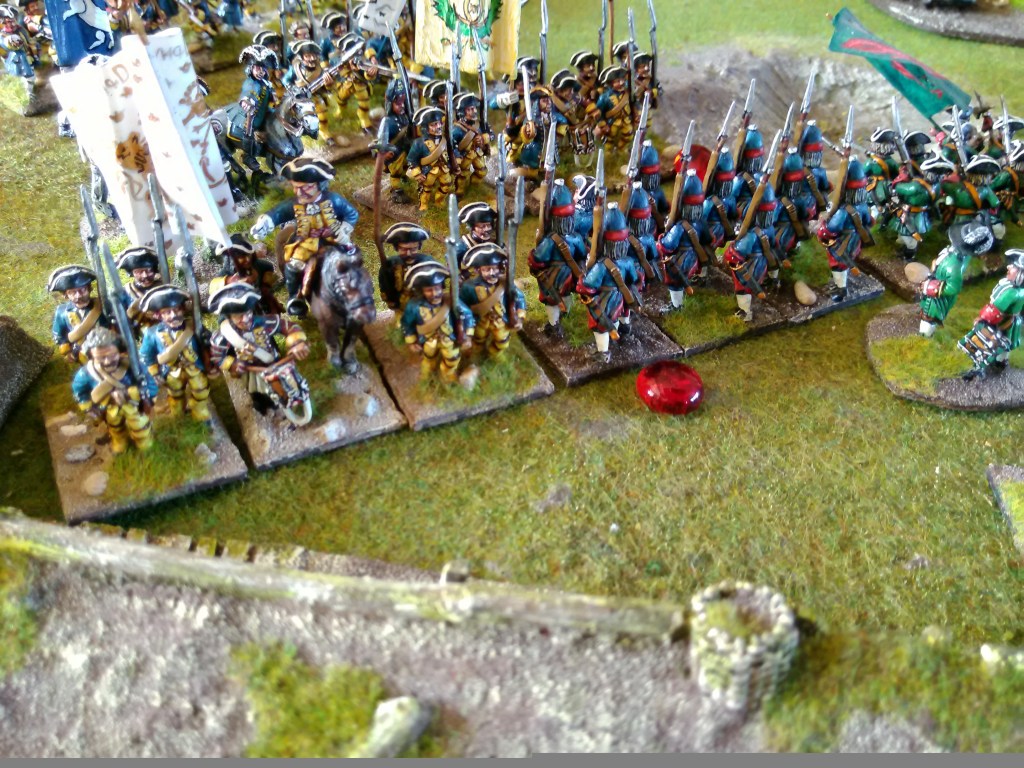
Bieltz’s Grenadiers
For those not in the know, Holowczyn was the opening battle in Charles XII’s campaign against Peter the Great’s Russia which kicked off in the summer of 1707. By the summer of 1708 the Swedes were well into Russia struggling to come to grips with an enemy that kept retreating and burning everything – that sounds familiar 😒 but on June 30th Charles and the Swedes found themselves facing a dug in Russian army over the river Vabitich.
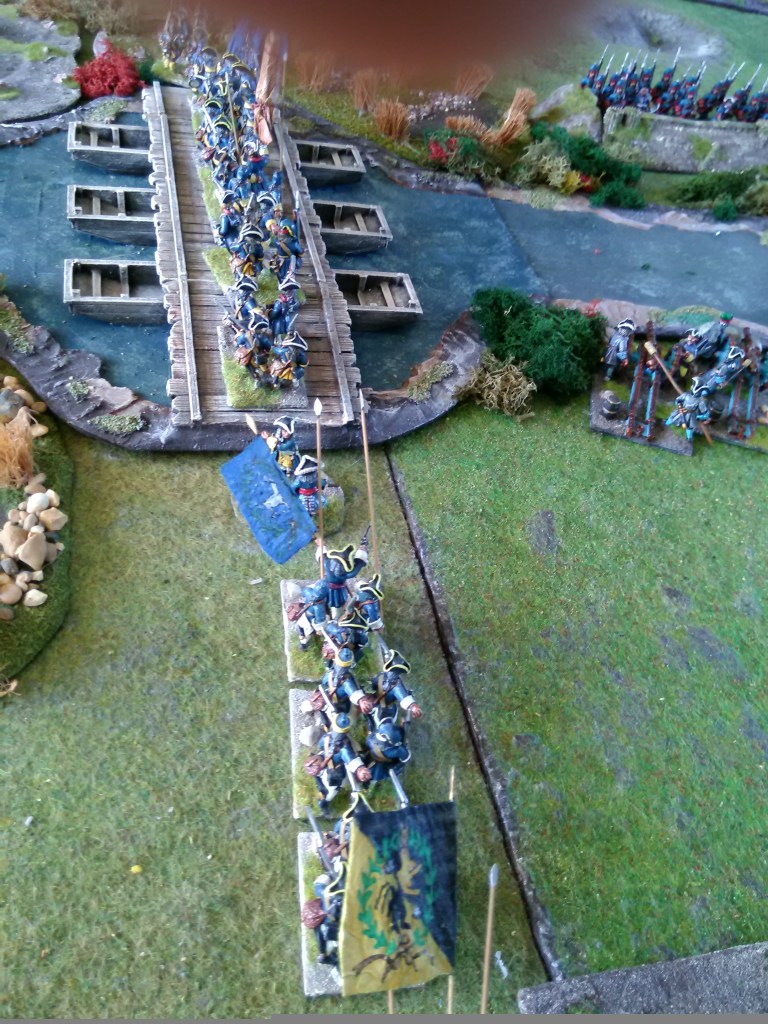
The long line of the column
In what would become his signature approach to battle, Charles opted for the mad idea 😁, so in the early hours of the morning of July 3rd 1708 he and his men waded across the river at an unguarded point, advanced through a marsh, deployed on the flank of the enemy and attacked. The Russians were slow to respond, not being sure whether it was a full attack or a diversion, and ended up conducting a fighting retreat in a confused and haphazard firefight. Further infantry reinforcements merely added to the confusion and when the Russians committed their cavalry the outclassed dragoons were swept away and the field was clearly in Swedish hands. It was however somewhat of a phyrric victory, Russian dead were 4x that of the Swedes but most of the Swedish wounded (around a thousand) would succumb to their wounds and the losses were mainly among the guard infantry, losses that would be felt at Poltava.
It took a while!
The reality of the battle was that Charles was attacking one division (Repnin’s – the biggest, comprising 2 brigades) of the three positioned along the Vabitch and was inserting himself between Repnin on the left and Sheremetiev in the centre while Hallart was out on the right; to the left of Repnin was Goltz’s substantial cavalry division of 3 brigades. The only other troops to get themselves involved was a brigade detached late in the day from Sheremetiev’s division. The Swedes comprised the vanguard foot brigade, commanded by Charles himself, featuring the 4 battalions of the Guard plus 2 other battalions, then a 2nd brigade of 6 battalions and finally a cavalry brigade featuring the Guard Cavalry & Guard Dragoons and 3 other cavalry regiments.
Charles XII
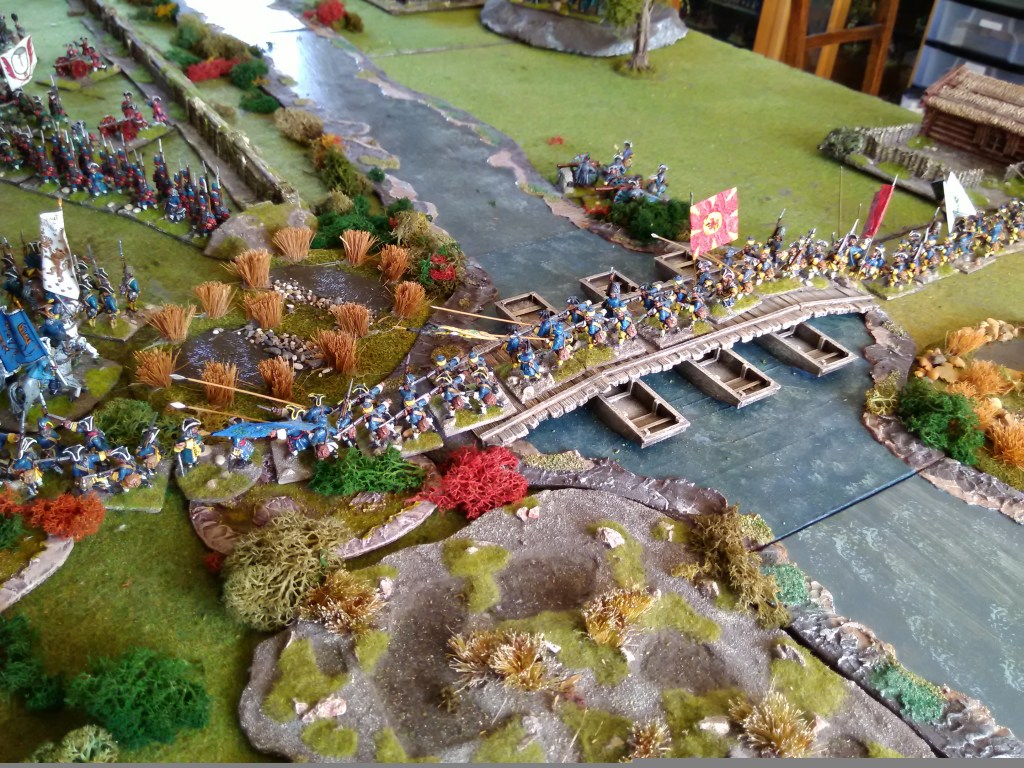
Looking at our collection we easily had the numbers (and we’d sold a third of it back in 2020!) and even had most of the named regiments/battalions, unfortunately only 3 Guard battalions but we reckoned it wouldn’t make much difference (it didn’t 😊). Measuring up the space that would be occupied by the battalions representing the actual number of Russian battalions behind the earthworks we reckoned they would need about 5 foot, give or take, so the 8 foot x 6 foot standard table would allow us to deploy them, allow space for the marsh and give space on the table end for the later Russian reinforcements. Our trusty river section we positioned 2 foot in and used the section with a pontoon bridge on to represent the crossing point (the Swedes did have pontoons but abandoned them – why do it the easy way?) and at that crossing point we constructed a substantial marsh. Along the rear of the Russian table edge we put on plenty of trees and down part of the left flank; into these we placed Goltz’s cavalry division (on the left) and Renne’s reinforcing infantry from Sheremetiev (on the right) while in the centre behind Repnin’s division we put on the army camp.
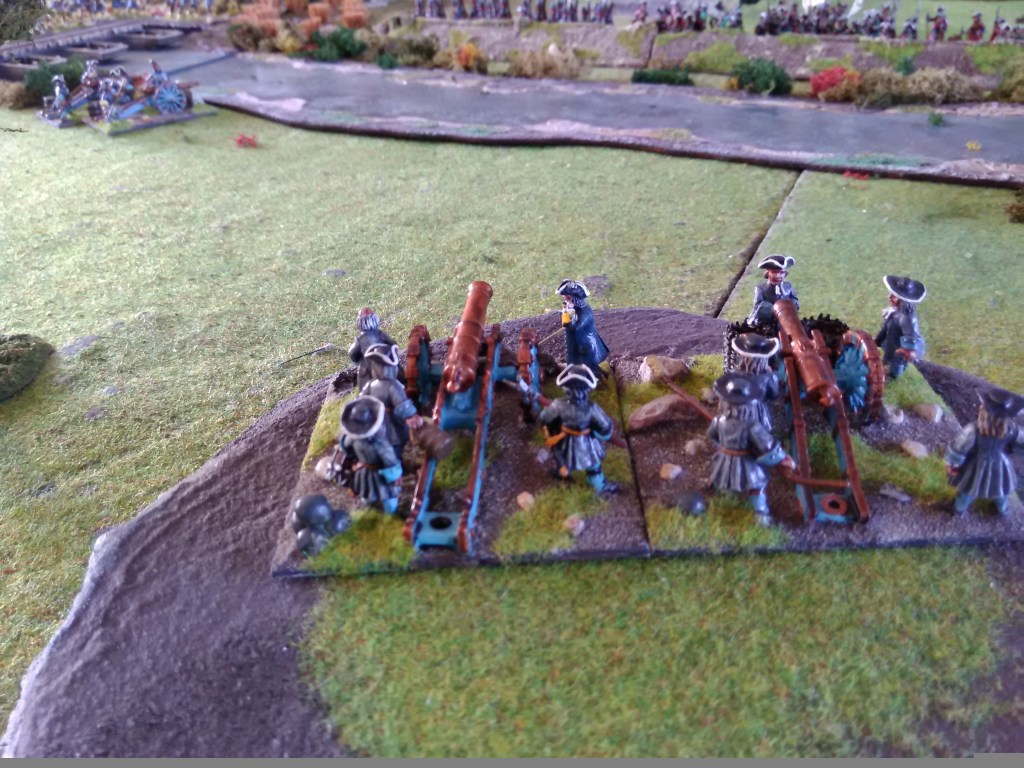
Swedish field artillery
Our thinking with the Russians was that Repnin’s 2 big brigades would be positioned facing out across the river and wouldn’t start responding until the Swedes emerged from the marsh and then only the brigade that could see them (Schweden). The reinforcing cavalry and infantry could only be activated by Repnin finding out from Schweden that they were under attack and sending a message off to Goltz who would then roll a D6 for the number of turns after receipt for when he could start to emerge, said messenger would then carry on to Renne to release his infantry using the same process. The process was made deliberately slow (wargamers are very good at responding to things they can’t see unless you stop them 😉) which is just as well because both reinforcement commands rolled a 1! Deploying the Swedes was more straight forward as they only had one route so we strung out the infantry battalions, led by the Guard, all the way from the table edge, across the pontoons and into the marsh with the 1st Guards on the edge of the marsh, somewhat disorganised, ready to go; this signalled the start of turn 1. As a side note, the Swedes, for once, out gunned the Russians so we placed some regimental guns next to the crossing point to fire in support and some big field guns on a low hill to pound the entrenched Russians, the Russians only had regimental guns strung out along the line.
Guards face off to the Grenadiers
Rather than go balls out, the Swedish commander decided to remain stationary with the 1st Guards to shake the accumulated disorder and wait for the 2nd Guards form up alongside and do the same, this gave the Russian grenadiers time to about face and wheel out of their entrenchments to face off and allow the Russian high command to panic and send for help.
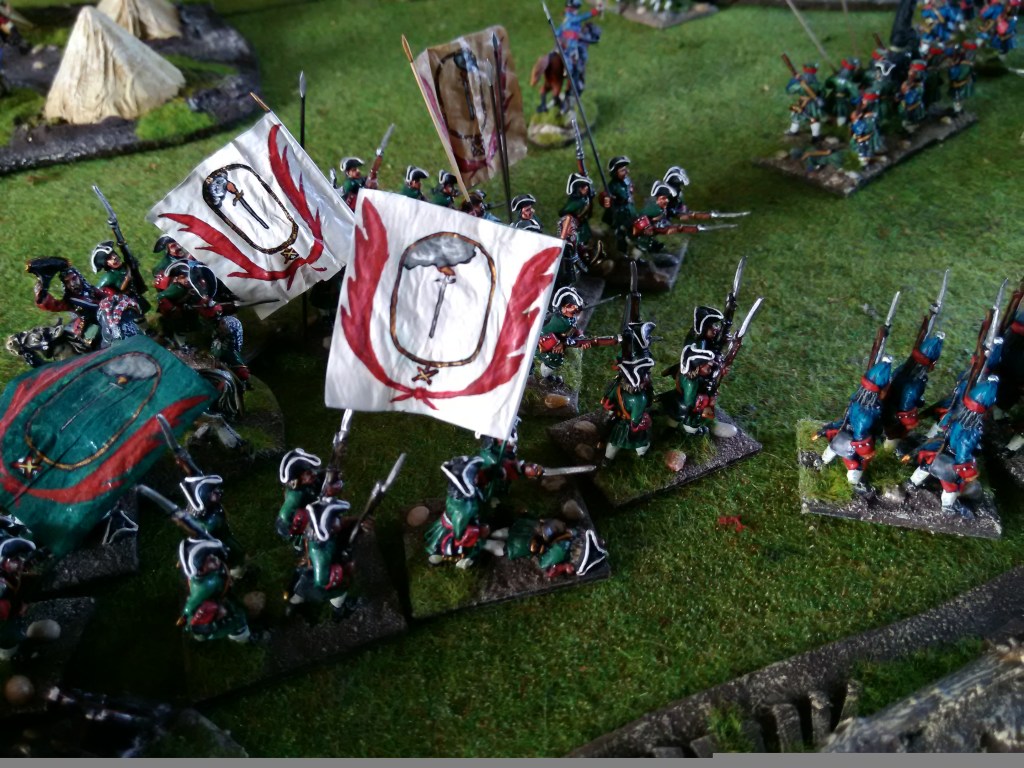
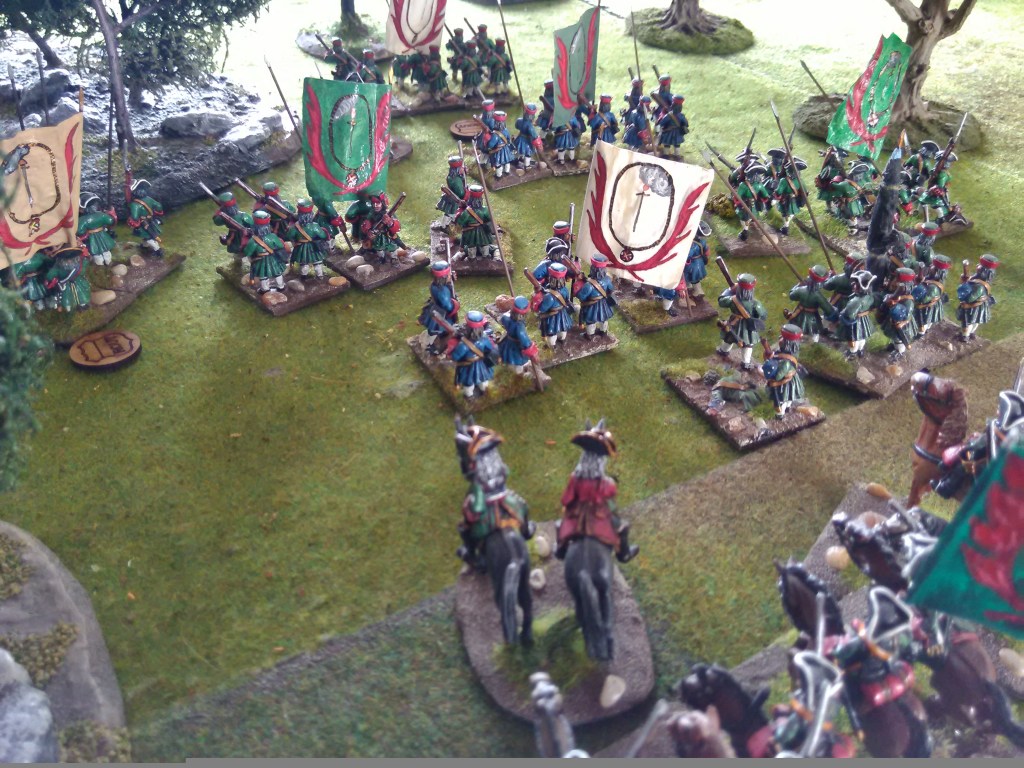
Repnin and Schweden
With the grenadiers and Guards in range both opened up on each other at effective range, losses were even, so no morale failures and the rest of Schweden’s command started to turn about as more Swedes emerged from the marsh. Another volley and Charles decided it was time to force the issue so the 1st & 2nd Guards moved into close range and fired again forcing one of the grenadiers to rout and punching a hole in the the shaky Russian line.
1st Guards
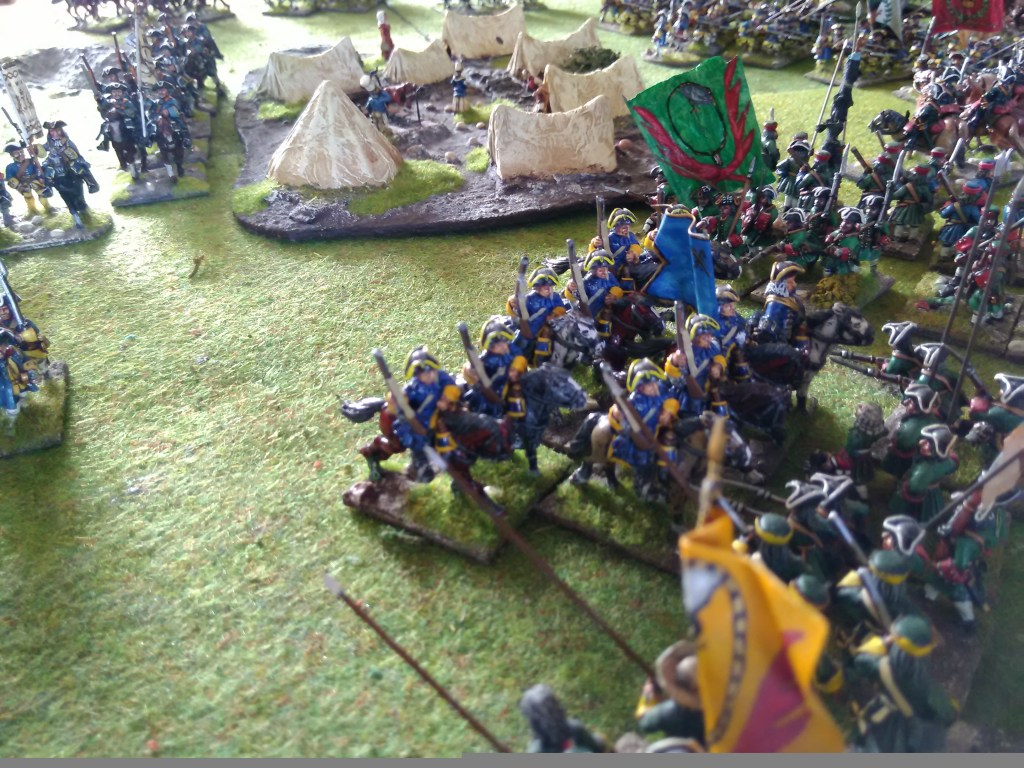
First brigade morale test of the day (due to the grenadiers rout) and Schweden’s brigade failed spectacularly, hotfooting along the entrenchments and into the camp. Fortunately Repnin and Schweden were able to rally some of the units further back and start to restore order but they would now count as a failed brigade for any further tests which for Russian morale was always going to be a worry. The collapse enabled Dalcarian (2 battalions) and the 3rd Guards to get out of the marsh and form up with the 1st & 2nd into a fairly coherent line while Sparre and the other brigade marched on through the marsh to eventually emerge at the top end and march south on the other side of the camp.
Rallying the troops
As Repnin and Schweden tried to stem the flight Goltz received the request for help and rolled his 1 so Illfland’s brigade was first out of the woods and headed along the top edge of the camp in what would become a collision with Sparre. Back with the Guards, Charles went all out now and threw the 1st & 2nd into close combat with the rallied Russian foot, who of course had almost no losses at this point and managed to repulse the Guards, shouts of “huzzah”. Testing for losses the 1st Guards failed and routed but the subsequent brigade test was passed with ease (it helps having Charles XII as your brigade commander 😂) and the 1st were rallied by him pronto but sat out the hard action for a while as they called in stragglers and tended to the wounded.
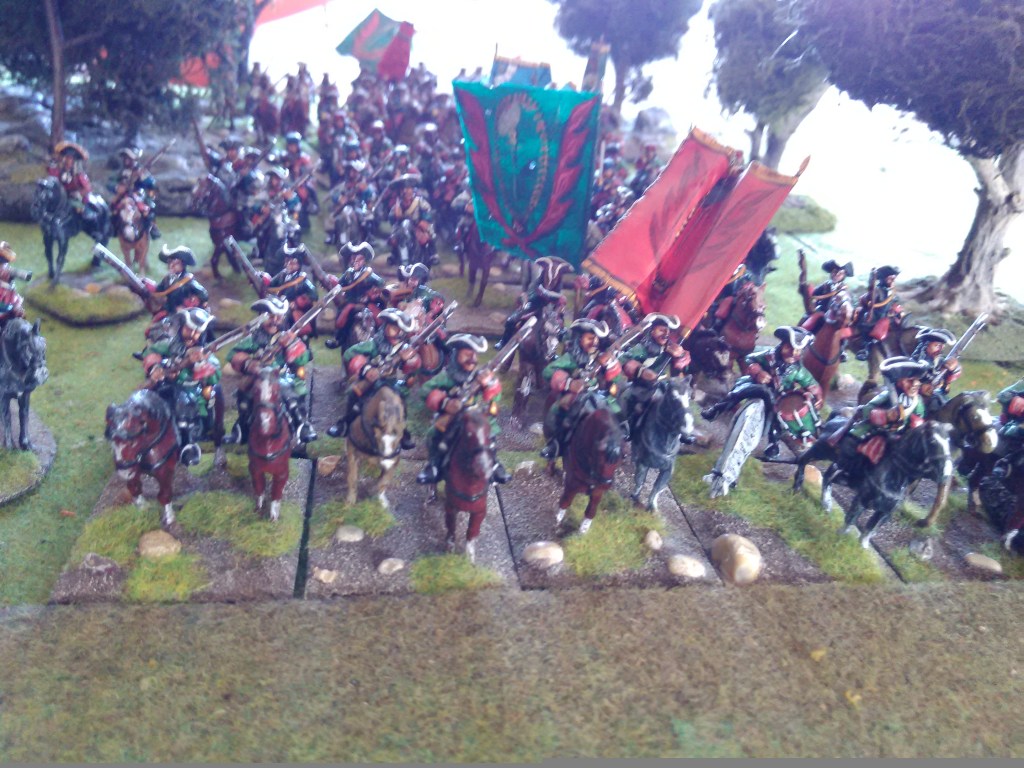
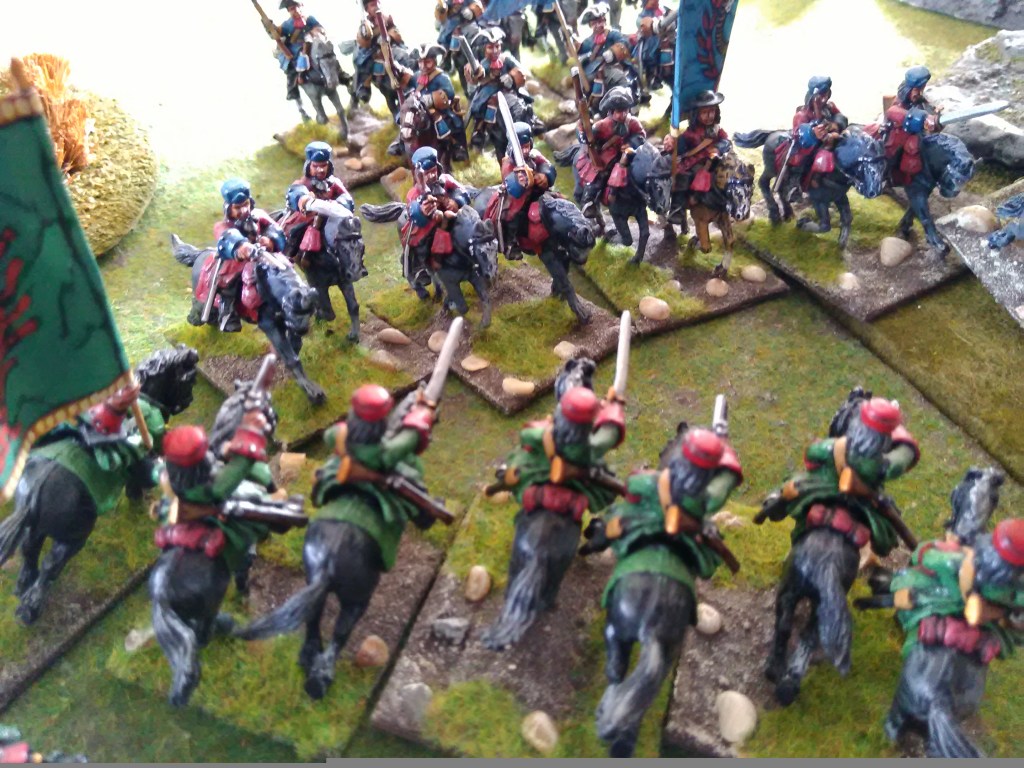
That’s a lot of cavalry!
While the infantry slogged it out on one side of the camp Illflands dragoons advanced on Sparre’s infantry, who due to the terrain could only deploy two battalions abreast, but non the less Vasterboten forced Narvski back and slowly ground forward – the dragoons were never going to charge the Swedish infantry so it became a shooting match which for a while the dragoons did ok in but eventually legged it for the woods.
Vasterboten v Narvski
Seeing how ‘well’ Illfland was doing Goltz realised that his other two brigades were going to be no use in the limited space so made the fateful decision to send them both into the woods to outflank Sparre and attack the rear of the Swedes; a bold plan which the Sparre player could realistically not respond to and was a calculated gamble by Goltz that he could be through and out before the Swedish cavalry under Creutz got through the marsh. An alternative plan could have been to dismount in the woods and fire on the flanks of Sparre’s command which might have forced him to stop and deal with the threat – we discussed this after the game and the Goltz player took the view that as the real Goltz didn’t do it neither would he!
If you go down to the woods today…..
Back at the real battle 🤣 Charles and his brigade were definitely in and amongst the entrenchments facing off to a hastily constructed second line by Schweden which Chambers was extending out to the right effectively forming behind Illfland’s withdrawing dragoons – the size of Chambers brigade (9 battalions) made cohesion quite difficult in the space available and we could see why in the real thing they just faded into the woods.
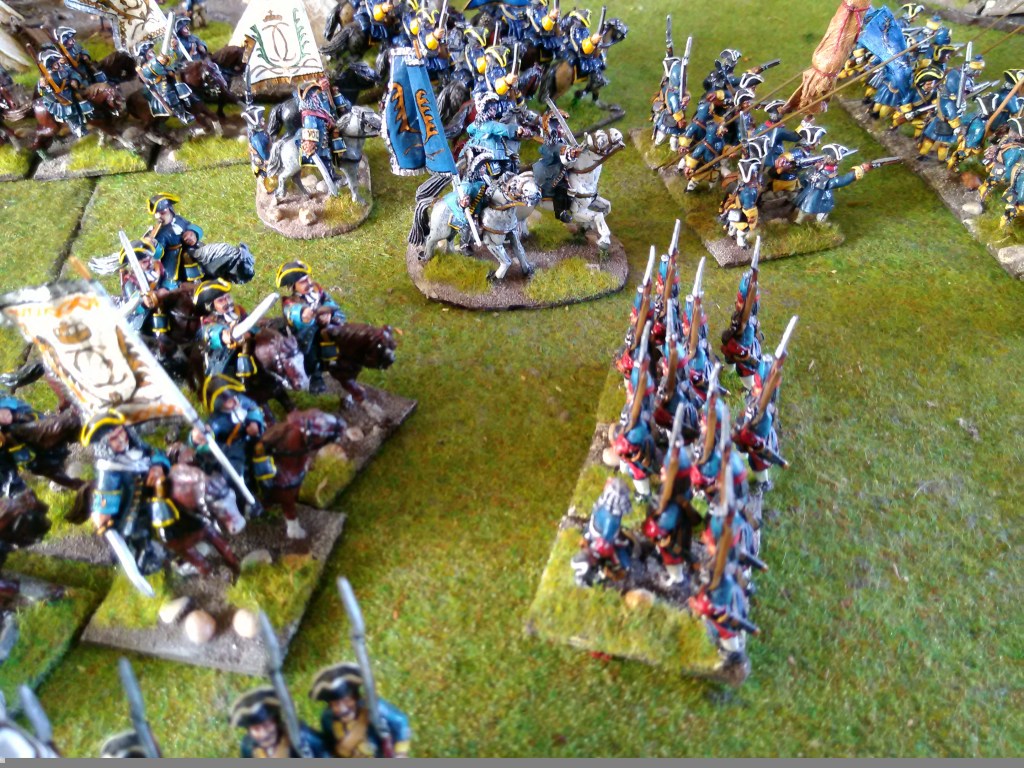
Guard cavalry
To force the issue in the main battle area Charles summoned the Guard Cavalry & Dragoons from Creutz along with Nyland to punch Schweden’s already weakened brigade; this was a risk, it weakened Creutz’s command and if the Guards didn’t do as well as envisaged they wouldn’t have their commander to rally on. Always willing to “roll the hard six” the Swedish cavalry blasted their way in and made some big holes although the Dragoon Guards did pay for a reckless pursuit and got themselves shot up 😒
Nyland
Unfortunately for the Russians the holes punched by the Swedes was in Chambers brigade and in the ensuing test for routing units and having Schweden’s failed brigade on their flank the big brigade failed and ran for the woods. Not surprisingly, Schweden’s already shaky brigade didn’t survive their test and they too duly headed for the woods.
“you’re going the wrong way!”
While all this was happening Heinsk’s dragoons emerged from the woods, somewhat disorganised, but all they needed was a bit of a breather and they could catch Sparre by surprise. Even better was the emergence of the lead battalions of Renne’s infantry from their wood. It could all be saved!
Oh dear
Unfortunately for Goltz and Heinsk, regiment Hielm of Creutz’s reduced command had other ideas and charged home smashing the lead dragoons off the table who routed through their brethren behind who were caught in the pursuit and equally smashed resulting in a brigade morale failure (surprise😁) and the end of the flank move.
Goodbyeee
That was really it, both infantry brigades were on the run, Illfland’s & Heinsk’s cavalry were shattered and running, while Hesse Darmstadt cowered in the woods; the fact of Renne’s arrival was insignificant, yes it was a substantial brigade (6 battalions) but what was it going to do? Clearly a substantial Swedish victory.
It’s all ours
When we analysed the game the Russians initially did better than their historical counterparts – well they stood and fought! but low morale and poor command levels meant they were never going to last that long once things went wrong. I think it’s interesting that wargamers will stand and slug it out even when the odds are stacked against them unlike the historical prototypes who couldn’t get off the field quick enough – mind you it wouldn’t have been much of a game if the Russians had just turned round and retreated! For the Swedes bold play paid off, so very historical but the casualty tables also equated to history with the Guards showing the kind of casualty figures that would make a general think about amalgamating regiments, everyone else was pretty much insignificant.
Guards
It was nice to give the GNW collection a run out, good job we didn’t sell the whole lot! The rules were our own ‘Ga Pa’ – oh how original, we hope you enjoyed the write up, feel free to fire in any questions.











 Westbury Wargamers